Le forex est le plus grand marché financier au monde. Plus de 7,5 billions de dollars sont échangés chaque jour, ce qui dépasse le total de toutes les bourses mondiales combinées. Malgré sa taille, les mécanismes sont simples : vous spéculez sur la possibilité qu'une devise augmente ou diminue par rapport à une autre.
Ce guide explique ce qu'est le trading de devises, comment il fonctionne, ce qui influence les prix des devises et comment prop trading sociétés comme Alpha Capital Laissez les traders accéder au marché du forex sans risquer de gros capitaux personnels.
Que signifie Forex ?
Le Forex est l'acronyme de foreign exchange, le marché mondial où les devises sont achetées et vendues. Le marché Forex n'a pas d'échange central. Il fonctionne en gré à gré (OTC), ce qui signifie que les transactions se produisent directement entre les participants via un réseau de banques, de courtiers et de plateformes de trading.
Le marché du forex est ouvert 24 heures sur 24, cinq jours sur sept, sur quatre sessions de trading majeures : Sydney, Tokyo, Londres et New York. Le chevauchement de Londres et de New York (environ de 13 h à 17 h GMT) est la période la plus liquide de la journée de trading, lorsque les spreads sont les plus serrés et que les mouvements de prix sont les plus actifs.
Comment fonctionne le trading Forex ?
Le trading de devises consiste à acheter une devise tout en vendant simultanément une autre. Les devises sont toujours cotées en paires, la première devise de la paire est la devise de base, et la deuxième est la devise quote.
Exemple : EUR/USD à 1,0850 signifie qu'1 euro achète 1,0850 dollars américains.
Si vous pensez que l'euro se renforcera par rapport au dollar, vous achetez EUR/USD. Si vous pensez qu'il s'affaiblira, vous vendez EUR/USD. Votre profit ou perte est la différence entre votre prix d'entrée et votre prix de sortie, multipliée par la taille de votre position.
Chaque opération de change implique deux actions simultanées : vous achetez toujours une devise et vendez une autre en même temps, c’est pourquoi les paires sont toujours cotées ensemble.
Quelles sont les paires de devises ?
Les paires de devises sont réparties en trois catégories :
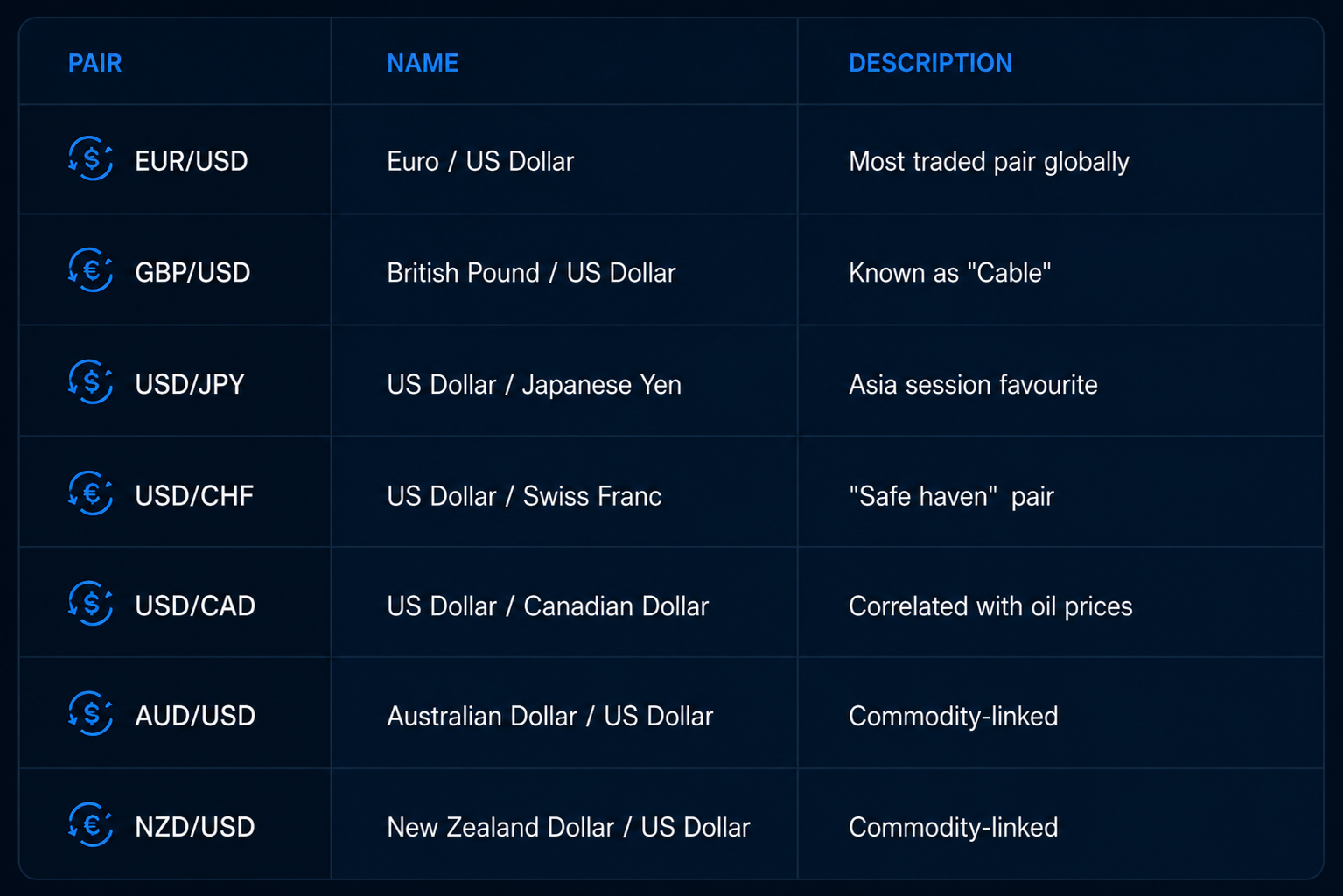
Paires majeures
Les paires les plus échangées au monde. Toutes incluent le dollar américain.
Paires mineures (Paires croisées)
Paires qui n'incluent pas le dollar américain. Exemples : EUR/GBP, GBP/JPY, EUR/JPY.
Paires exotiques
Une devise majeure couplée à une devise d'un marché émergent (par exemple, USD/TRY, EUR/ZAR). Spreads plus élevés, liquidité plus faible, volatilité plus élevée.
La plupart des traders forex de détail et prop traders Concentrez-vous sur les paires majeures en raison de spreads plus serrés et d'un comportement de prix plus prévisible.
Qu'est-ce qui détermine les fluctuations des prix du Forex ?
Les prix du forex évoluent en fonction de l'offre et de la demande des devises. Plusieurs facteurs influencent cette demande :
- Les taux d'intérêt - le principal moteur. Lorsqu'une banque centrale augmente ses taux d'intérêt, sa monnaie se renforce généralement car des taux plus élevés attirent les capitaux étrangers à la recherche de meilleurs rendements. Les décisions de la Réserve fédérale (USD), de la Banque d'Angleterre (GBP), de la Banque centrale européenne (EUR) et de la Banque du Japon (JPY) bougent les marchés instantanément.
- Données économiques - les publications clés incluent les créations d'emplois hors agriculture (NFP), le PIB, l'inflation (IPC), les ventes au détail et les chiffres de l'emploi. Des données solides renforcent généralement une devise ; des données faibles l'affaiblissent.
- Les événements géopolitiques - élections, guerres commerciales, sanctions et conflits - créent de l'incertitude. L'incertitude a tendance à pousser les capitaux vers les devises considérées comme des « refuges sûrs » comme le USD, le JPY et le CHF.
- Le sentiment du marché - les périodes de risque (les investisseurs se sentant confiants) ont tendance à stimuler les devises à haut rendement liées aux matières premières. Les périodes de risque aversion poussent les capitaux vers les valeurs refuge.
- Les niveaux techniques - support, résistance, blocs d'ordres, gaps de valeur juste et zones de liquidité - influencent le mouvement de prix à court terme, en particulier dans le trading sur des périodes de temps plus courtes.
Qu'est-ce qu'un pip en Forex ?
Un pip (pourcentage en point) est le plus petit mouvement de prix standard dans une paire de devises. Pour la plupart des paires, un pip équivaut à 0,0001 du prix affiché.
Exemple : Si EUR/USD passe de 1,0850 à 1,0860, cela représente un mouvement de 10 pips.
Pour les paires JPY, un pip = 0,01 (car le yen est coté à 2 décimales au lieu de 4).
La valeur d'un pip en argent réel dépend de la taille de votre position (taille du lot). Un lot standard est de 100 000 unités de la devise de base. Un pip sur un lot standard EUR/USD équivaut à environ 10 $.
Qu'est-ce que la marge dans le Forex ?
L'effet de levier vous permet de contrôler une position plus importante que ce que votre solde de compte permettrait normalement. Un ratio d'effet de levier de 1:100 signifie que 1 000 $ de marge contrôlent une position de 100 000 $.
L'effet de levier amplifie à la fois les profits et les pertes. Un mouvement de 1% à l'encontre d'une position entièrement engagée peut anéantir le compte. C'est pourquoi la gestion des risques - en particulier la détermination de la taille des positions et le placement des stop-loss - est la compétence la plus importante dans le trading de devises.
Les courtiers de détail réglementés au Royaume-Uni (sous les règles de la FCA) limitent l'effet de levier à 1:30 pour les paires de devises majeures.. Prop trading sociétés comme Alpha Capital proposer des comptes d'évaluation avec un effet de levier allant jusqu'à 1:100 sur leurs Alpha Pro plan, dans un environnement simulé où vous ne risquez pas de capital personnel au-delà des frais d'évaluation.
Qu'est-ce que Forex Prop Trading?
Forex prop trading (Le trading sur fonds propres (ou "prop trading") signifie trader au nom d'une société en utilisant un capital simulé alloué par la société, plutôt que de trader avec vos propres fonds personnels.
Prop trading sociétés comme Alpha Capital Group effectuez des évaluations (également appelées défis dans le jargon du secteur) où les traders prouvent leurs compétences face à des objectifs de profit et des limites de drawdown définis. Si vous réussissez l'évaluation, vous obtenez accès à un compte simulé financé - souvent de 5 000 $ à 200 000 $ - où vous percevez des frais de performance (split des profits) pouvant atteindre 80 % sur les profits simulés.
Pour les traders forex de détail, prop trading résout un problème fondamental : la plupart des traders ont une stratégie rentable mais un capital personnel limité pour la développer. prop firm Une évaluation coûtant de 50 à 577 dollars donne accès à des comptes qu'ils ne pourraient autrement pas se permettre.
Stratégies de Trading Forex
Différentes stratégies conviennent à différents horizons temporels, personnalités et tolérances au risque :
- Scalping - entrée et sortie des opérations en quelques secondes à quelques minutes. Haute fréquence, petit profit par opération, nécessite une exécution rapide et des spreads serrés. Note : certaines prop firms restreindre le scalping ou appliquer des règles de durée minimale de transaction.
- Le day trading - ouverture et fermeture de toutes les positions dans la même journée de trading. Le plus courant chez les particuliers et prop traders. Pas d'exposition nocturne.
- Trading de swing - maintenir des positions pendant des jours à des semaines pour saisir des mouvements de prix plus importants. Nécessite une tolérance aux positions ouvertes pendant la nuit et le week-end.. Alpha Capital d' Alpha Swing Ce compte est spécialement conçu pour les traders swing.
- Trading positionnel - maintien des positions sur plusieurs semaines à plusieurs mois en fonction d'une thèse macroéconomique. L'approche la plus longue durée, la plus proche de l'investissement traditionnel.
- Trading d'actualités - prise de positions autour de publications économiques à fort impact (NFP, CPI, décisions des banques centrales) pour saisir des mouvements à court terme importants. Permis sur Alpha Swing avec une règle de fenêtre de 4 minutes.
Comment débuter le trading Forex
Étape 1 : Apprenez les bases. Comprenez les paires, les pips, l'effet de levier et la gestion des risques avant de passer un ordre réel. Ressources gratuites : BabyPips School of Pipsology, TradingView contenu éducatif, YouTube.
Étape 2 : Entraînez-vous sur un compte démo. La plupart des courtiers et des plateformes de prop trading proposent des comptes démo gratuits pour s'entraîner sans risquer d'argent.. Alpha Capital Les comptes d'évaluation fonctionnent dans un environnement simulé, une manière structurée de prouver ses compétences avec des conséquences réelles (le frais d'évaluation) sans risque de perte de capital personnel.
Étape 3 : Définissez votre stratégie. Quel horizon temporel ? Quelles paires ? Quel risque par opération (les traders les plus expérimentés risquent de 0,5% à 2% du compte par opération) ? Quel est votre avantage ?
Étape 4 : Commencez petit et soyez constant. Un compte de détail ou un petit prop firm évaluation (Alpha One Commencer avec 5 000 $ à partir de 50 $ est bien meilleur que de sur-leverer un grand compte dès le début.
Étape 5 : Suivez vos transactions. Enregistrez chaque transaction : entrée, sortie, raison, résultat. La plupart des traders les plus rentables examinent leurs journaux chaque semaine. Sans journal, vous ne pouvez pas identifier ce qui fonctionne ou ce qui continue de mal tourner.
Erreurs courantes dans le trading Forex
- Sur-endettement - utilisation du levier maximal disponible sur chaque opération
- Pas de stop loss - maintien des positions déficitaires indéfiniment et espérant un retournement.
- Trading de vengeance - augmenter la taille de la position après une perte pour récupérer plus rapidement
- Le trading d'actualités sans plan - l'entrée dans des positions aveuglément sur des publications à fort impact
- Ignorer le ratio risque-récompense - prendre des trades où la perte potentielle est supérieure au gain potentiel
- Changer constamment de stratégies - chaque stratégie connaît des périodes de pertes ; abandonner après une mauvaise semaine empêche toute stratégie de se prouver.
Foire aux questions
Qu'est-ce que le trading forex en termes simples ?
Le trading de devises consiste à acheter une devise et à vendre une autre, en spéculant sur la direction dans laquelle le taux de change évoluera. Le profit est réalisé lorsque vous prédisez correctement le mouvement. Le marché des changes est le plus grand marché financier au monde, avec 7,5 billions de dollars échangés quotidiennement.
Les débutants peuvent-ils faire du trading de forex ?
Oui. Les débutants peuvent commencer sur des comptes de démonstration ou des comptes d'évaluation de faible solde pour pratiquer sans risquer un capital important. La plupart des traders expérimentés recommandent 6 à 12 mois de trading en démonstration ou avec un faible capital avant de passer à une échelle plus importante.
Combien d'argent avez-vous besoin pour commencer le trading de devises ?
Les comptes forex de détail peuvent être ouverts à partir de 50 $ à 100 $ avec certains courtiers.. Prop firm évaluations comme Alpha Capital d' Alpha One 5K à partir de 50 $, donnant accès à un compte simulé de 5 000 $ après réussite à l'évaluation.
Le trading forex est-il rentable ?
Cela peut être le cas, mais la plupart des traders de détail perdent de l'argent au départ. Des études montrent constamment que 70 à 80 % des traders de forex de détail perdent de l'argent sur une période de 12 mois, généralement en raison de l'effet de levier excessif, de l'absence de gestion des risques et de l'abandon trop rapide des stratégies. Les traders constamment rentables partagent des traits communs : des règles de risque strictes, un avantage défini et un journal de trading.
Quelle est la meilleure plateforme de trading forex ?
MetaTrader 5 (MT5) est la norme de l'industrie pour le forex, utilisée par la plupart des courtiers et prop firms incluant Alpha Capital. cTrader est la principale alternative, populaire pour sa visibilité sur la profondeur de marché et son exécution de style ECN.. TradingView est largement utilisé pour le graphique et l'analyse.
Qu'est-ce qu'un prop firm Dans le forex ?
A prop firm Alpha Capital Group est une société qui fournit aux traders un capital simulé pour le trading, en échange d'une part des profits réalisés (la commission de performance ou le partage des profits). Les traders paient des frais d'évaluation uniques, réussissent un défi prouvant leurs compétences, puis accèdent à un compte financé.. Alpha Capital est basée au Royaume-Uni forex prop firm avec des comptes de 5 000 à 200 000 $.
Le trading de devises est-il le même que le trading de devises ?
Oui. Forex, marché des changes, FX et trading de devises font tous référence au même marché, l'achat et la vente de paires de devises afin de profiter des fluctuations des taux de change.
Commencez à Trader Forex avec Alpha Capital
Alpha Capital Group propose forex prop trading évaluations sur quatre formats de compte - Alpha One (1 étape), Alpha Pro (2 étapes), Alpha Swing, et Alpha Direct - sur MetaTrader 5, cTrader, DXtrade, et TradeLocker. Alpha Three n'est actuellement pas proposé aux nouveaux achats.
Les évaluations commencent à partir de 50 $. Les traders qualifiés peuvent gagner jusqu'à 80 % du partage des profits simulés.
Voir Alpha Capital comptes d'évaluation | Explorez le centre de ressources
Alpha Capital Group est une société de trading propriétaire basée au Royaume-Uni. Tous les comptes fonctionnent dans un environnement de trading simulé avec des fonds simulés. Les frais de performance sont basés sur les résultats et les résultats de trading simulés éligibles et les résultats ne sont pas garantis. Veuillez toujours confirmer les règles en direct, les prix et l'éligibilité sur alphacapitalgroup.fr avant d'acheter une évaluation.