Strong AI Demand Is No Longer Enough, as the Market Stops Paying for Promises and Starts Demanding Cash
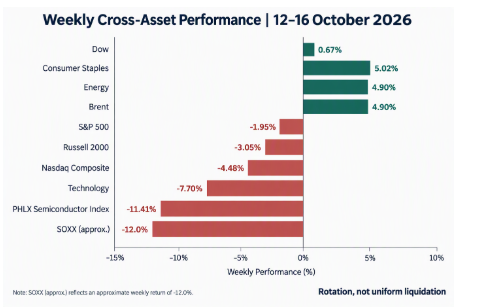
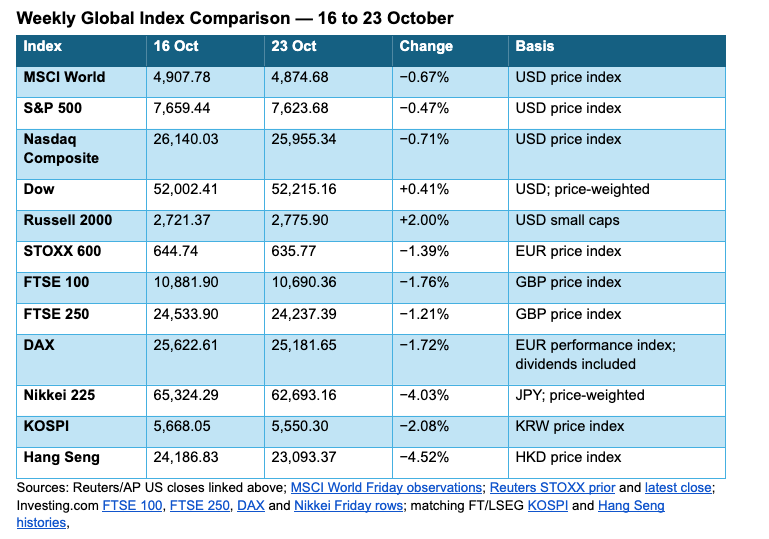
Last week started with a bounce and finished with another question mark over AI. On a Friday-to-Friday basis, the moves looked modest. The S&P 500 lost 0.47% to 7,623.68, the Nasdaq Composite slipped 0.71% to 25,955.34, the Dow gained 0.41% to 52,215.16, and MSCI World fell 0.67%. Those numbers hide a messy week underneath. The semiconductor index finally broke an eight-session losing streak on Monday, then fell 6.7% on Thursday, and by Friday, financials, discretionary names, and even staples were coming under pressure.
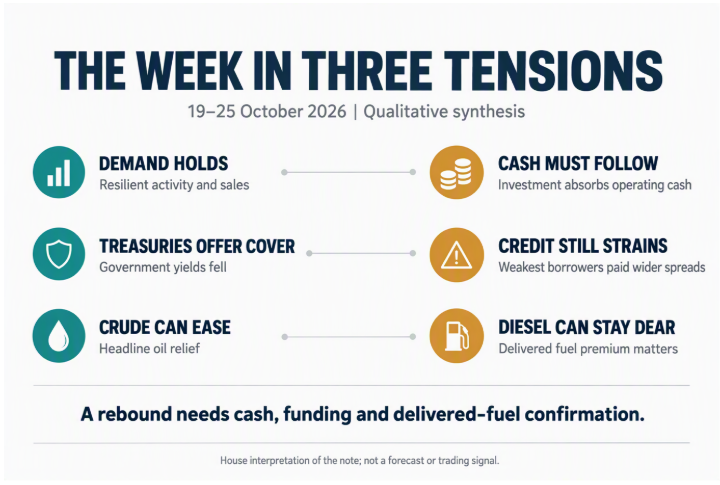
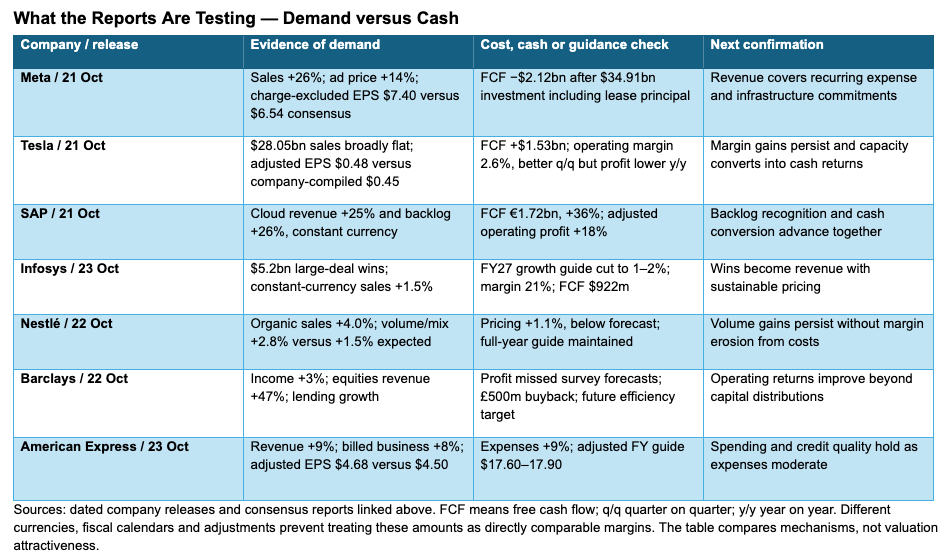
That is the change worth watching. Rotation can absorb a technology sell-off while other sectors hold up, but if those supports give way together, we are looking at something broader than money changing lanes. Good sales are no longer enough: Meta grew revenue 26%, yet $34.91 billion of capital spending left free cash flow negative by $2.12 billion, and the stock fell 7% on Thursday. Money had not stopped coming in, with global equity funds taking $28.16 billion through Wednesday, but the flow data stopped before the worst of the selling.
Market Overview: A Concentration Unwind Where the Cash Behind the Headline Now Matters
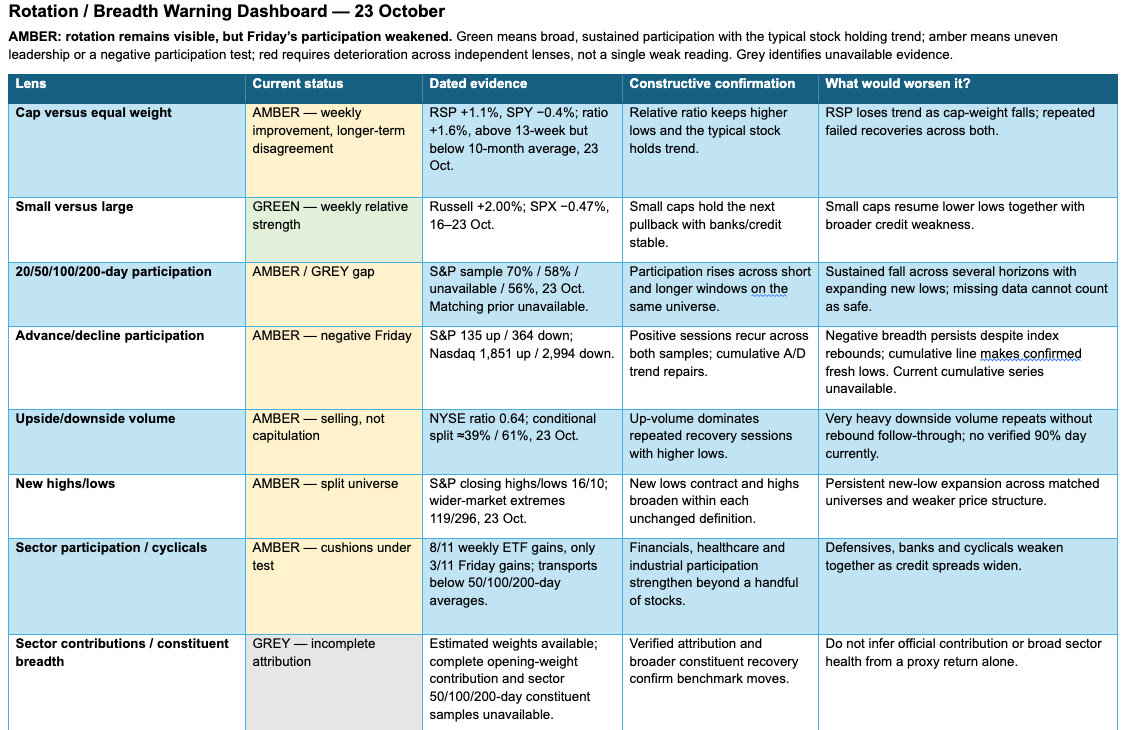
The US headline understated the distance between winners and losers. The Russell 2000 rose 2.00% to 2,775.90, beating the S&P 500 by about 2.47 percentage points, while the equal-weighted market gained as the cap-weighted index slipped. RSP rose 1.1%, and SPY fell 0.4%, lifting their ratio about 1.6% and pushing it above its thirteen-week average, though still below the ten-month average.
So the near-term improvement has not yet become a confirmed leadership change. Small caps and equal weight supplied a useful counterweight to technology weakness, but Friday's selling across banks, consumer stocks and defensives showed that counterweight cannot be taken for granted.
The concentration arithmetic keeps this fragile. Technology sits at about 38.1% of the S&P mix and energy at just 3.9%, so a one-percent move in technology carries almost ten times the index weight of the same move in energy. Technology, communication services and discretionary together are around 56.2%.
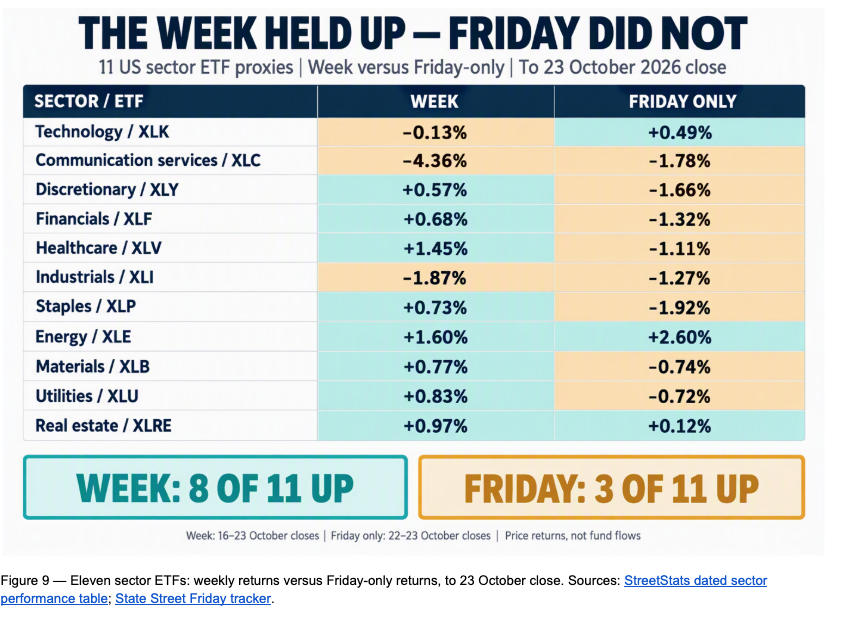
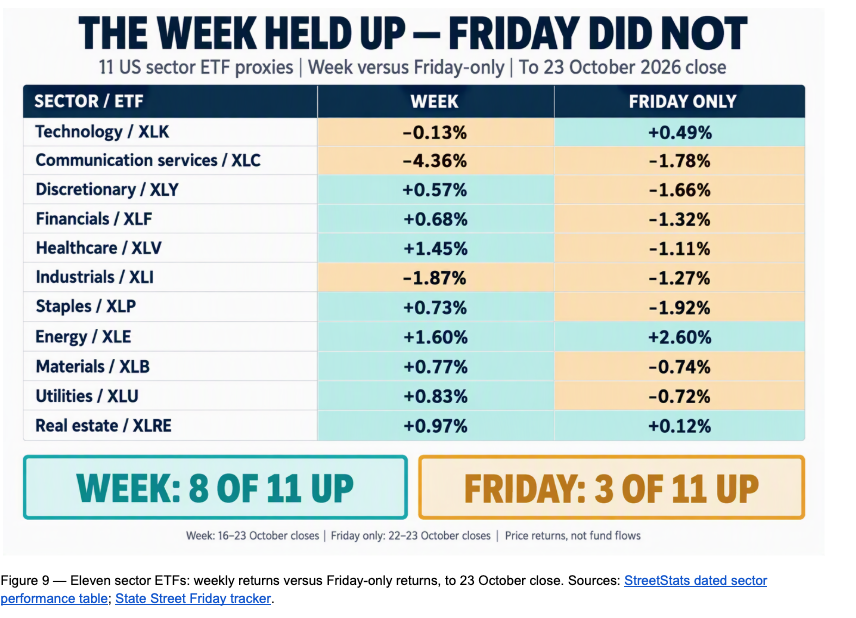
Eight of eleven sectors gained over the five sessions, led by energy and healthcare. Friday reversed much of that comfort, with only energy, technology and real estate rising into the close.
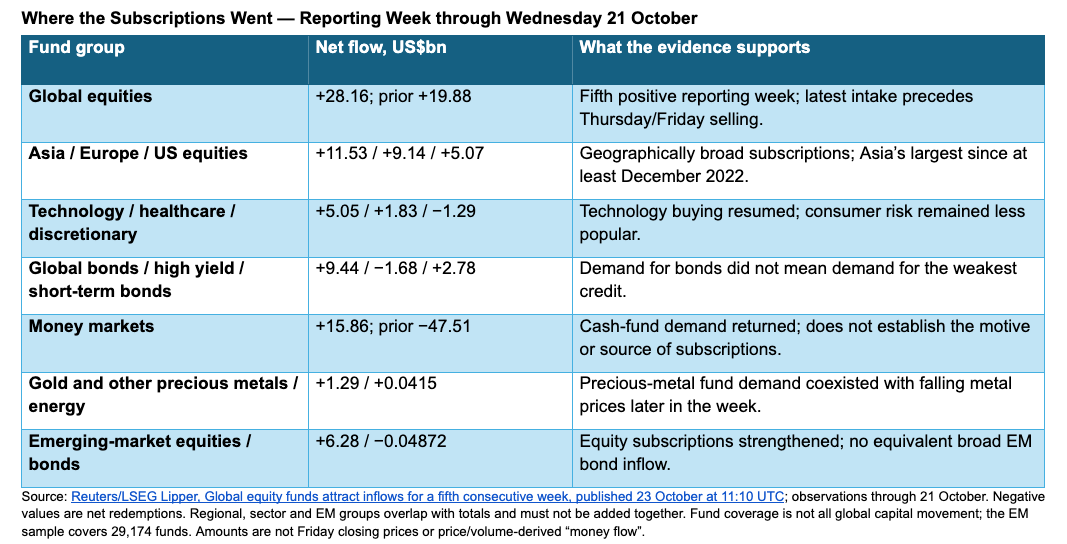
The flow picture confirms positioning rather than panic, at least up to Wednesday. Asian funds attracted $11.53 billion, European funds $9.14 billion, and US funds $5.07 billion. Technology funds took in $5.05 billion after losing $4.77 billion the previous week, while discretionary funds lost $1.29 billion. Investors were still backing a technology recovery while being more selective about household demand, but these flows stopped before Thursday and Friday's weakness.
Macro & Policy Watch: One Fuel Shock, Many Different Central-Bank Answers
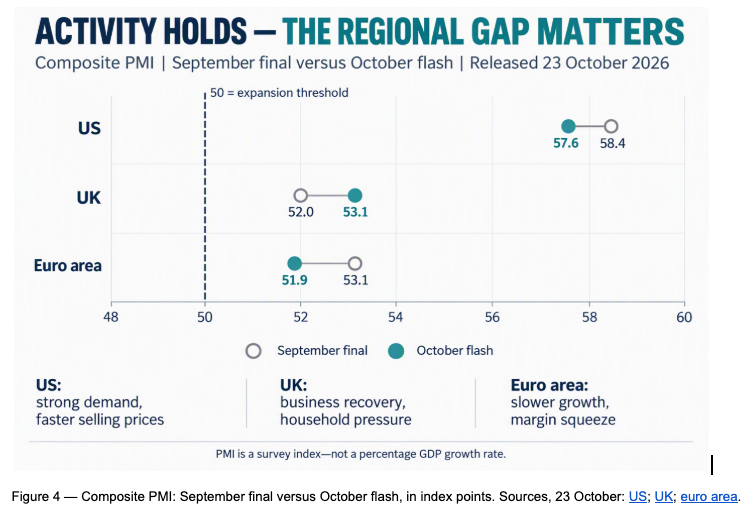
The backdrop is a growth story shadowed by an inflation problem that refuses to resolve cleanly. October's flash composite PMIs came in at 57.6 for the US, 53.1 for the UK and 51.9 for the euro area. The US had the stronger activity reading, but its selling-price gauge rose to 59.8, the highest since August 2022. Firms were not merely paying more; they were finding room to charge more.
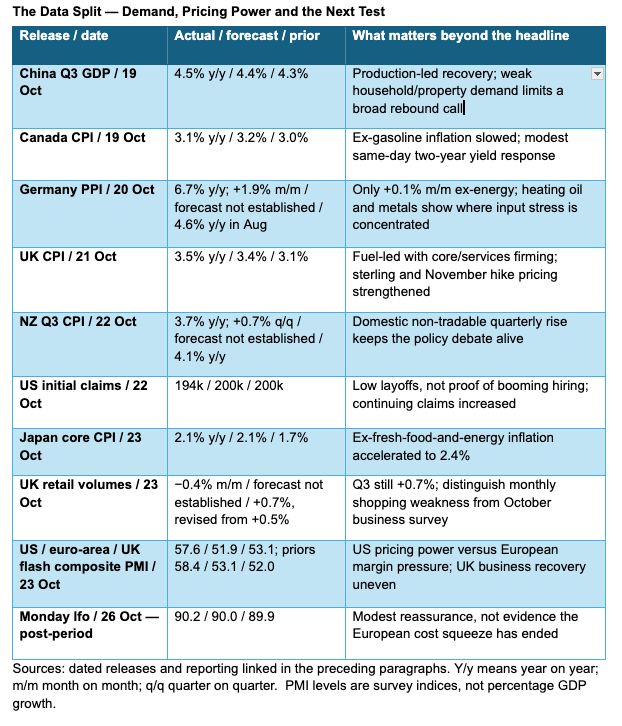
Europe grew more slowly, with input costs accelerating while selling prices rose more slowly. That is the combination which threatens profits when customers will not absorb the full increase. A softer growth number is not automatically good news for equities if the cost pressure refuses to ease.
That leaves central banks with different problems, and last week they gave very different answers to the same fuel shock. The Philippines raised by 50 basis points to 5.50%, double the expected move, and lifted its 2027 inflation forecast to 6.0%. Indonesia held at 5.75% but raised its deposit-facility rate and strengthened currency protection. Türkiye went the other way, cutting the repo rate 100bp to 36%.
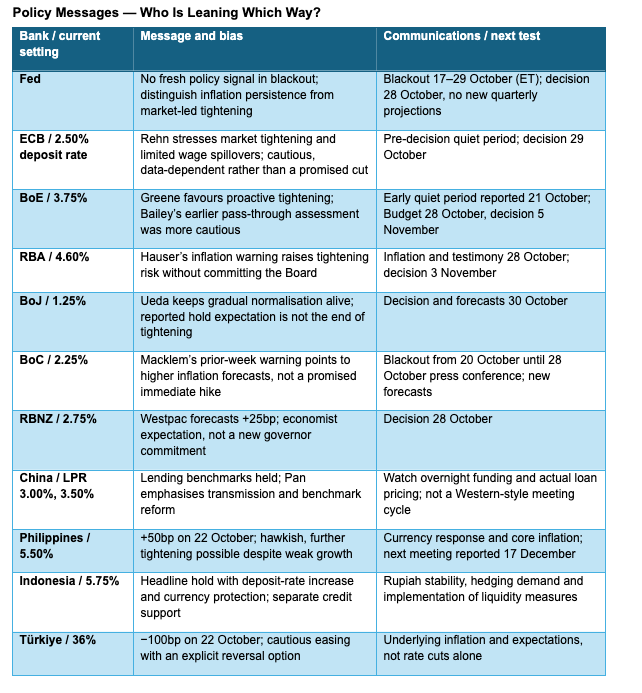
The message threads were just as varied. Greene at the BoE argued for leaning against inflation before wages catch up, Rehn at the ECB stressed that higher market rates are already biting demand, and Ueda at the BoJ warned that doing too little can itself push long yields higher. The Fed stayed silent in its 17 to 29 October blackout ahead of Wednesday's decision.
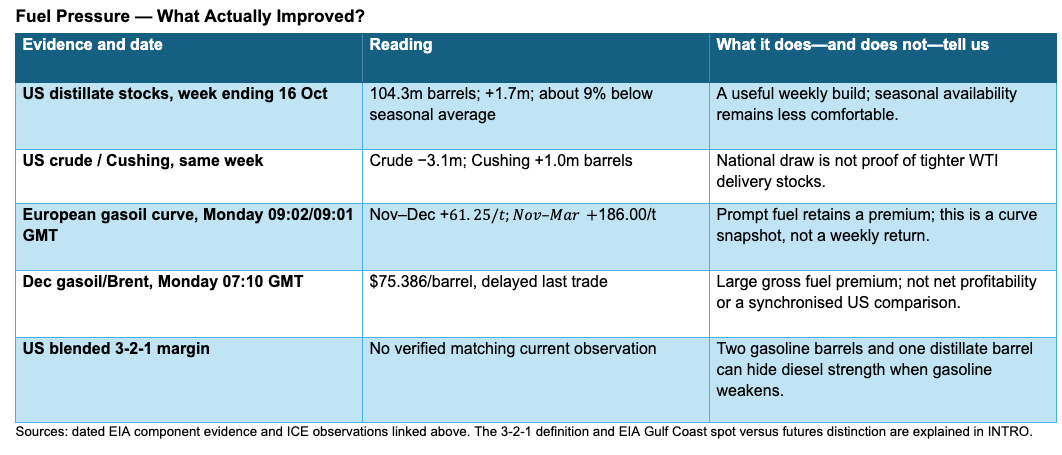
The oil rise matters, but diesel tells us more about who is feeling the squeeze. Brent finished at $116.72, up 6.24% on the week, yet the December gasoil/Brent crack was still around $75.39 a barrel. That is a sizeable diesel premium over crude, not a pump price or a refiner's net profit. Europe is the market to watch, where cargo availability, shipping costs and local stocks can keep diesel expensive even as Brent eases.
The geopolitical thread feeds straight into this. The market keeps trading the chance of peace, with talks in Tehran and a Kremlin signal on resuming US-mediated discussions in November, but a diplomatic headline is not the same as an open shipping route. Until cargoes, freight costs and product spreads improve, fuel-heavy businesses stay exposed even when equities try to bounce.
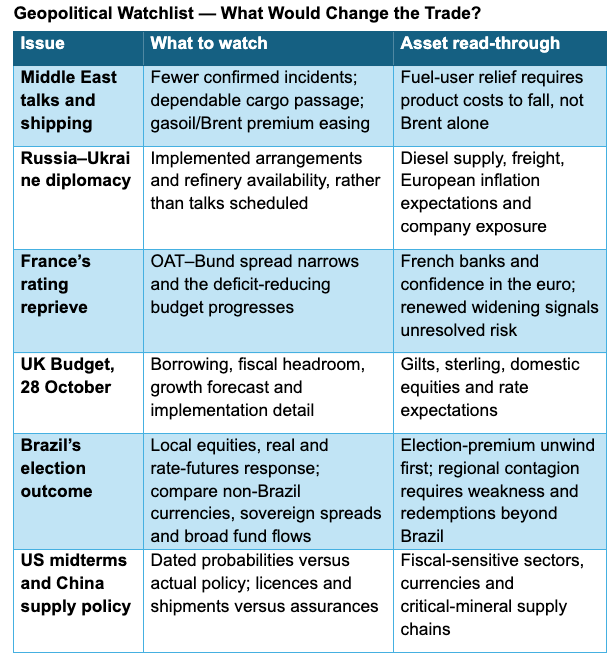
Europe's fiscal fault line stayed live. France avoided a downgrade, as Moody's retained Aa3 with a negative outlook, but that clears a hurdle without fixing the budget. The French ten-year reached 5.14% during the week, and the OAT-Bund premium widened to a fifteen-year high, touching 174.6bp on Thursday. Britain faces its own test with Wednesday's Budget, where the borrowing and growth forecasts matter as much as the tax headlines.
Technical & Sentiment Breakdown: Supportive, but Increasingly Fragile
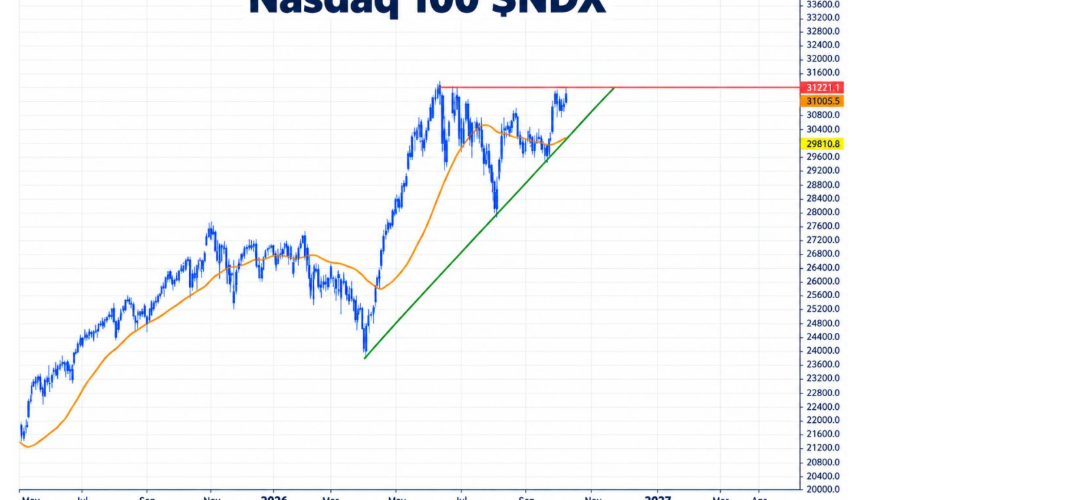
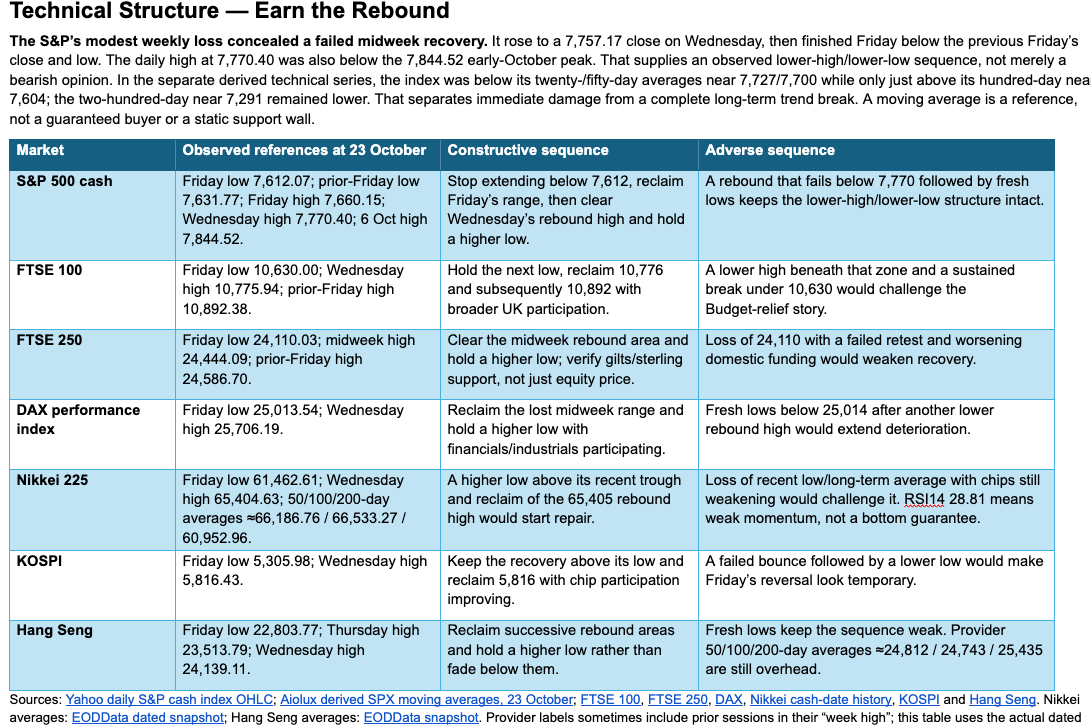
The structure is intact, but the internals are doing the arguing. The S&P's modest weekly loss concealed a failed midweek recovery. It rose to a 7,757.17 close on Wednesday, then finished Friday below the previous Friday's close and low, with the daily high at 7,770.40 sitting beneath the 7,844.52 early-October peak.
That is an observed lower-high, lower-low sequence, not merely a bearish opinion. The index sat below its twenty- and fifty-day averages near 7,727/7,700, just above its hundred-day near 7,604, with the two-hundred-day near 7,291 still well below. That separates immediate damage from a complete long-term trend break.
Breadth and the last session disagreed. Friday counted 135 advancers against 364 decliners, with only 27% of the sample rising. Yet 70% remained above their twenty-day average, 58% above the fifty-day and 56% above the two-hundred-day. A little over half above the two-hundred-day line is mixed health, not broad record-market participation. The high/low picture was split too, with the wider US universe showing 119 highs against 296 lows.
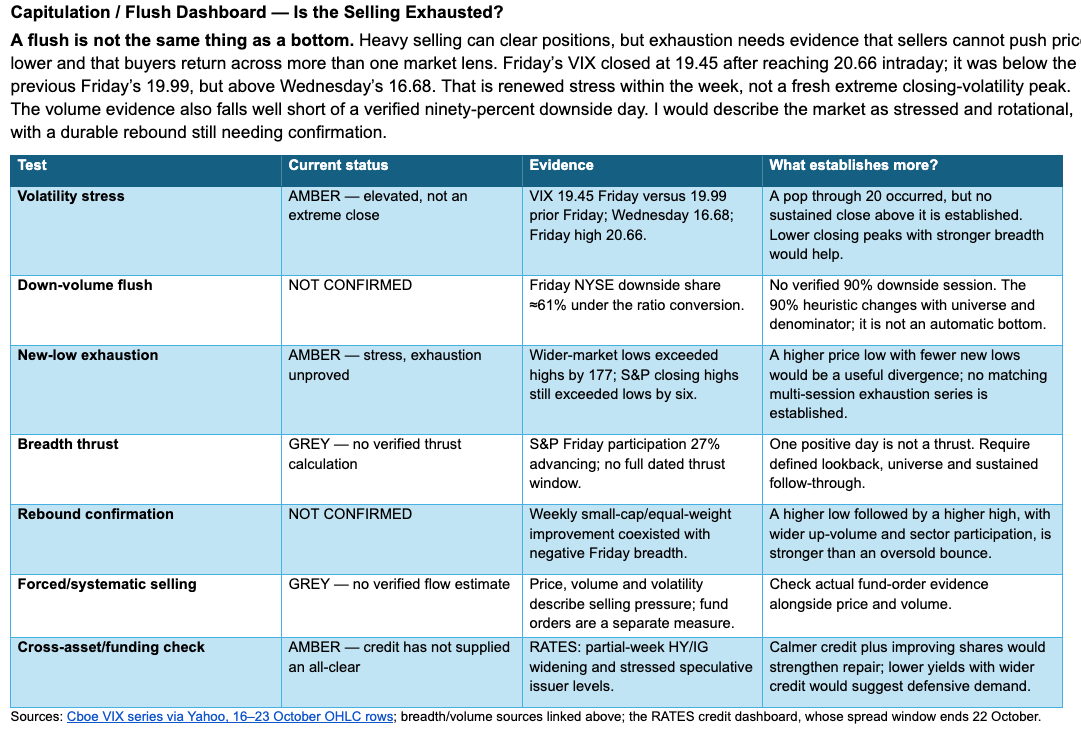
On the capitulation question, the evidence stops short of exhaustion. Friday's VIX closed at 19.45 after reaching 20.66 intraday, below the previous Friday's 19.99 but above Wednesday's 16.68. The NYSE advancing/declining volume ratio was 0.64, implying roughly 61% downside volume, nowhere near a verified ninety-percent capitulation day. A flush is not the same thing as a bottom.
Sentiment turned more cautious before the worst of the selling, which is the uncomfortable part. AAII bulls fell to 36.9%, and bears rose to 45.8%, widening the gap to about minus 8.9 points. That leaves room for a contrarian recovery without telling us the low is in.
The consensus-risk flag is the gap between retail fear and professional exposure. Active-manager exposure read 87.7, up sharply. Goldman's prime sample showed fundamental long/short net leverage near a three-year low while gross leverage was rising and short leverage sat at the 99th percentile of its five-year history. Lower net exposure is not the same as lower squeeze risk: with gross still substantial, a rebound can hurt the shorts even as another technology leg hurts the longs.
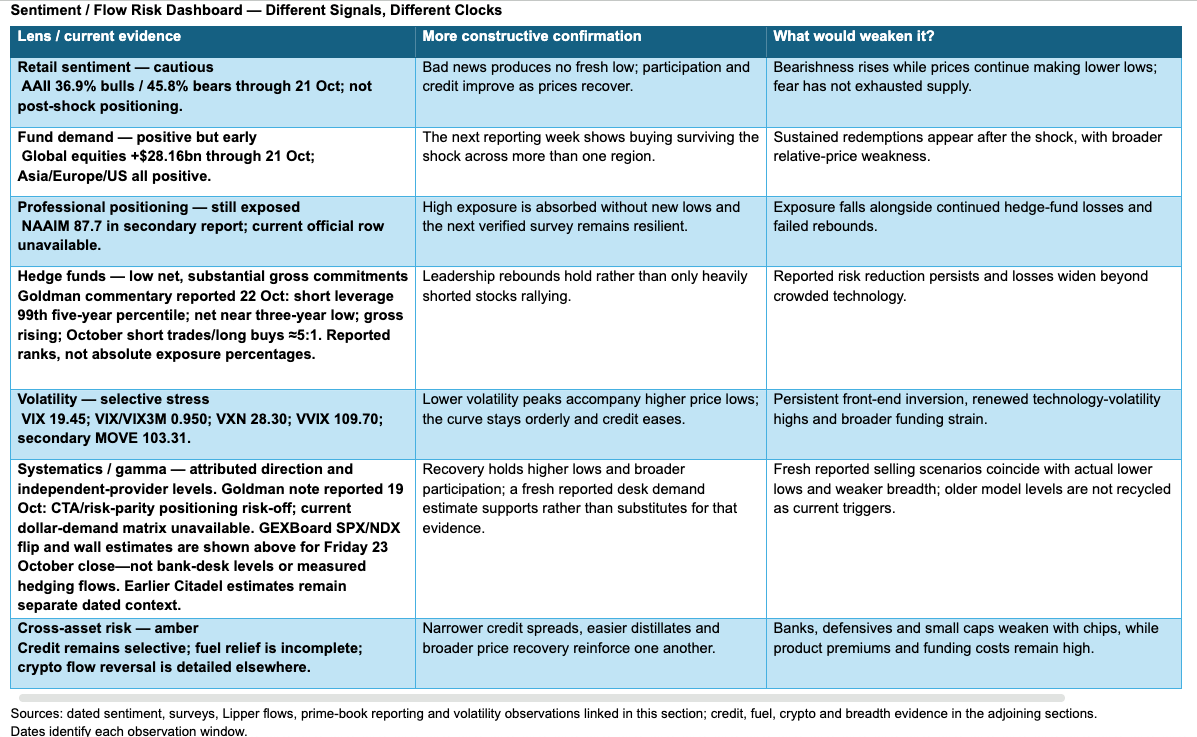
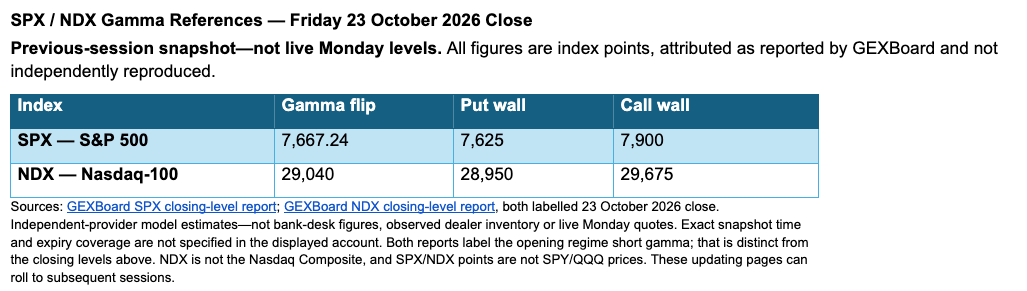
Volatility added its own caveats. The term structure stayed upward-sloping, with VIX at 19.45 against a three-month VIX of 20.48, so no acute inversion. The Nasdaq told a tenser story, with VXN at 28.30, an 8.85-point premium over VIX. The dealer-gamma map left the index near its modelled flip, with SPX gamma flip at 7,667.24, the put wall at 7,625, and the call wall up at 7,900. A put wall near the market is not a floor, and a distant call wall is not a target.
Last Week's Recap: Resilient Demand, Defensive Cushions and a Fuel Bill That Won't Quit
A week where the index damage looked mild, but the internals told a harder story: good earnings that failed to lift shares, a bond rally that bought protection while the weakest credit widened, and an energy complex pulling in several directions at once.
Key Highlights
Macro
The economy did not roll over; the inflation problem just became more uneven. US new orders reached their strongest pace since March 2022, and claims fell to 194,000, but the selling-price gauge hit its highest since August 2022. Britain's CPI rose to 3.5%, fuel-led but with core and services firming, while German PPI showed heating oil up 91.8% year on year. The question throughout is who can pass the fuel bill on and who has to absorb it.
China
China's growth beat was real, and so was the imbalance. Q3 GDP grew 4.5% year on year against 4.4% expected, helped by export-oriented production and technology activity, while goods consumption and property stayed much weaker. Chinese blue chips entered Monday after eleven successive weekly losses despite the stronger export picture.
Earnings
The reports did not say demand had disappeared; they said investors were getting harder to satisfy. With about a quarter of the S&P 500 in, 83% beat EPS estimates, but the aggregate surprise was only 2.1%, well below the 7.5% and 8.0% longer-run averages. Meta's free cash flow turned negative after infrastructure spending, and Tesla's operating profit stayed 56% below a year earlier. SAP showed the better template, with cloud revenue up 25%, while Infosys cut guidance as clients redirected spend toward AI.
Commodities
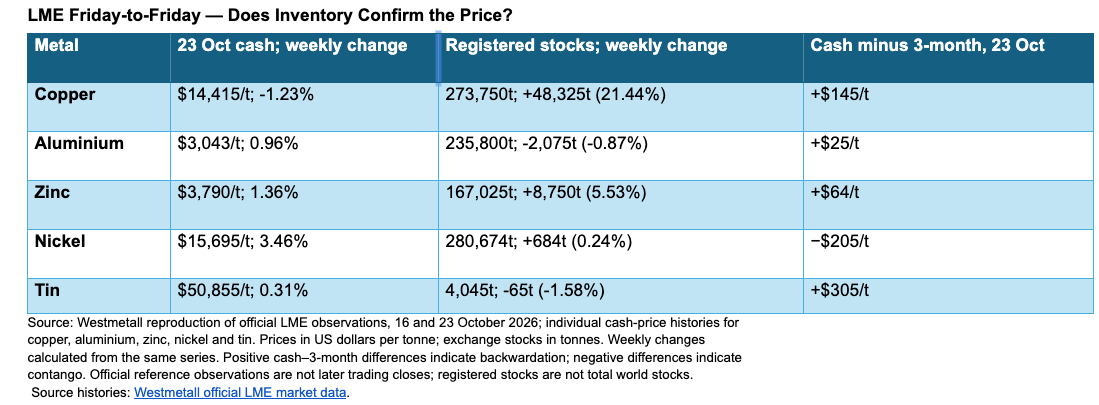
This was not a broad commodity rally. Gold did not provide the protection government bonds did, with December futures settling at $4,007.90, a 4.14% weekly fall, as a non-yielding asset lost appeal with rates expected to stay restrictive. Industrial metals diverged: LME cash copper slipped 1.23% to $14,415 even as registered stocks jumped 21.44%, yet cash still carried a $145 premium over three-month metal.
Crypto
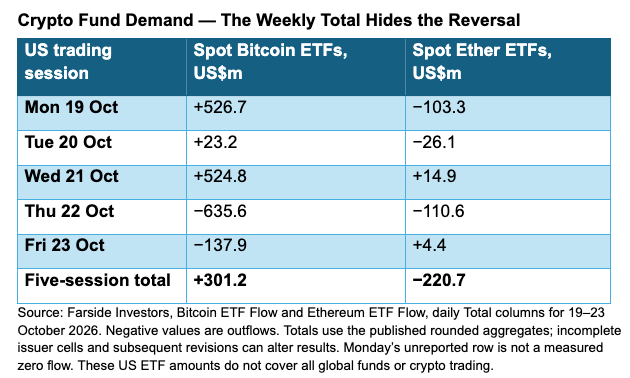
Early-week buying did not survive the risk-off test. Bitcoin finished little changed at $81,074.19, down 0.52%, after reaching $84,840 intraday on Wednesday, but the weekend added another leg down to make the Sunday-to-Sunday change minus 2.43%. Thursday's $635.6 million and Friday's $137.9 million outflows removed about 72% of the week's earlier intake, and Ether fund demand was weaker still, losing $220.7 million across the five sessions.
Oil
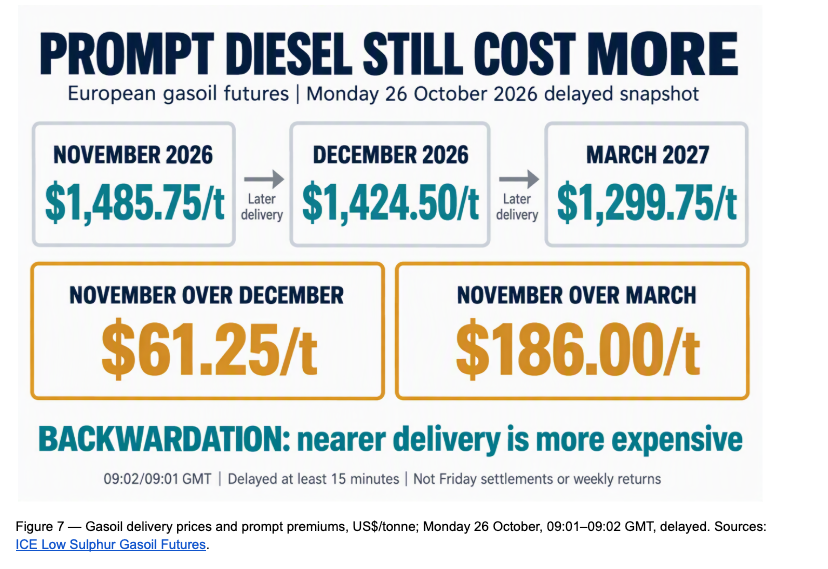
Brent led the energy rise, but the refined barrel is where the squeeze lives. Brent's $116.72 close and 6.24% weekly gain capture the pressure on crude, yet the diesel premium is the more direct link to freight and factory margins. Monday's gasoil curve was in backwardation, with November at $1,485.75 a tonne against December at $1,424.50 and March at $1,299.75, while US distillate stocks stayed roughly 9% below their five-year seasonal average.
The Week Ahead: Key Data and Market-Moving Signals
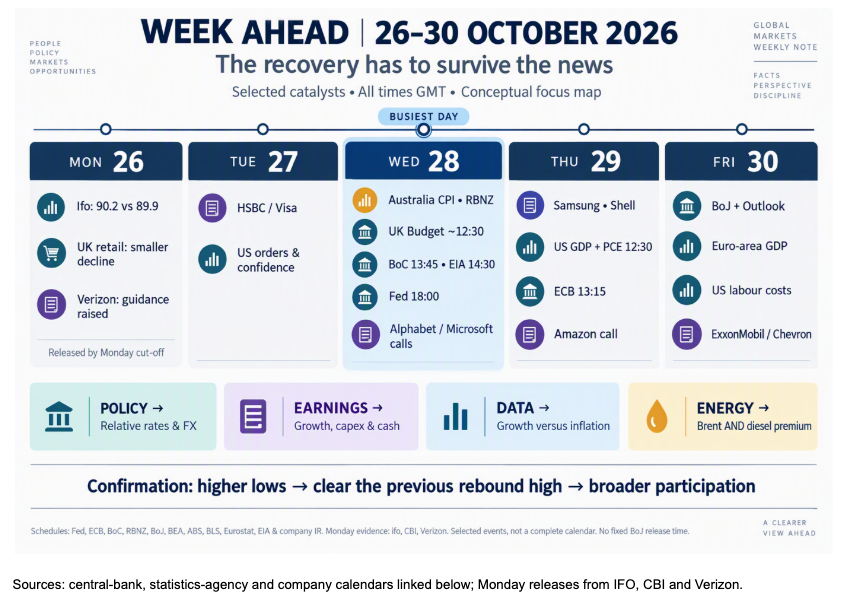
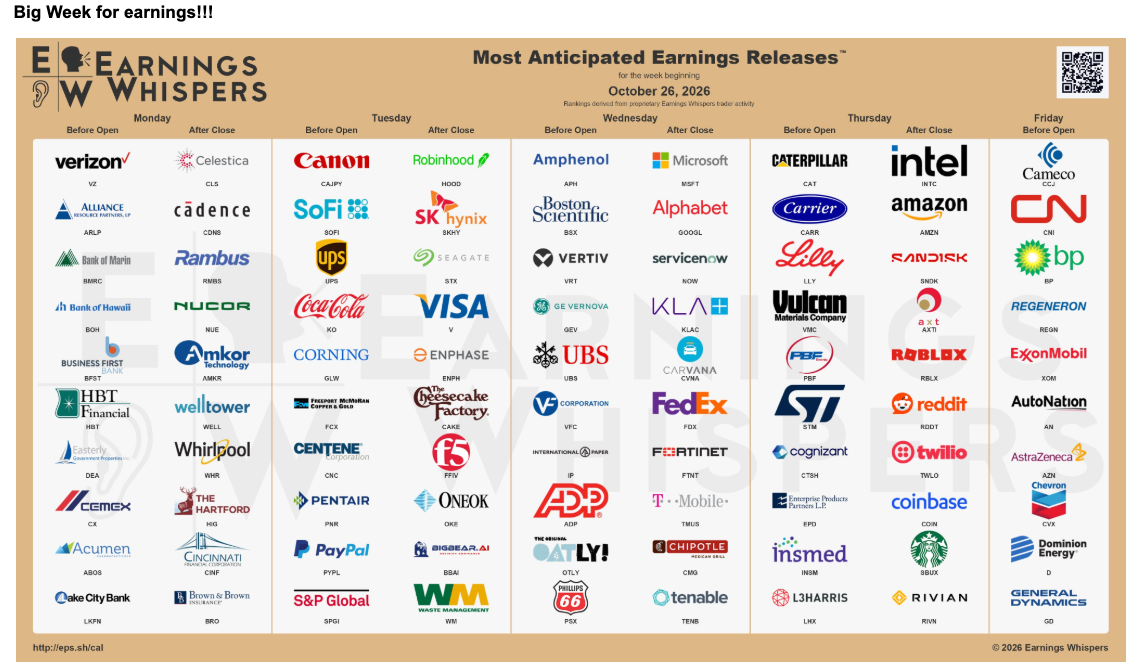
A week when the first move may not be the useful one. Five central banks decide on policy, the UK Budget lands in the middle of Wednesday's crowd, and the biggest cloud companies report just as markets digest the Fed. Wednesday into Thursday is the main pressure point. Calendar times are GMT.
Monday, October 26
- Germany: Ifo Business Climate (Oct)
- UK: CBI Retail Sales (Oct)
- US: Verizon Q3 Results
- US: Chicago National Activity Index; Dallas Fed Manufacturing
Tuesday, October 27
- UK: HSBC Q3 Results
- US: Durable Goods Orders; Consumer Confidence
- US: Visa Q4/FY Results
Wednesday, October 28
- Australia: CPI (Sep & Q3)
- New Zealand: RBNZ Rate Decision
- Europe: Deutsche Bank Q3 Results
- UK: Autumn Budget & Fiscal Forecasts
- Canada: BoC Rate Decision & Monetary Policy Report
- US: Crude Oil & Distillate Inventories
- US: Fed Rate Decision
- US: Alphabet & Microsoft Earnings
Thursday, October 29
- Asia: Samsung Q3 Earnings
- Europe: Shell Q3 Results
- US: GDP (Q3); PCE & Personal Income/Outlays (Sep)
- US: Initial Jobless Claims
- Eurozone: ECB Rate Decision
- US: Amazon Q3 Earnings
Friday, October 30
- Japan: BoJ Rate Decision & Outlook Report
- Eurozone: GDP (Q3); Unemployment Rate (Sep)
- US: ExxonMobil Q3 Results
- US: Employment Cost Index (Q3)
- Canada: GDP (Aug)
- Europe/US: Sanofi & Chevron Earnings
Alpha Takeaway: The Market Still Has Reasons to Recover, but Confidence Has to Be Earned
This looks like selective, unsettled markets, not a confirmed broad breakdown and not a completed reset. The next rebound has to do more than lift the headline index.
Equities
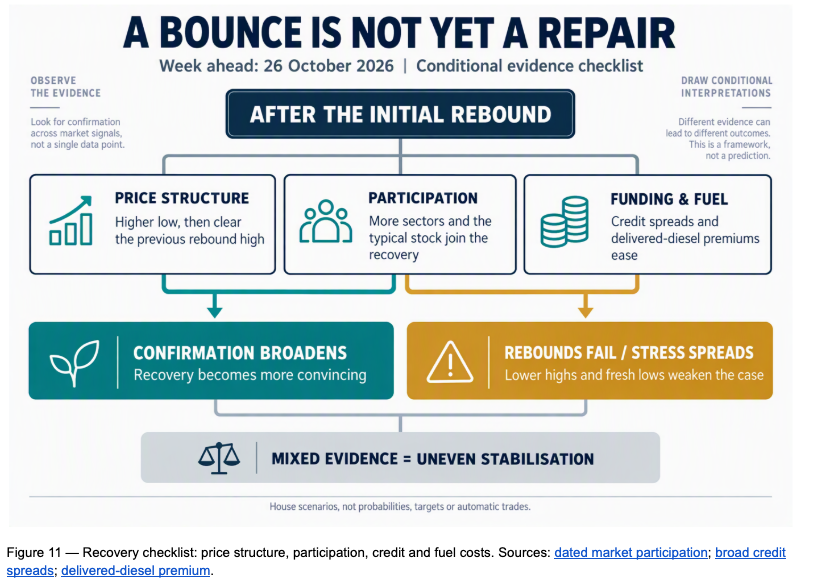
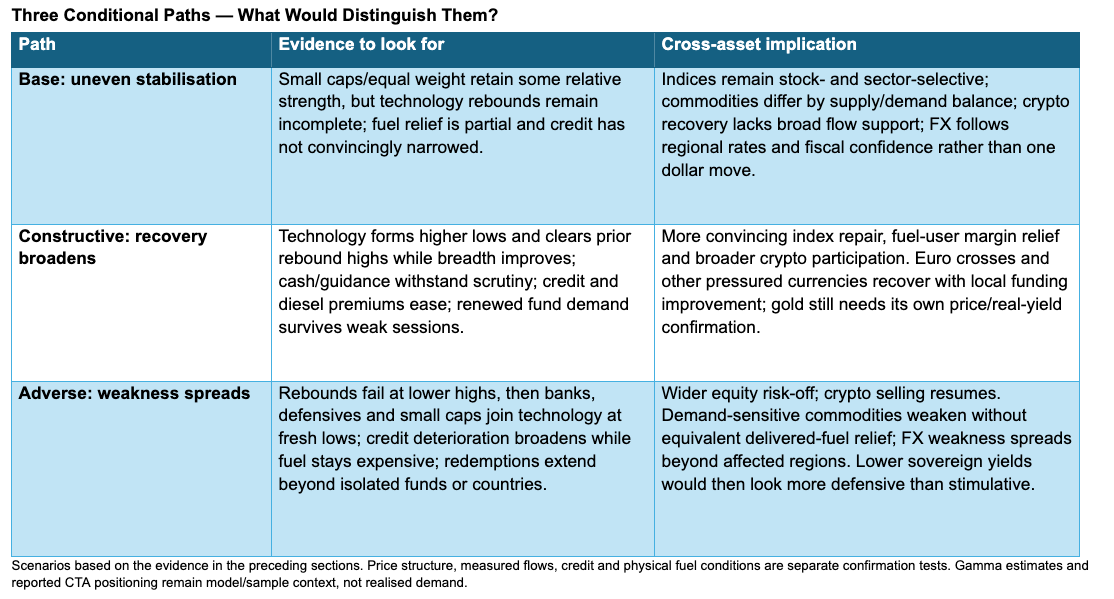
Friday's 7,612.07 low and Wednesday's 7,770.40 rebound high frame the test. Recovering lost ground, holding a higher low and then clearing that rebound high would be a greater change of character. If banks, defensives and small caps join chips lower while diesel and funding stay expensive, the story has moved beyond money changing sectors.
Gold & Silver
Gold's weekly weakness warns against assuming every refuge behaves the same way. Reclaiming $4,000 and holding a higher low would be an initial improvement, while recovering the $4,026.70 and $4,083.85 reference levels would show more lost ground regained. Silver's shared weakness with platinum and palladium is not proof of an identical physical deficit.
Crypto
Treat the bounce as unconfirmed, not repaired. A move above Friday's $81,956.34 high followed by a higher low would suggest stabilisation, while clearing Wednesday's $84,840 high with renewed fund demand would be stronger evidence. For Ether, continued underperformance against Bitcoin would not be broad repair.
Macro
The cleaner outcome is cheaper delivered energy without another deterioration in demand: narrower diesel cracks and tighter corporate spreads joining lower Treasury yields. The less comfortable outcome is crude relief with the squeeze simply moving elsewhere. An unchanged rate this week can still arrive with a hawkish message.
A tactical bounce can arrive before the medium-term trend repairs, and neither longer-term AI investment nor structural energy constraints validates today's price. The bottom line is simple: the market still has reasons to recover, but confidence has to be earned through cash, cheaper delivered fuel and a rebound that holds, not another promising headline.
Charts and figures are from the 26 October 2026 weekly pack. This is a recap of that tape. It is not a personal recommendation, and nothing in it is guaranteed.