The bond selloff ran into a jobs miss, hike odds collapsed, and gold bounced off a hard low. Equities did not really join in. Mega-cap tech is still holding the indexes up while equal-weight, credit, and diesel tell a tighter story. This is a market recap, not a recommendation to buy or sell.
The hike was priced, then the data took it away
Last week opened as a bond trade. The US 10-year yield was pushed to 5.342%, a 24-year high, and fixed income desks had roughly a 70% chance of a hike at the 28 October meeting priced in. That yield is a tax on almost everything that does not pay you cash while you wait. Gold felt it first.
The turn came in two prints. Core PCE was +0.2% on the month and 3.0% on the year, so the inflation scare did not get a fresh headline. Friday's September payrolls were the cleaner break: +29,000 jobs against +90,000 expected, plus a negative 60,000 revision to July and August. Unemployment rose to 4.2% with participation steady at 62.7%, which reads as hiring slowing down rather than a flood of new workers. Average hourly earnings were still +0.3% on the month. October hike odds fell from about 66% to about 25%. The 10-year rejected 5.342% and closed Friday back through 5.16% to 5.17%. The 2-year sat around 4.81% to 4.85%.
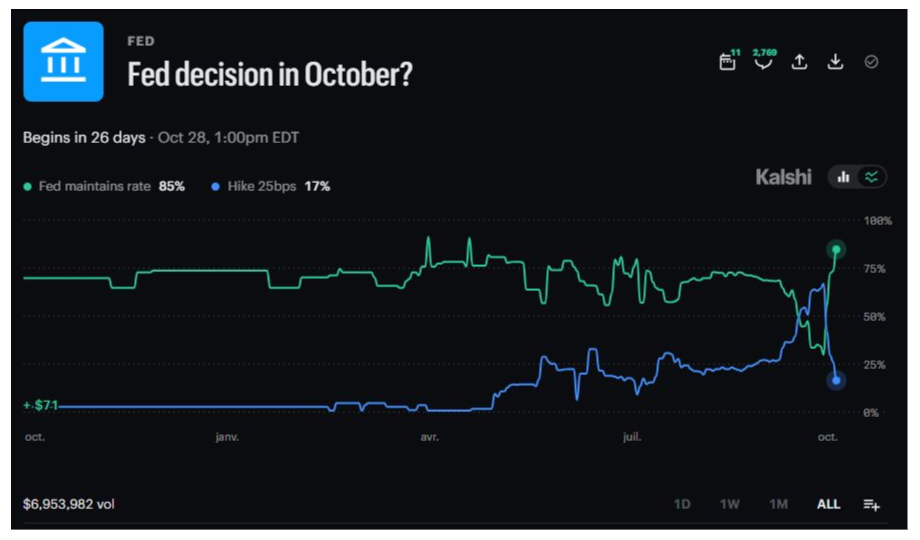
October rate-hike odds dropped after the payrolls miss.
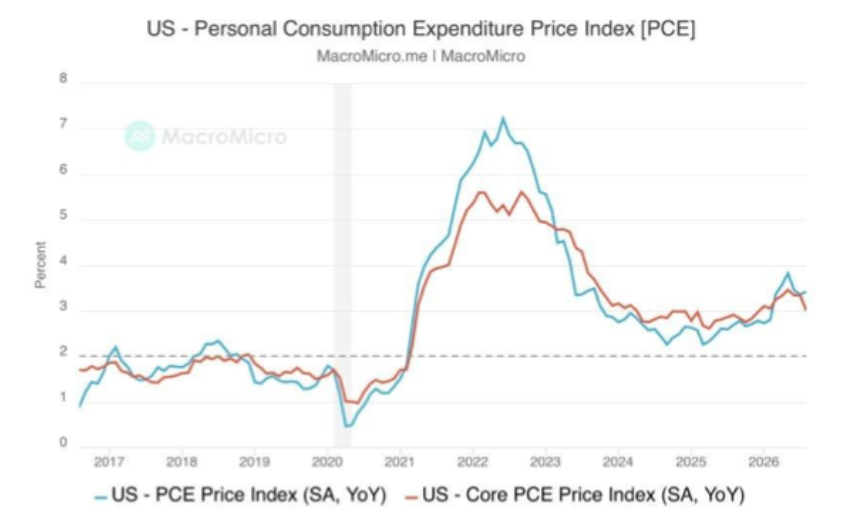
Core PCE cooled to +0.2% on the month.
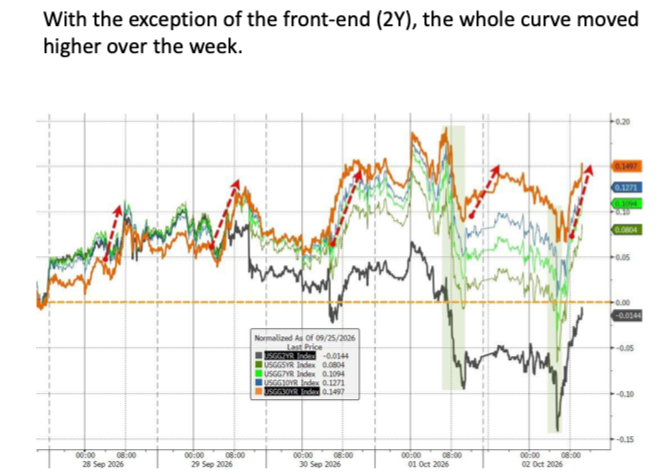
The curve after the 5.342% high.
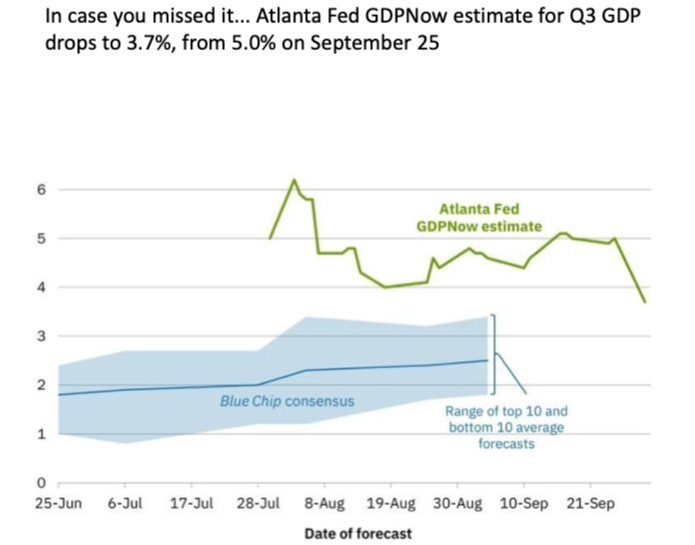
Atlanta Fed GDPNow has been sliding into this week.
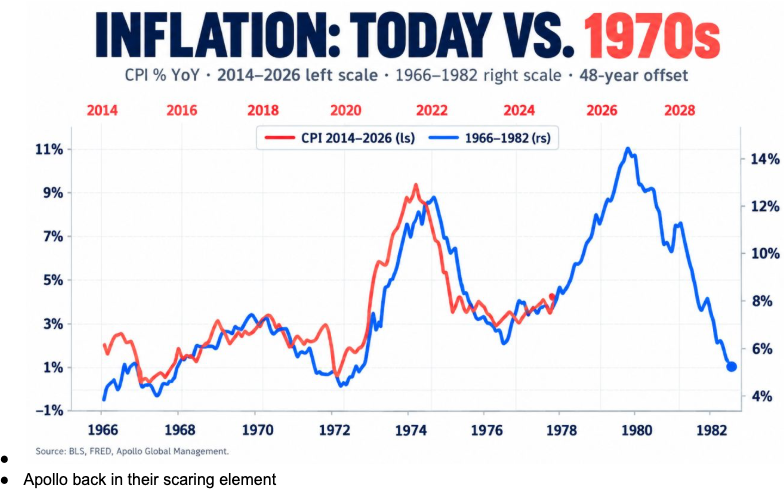
The 1970s comparison is back in the deck. It is a mood, not a forecast.
Market overview: the indexes waited, the internals did not
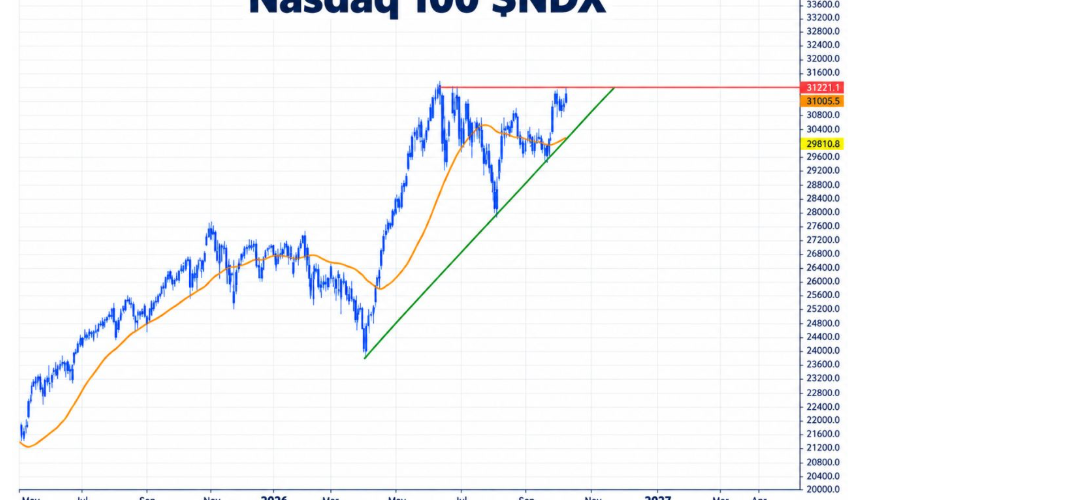
Helpful macro did not become a broad equity rally. The S&P 500 closed Friday at 7,722.72. The Nasdaq-100 closed at 30,807.93. After the open this week the pack had the S&P near 7,756 and the Nasdaq grinding around 30,957 to 30,980. On the surface that is a market leaning higher. Under it, equal-weight had a poor September, breadth is thin, and only a small share of Nasdaq names are above their 50-day average.
That is the split. Cash-rich mega caps are being treated like a hiding place. Rate-sensitive and cyclical names are not. Bond volatility jumped. Equity volatility mostly ignored it, which is why systematic funds that target a set volatility are still heavily allocated to stocks. If the index slips, that positioning is the part that can move fast. It is not, on its own, a reason the trend has already broken.
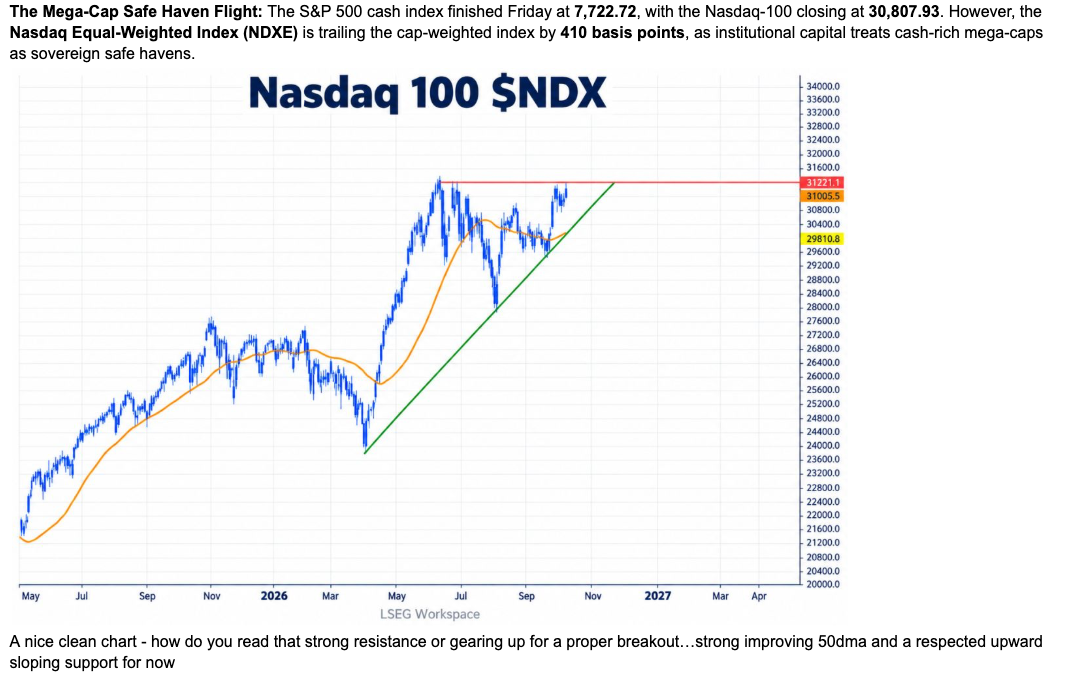
Nasdaq-100: a clean chart, still deciding between resistance and a breakout.
Equal-weight S&P on 5 October.
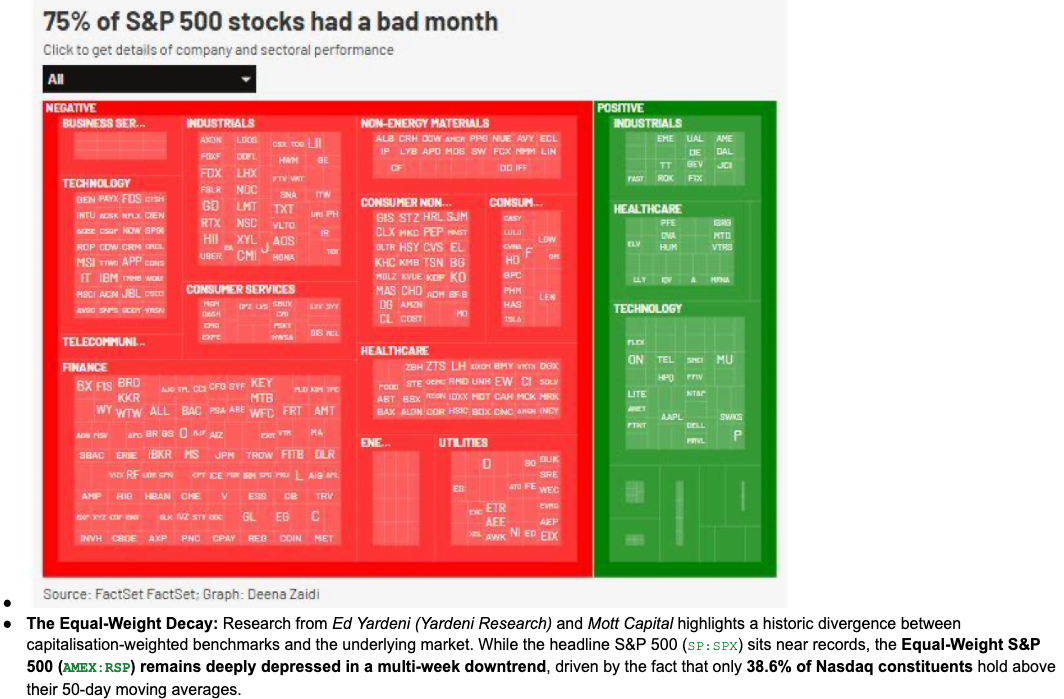
Equal-weight had a bad September while the headline index held up.
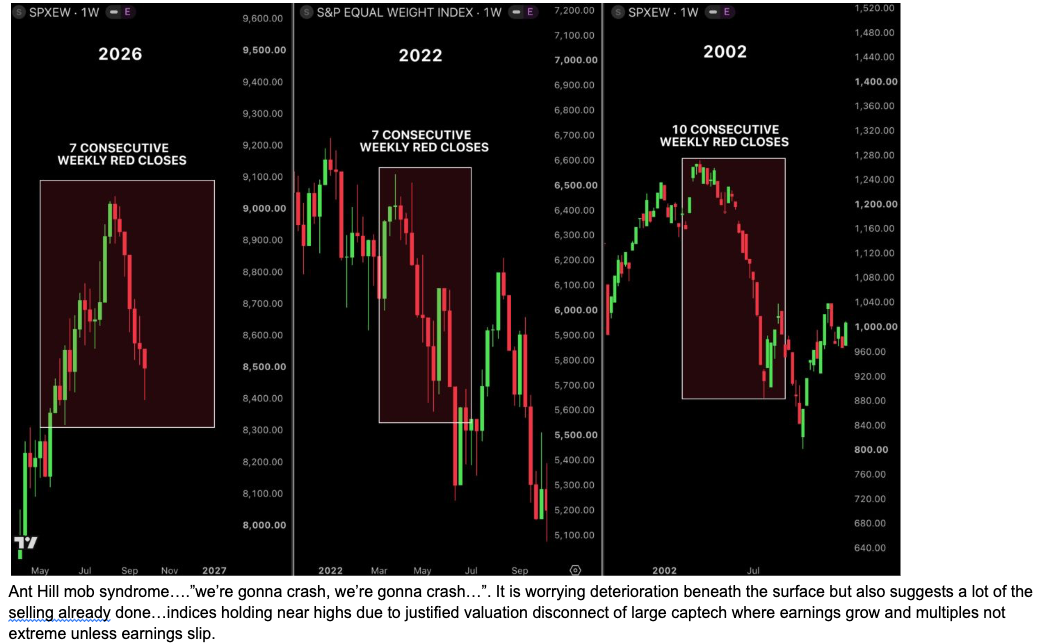
The equal-weight trend some desks are reading as a warning.
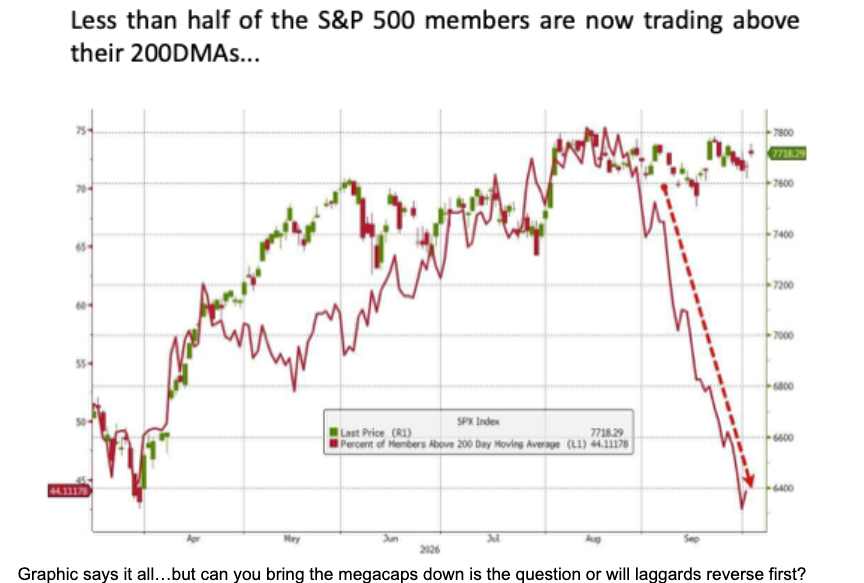
Breadth is weak with the index still near the highs.
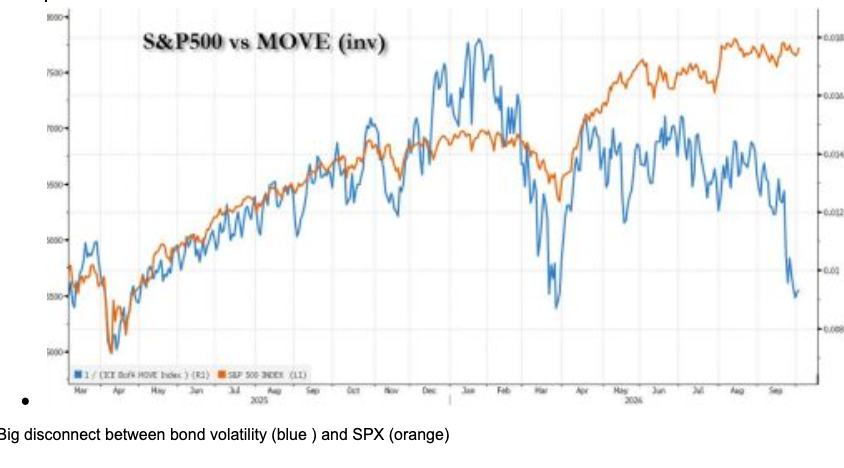
Bond volatility moved. The S&P did not.
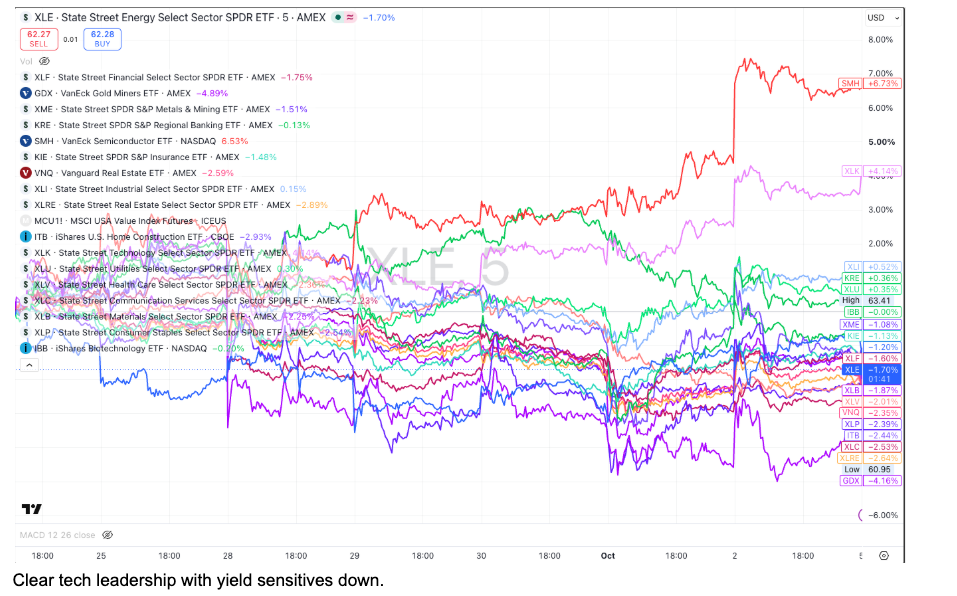
Tech versus rate-sensitive stocks last week.
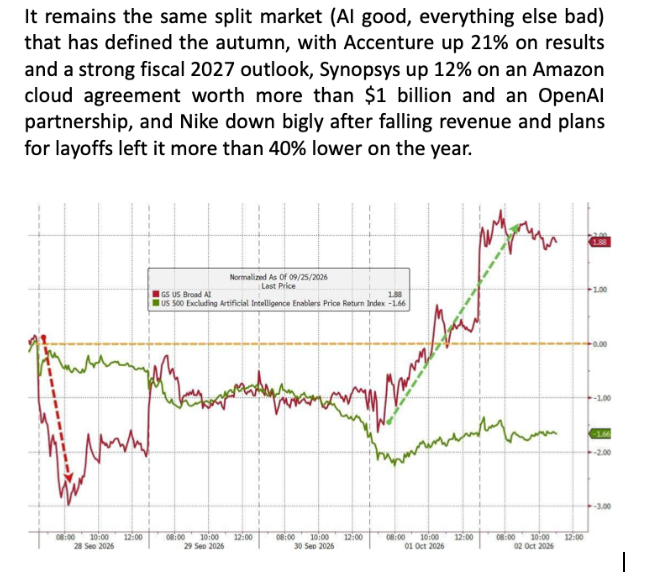
AI leadership is still doing the lifting.
Macro and policy: four central banks, four different problems
The Fed slate is what finished the hike repricing. Williams said there was no urgency. Hammack said the +29,000 print looked like a slower labour market, and that the Fed has time. Jefferson talked plumbing, not an emergency hike. Warsh kept a hawkish longer-term line but allowed that the near-term data gives room to wait. Barr was the outlier still talking about higher rates. Hammack speaks again today, Williams and Bowman follow, and the September FOMC minutes land Wednesday at 19:00 GMT+1. Those minutes were written before the jobs miss. Read them as the old baseline, not as the new one.
Europe is the opposite problem. Eurozone flash inflation hit 3.8%, a three-year high, with energy up 18.8% and core HICP at 2.5%. Lagarde stayed restrictive. Nagel said the ECB looks at inflation, not bond spreads, which is a blunt way of saying France does not get a rescue bid from the central bank just because OATs are widening. The Bank of England paused at 3.75% on a 6-3 vote. Bailey defended the hold. Mann still wants restriction. Pill's line is a long plateau, not a quick cut. The Bank of Japan is at 1.25%. Ueda said the job has flipped from creating inflation to capping it. Two board members dissented, so the next tightening step is less automatic than the headline hike.
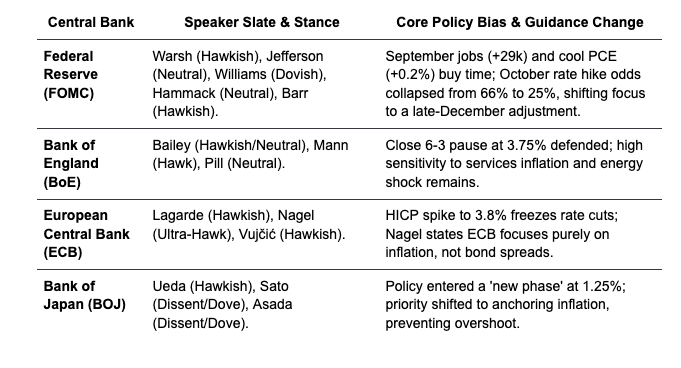
Where the main central bank speakers sat after the September decisions.
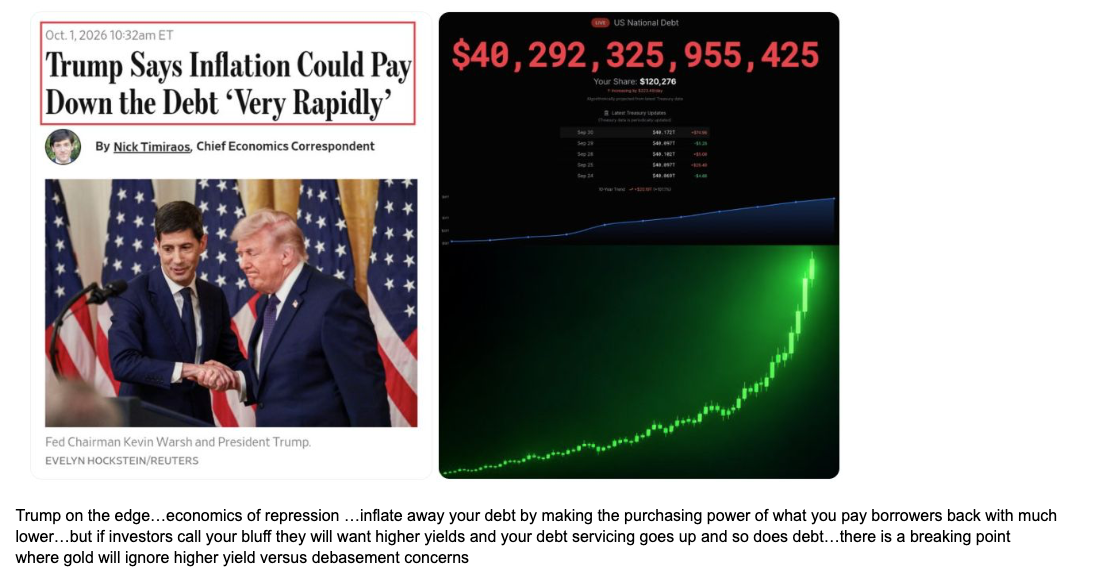
Inflating the debt away only works until lenders demand a higher yield for it.
Gold washed out. The debt hedge did not disappear.
Spot gold fell almost 4% in a session to a 7-week low at $4,110.55 and lost the $4,250 area while yields were at the high. Leveraged books were selling paper gold to cover bond losses. After the payrolls print it was back over $4,210. This morning's note had it nearer $4,153, so the bounce is not a straight line. A daily close back above $4,250 is the line the pack is using before it treats the washout as finished. High cash yields still punish an asset that pays nothing. The other chart in the pack is the longer argument: if the real risk is the value of the money you are paid back in, gold can stop trading as a simple yield math problem.
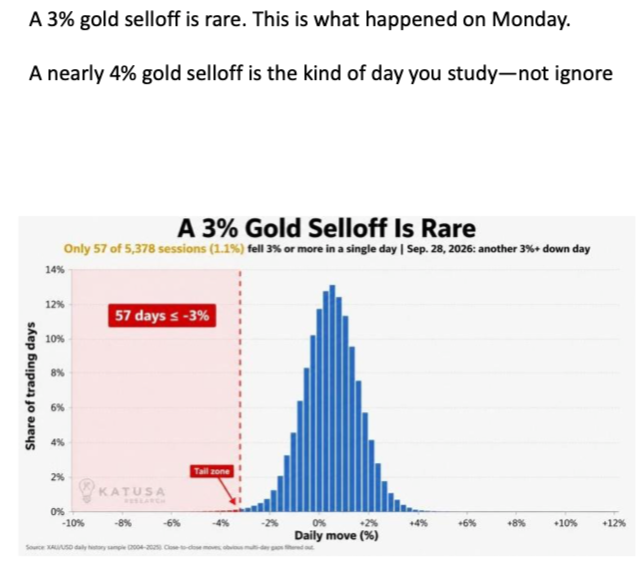
Gold's drop through $4,250 and the bounce back over $4,210.
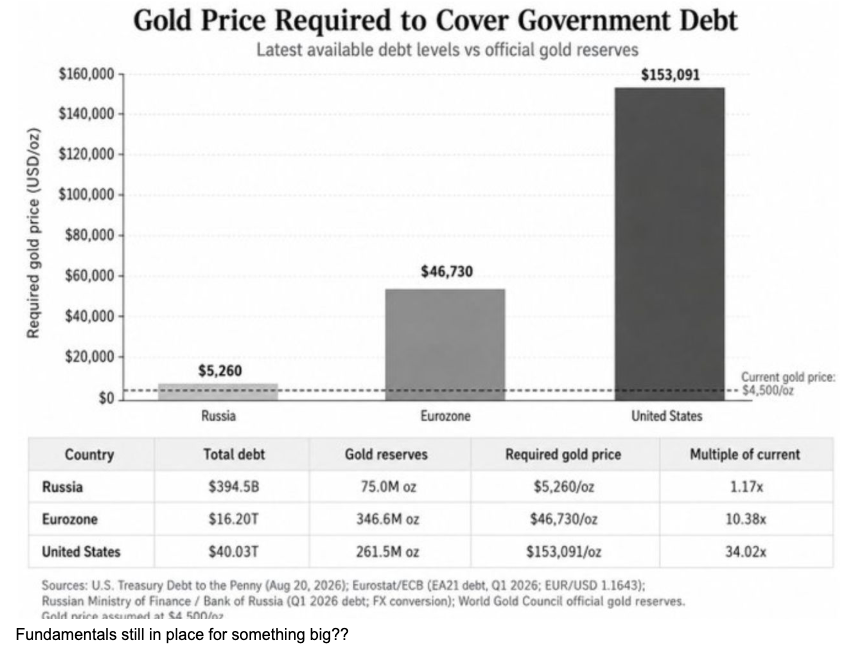
Gold against the debt stock, not just against last week's yield.
Oil can go around Hormuz. Gas cannot.
The US-Iran exchange has moved from headlines to infrastructure. Missiles have hit processing sites and pipelines, and a squeeze at the Strait of Hormuz has frozen a large share of seaborne traffic. Crude can be piped around the strait. Qatar's Ras Laffan cannot. It sits inside the Gulf, it is roughly a fifth of the world's LNG, and it leaves on tankers.
The policy response was an emergency stock release. After Washington threatened a domestic diesel export ban, the G7 agreed to release up to 100 million barrels of diesel and crude over four months. France's piece is about 50 million barrels of diesel, roughly 415,000 barrels a day. EU emergency diesel stocks were already 275 million barrels in June. Another 50 million takes them through the 2022 low. That is more diesel now and a thinner winter buffer. China froze October fuel exports at the same time, citing low domestic stocks, which takes a lot of the G7 release back out of the seaborne market.
The number that matters more than the crude headline is the diesel crack, near $112 a barrel. The pack is using $96.50 on WTI as the crude pivot. Above that, the release is being offset by China's export freeze. Below it, the crude premium can deflate while diesel still outperforms oil. Freight is the transmission. Higher shipping cost is a margin hit for anyone moving goods, and a better tape for whoever owns the ships.

Pipelines reroute crude. They do not reroute Qatar's LNG.
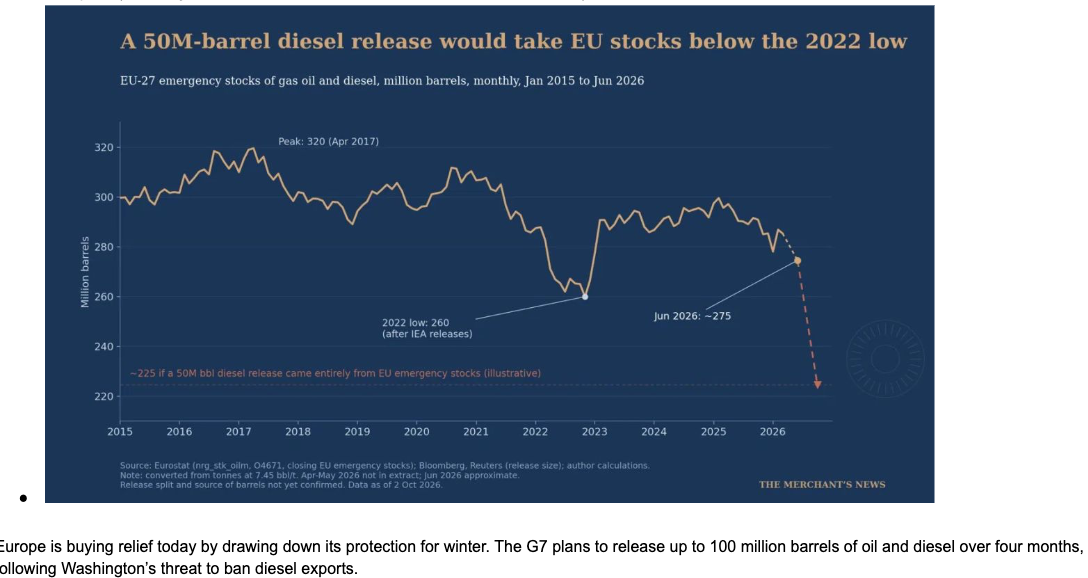
The European diesel release against stocks that are already low.
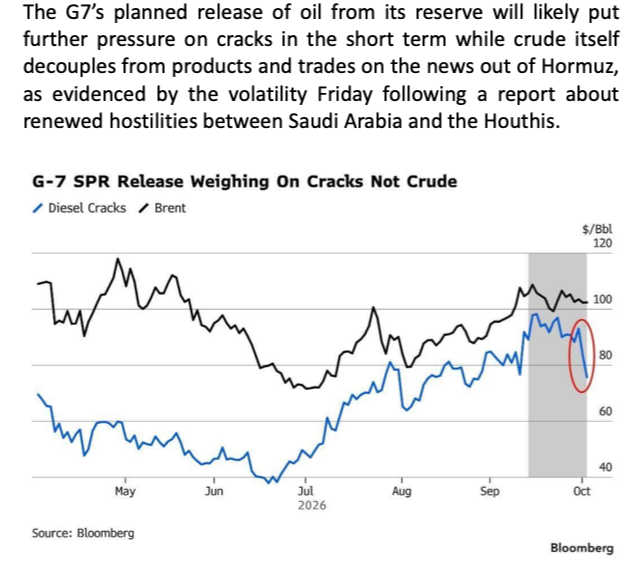
Diesel crack spreads, the part of energy that is actually tight.
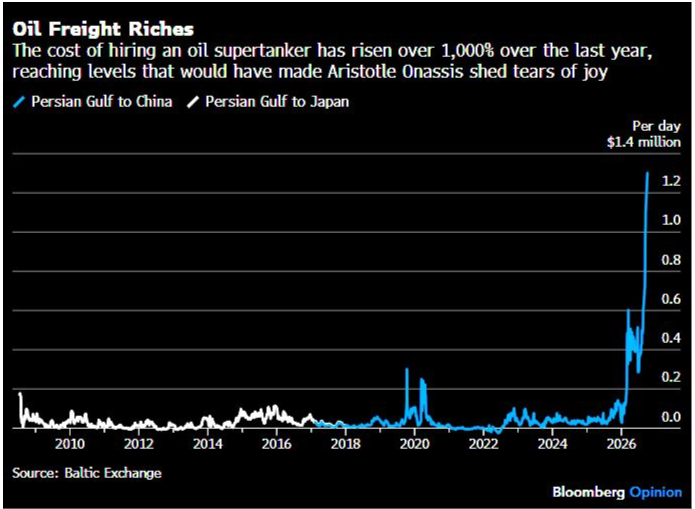
Freight: a cost problem for shippers, a better tape for owners.
Europe's bonds are the soft spot. Brazil is not.
US yields eased. European credit did not. The French 10-year hit 4.993%. The France-Germany 10-year spread reached about 159 basis points on Friday, a near-15-year wide, then eased toward 146 on Monday morning. Italy is starting to trade with France rather than against it. The UK 30-year gilt went through 6.02% for the first time since 1998. That is a 6% long-term borrowing cost with the local politics almost beside the point. The dollar is at an 18-month high, back around the April 2025 area. The euro is soft because the bond market underneath it is soft. Japanese funds have been large sellers of French government bonds, which is how a Tokyo allocation decision shows up in the OAT spread.
Brazil is the cleaner flow story in the pack. The charts show money coming back as the local picture looks more normal. It is not a verdict on the currency for the year. It is evidence that not every emerging market is being treated as one trade.

Japanese funds leaving French OATs.
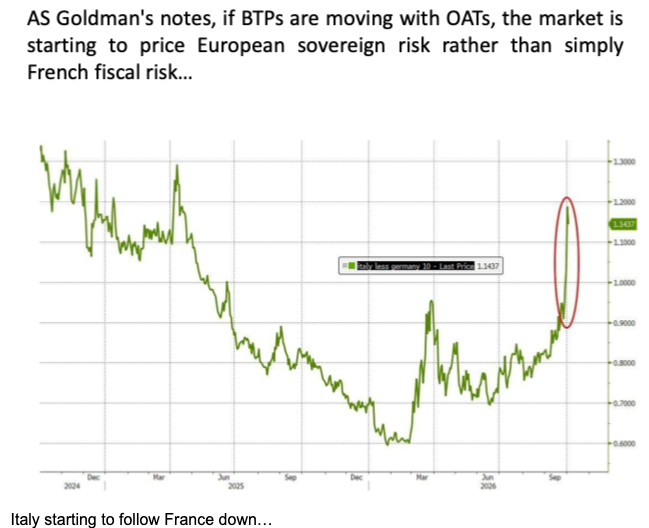
Italian bonds moving with France.
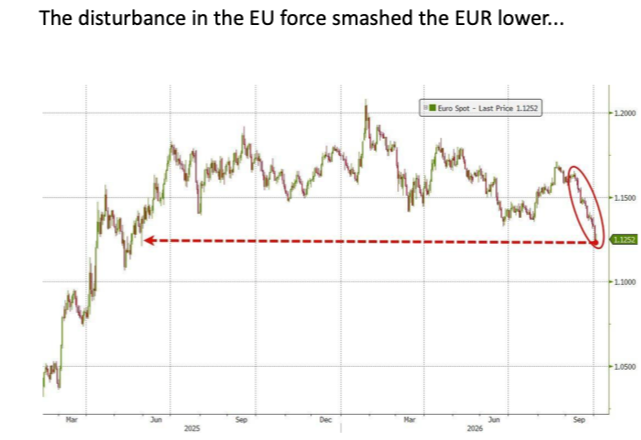
Eurozone bonds pulling the euro lower.
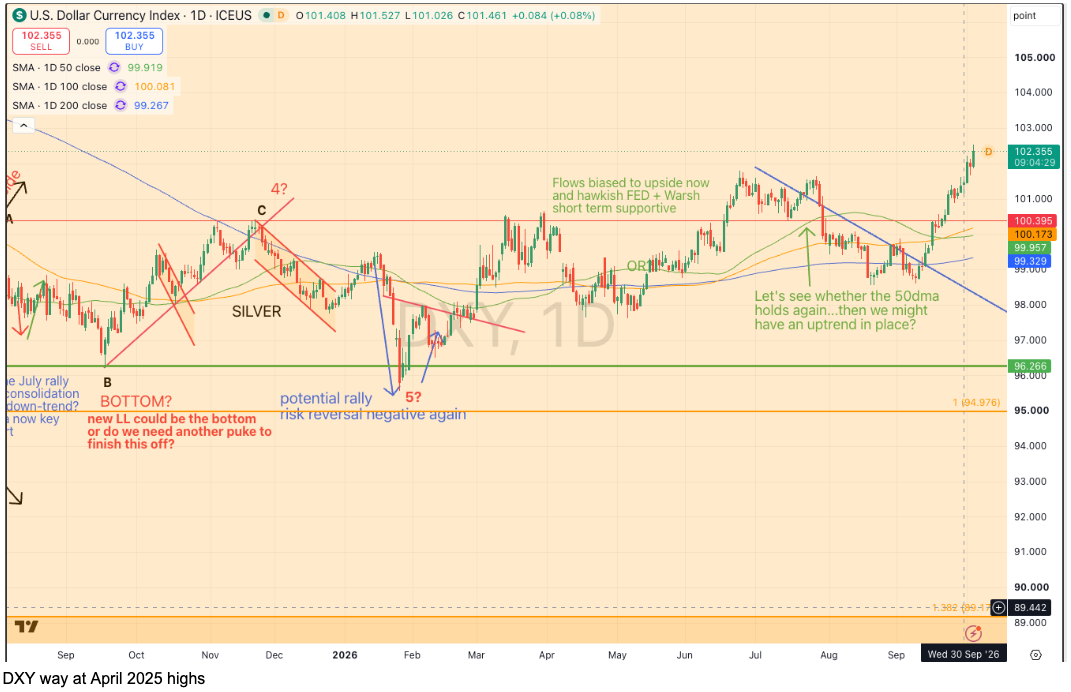
The dollar back at an 18-month high.
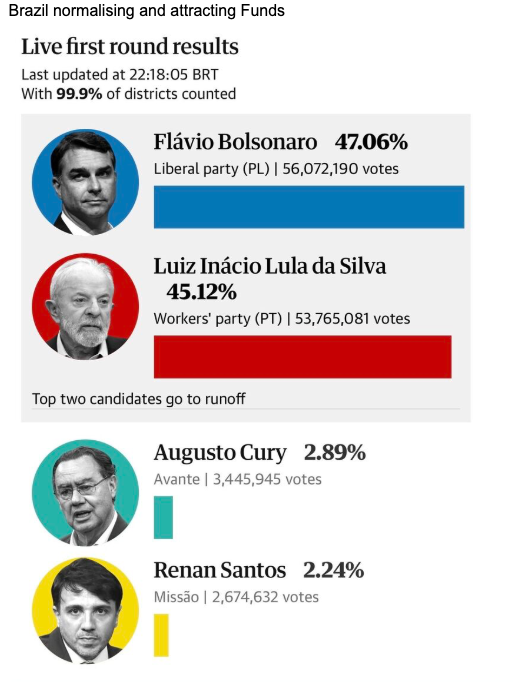
Brazil, first chart in the pack.
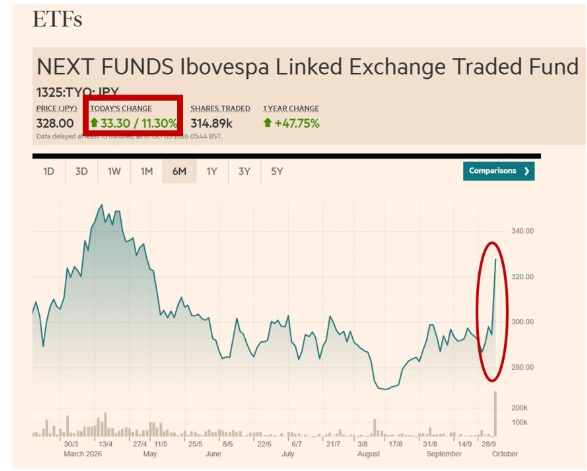
Brazil inflows picking back up.
Earnings: Micron made the quarter. The AI bill is in the credit market.
Micron's revenue was up 379% year on year. The stock closed at $1,097.39 after shaking off the post-earnings dip, with at least one desk taking a target up to $2,100. From 9 December 2026 it plans to return excess cash to shareholders. That is the clean version of the AI trade: a company that is actually collecting the revenue.
The messier version is the balance sheet. Amazon is moving about $8 billion of Nvidia Blackwell hardware into an off-balance-sheet vehicle and offering outside bond buyers a stake, with capex already above operating cash flow. SoftBank pushed through an $11.1 billion high-yield deal for OpenAI commitments and its credit default swaps moved past 400 basis points. Nvidia's buyback has not lifted the whole complex. The stock can be at a high while the forward rating is the lowest in five years, which is what happens when earnings grow faster than the multiple. Anthropic is trying to reach the public market while the window is still open. China is still in the Nvidia demand story. A survey in the pack shows only a small share of AI consumers are strongly bullish or strongly bearish. Most of the spending is happening without a strong public view either way.
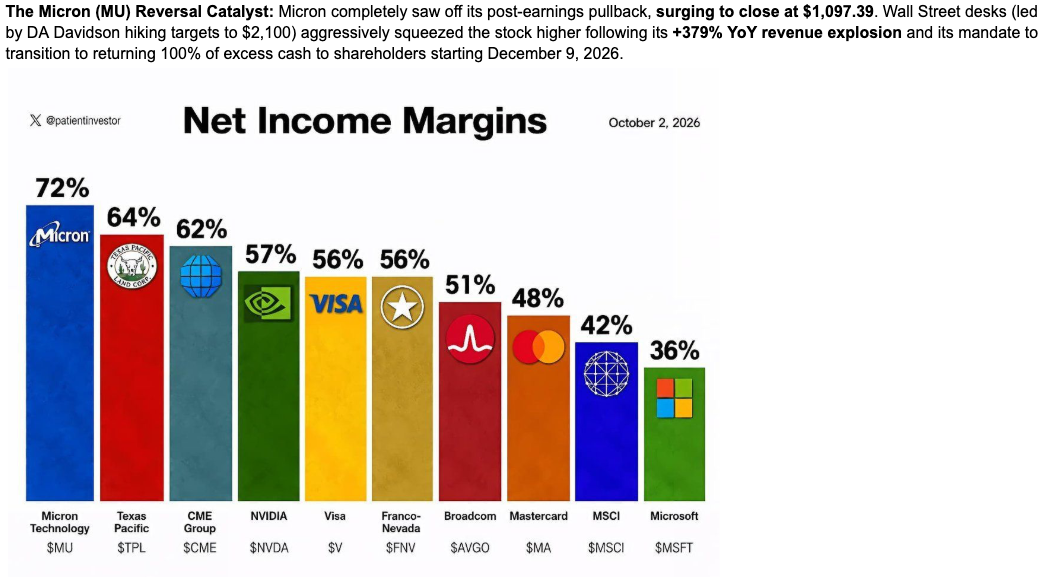
Micron margins after the revenue jump.
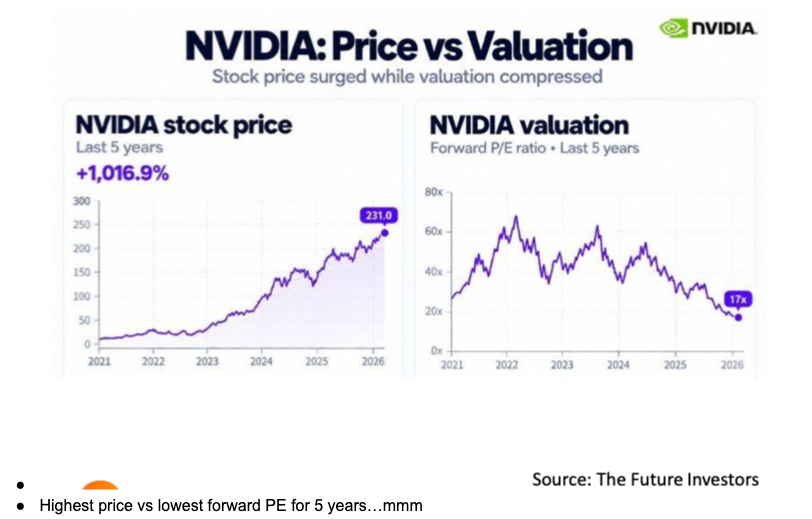
Nvidia at a high price, forward rating at a five-year low.
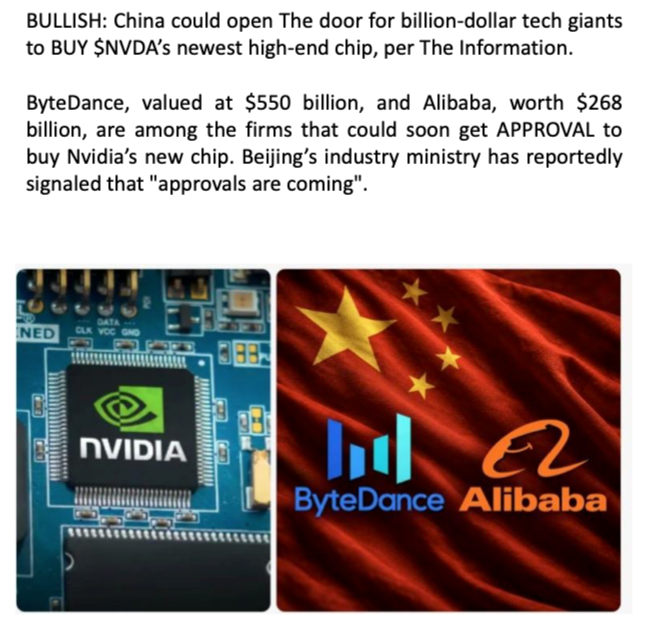
China still showing up in the Nvidia story.
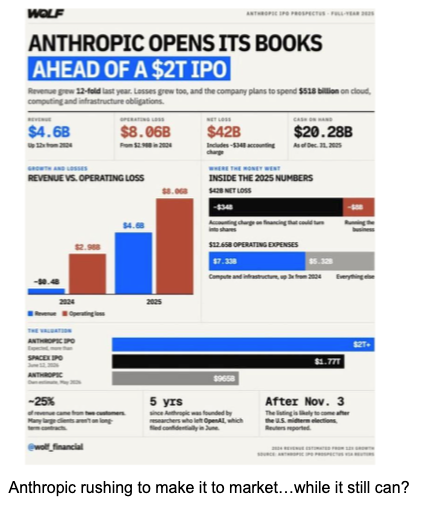
Anthropic trying to get to market.
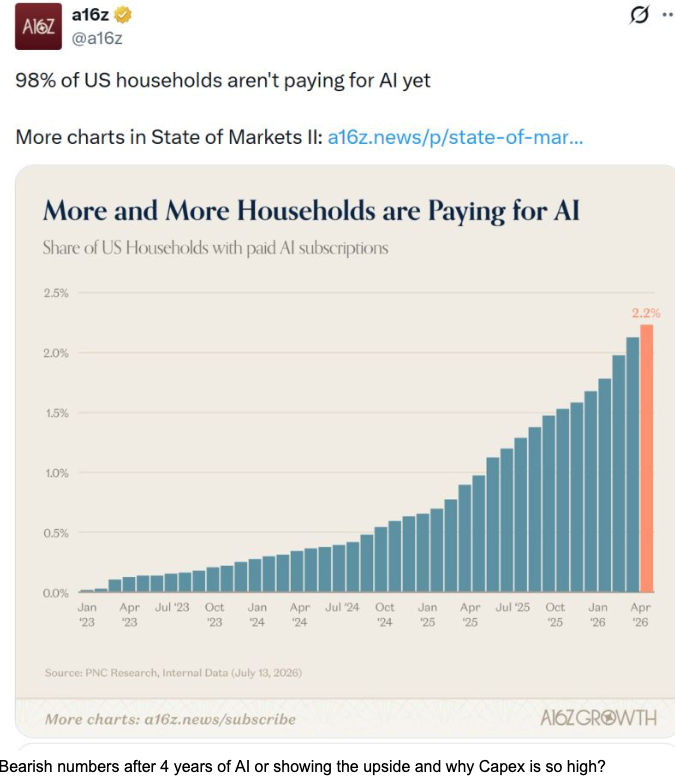
Very few respondents are strongly bullish or strongly bearish on AI.
Positioning: inflows at the top, stress underneath
Treasury shorts are still large even after the Friday squeeze. ETF inflows have not stopped. Money-market balances are at a record at the same time, so the public is buying risk and parking cash. Junk bonds are starting to stress, which is the credit version of the equal-weight chart. Flows into the mega-cap group are dominant. Momentum is back on top of the factor pile. KKR's note in the pack is the contagion question: if tech credit is the weak pipe, financials feel it next. Jim Bianco's point is narrower. The payrolls miss knocked yields off 5.342%, but diesel, AI debt issuance, and the deficit argue for a high plateau, not a quick return to 4%. The pack does not treat every dip in yield as the start of a bond bull market.
Bitcoin held near $83,700 through the same paper selloff that hit gold. The upside line in the pack is $87,265. Below that it is still a corrective range that can shake if equities lose the 7,720 area. Outflows since October 2025 are nearly all back, which says the selling wave finished. It does not say the next move is higher.
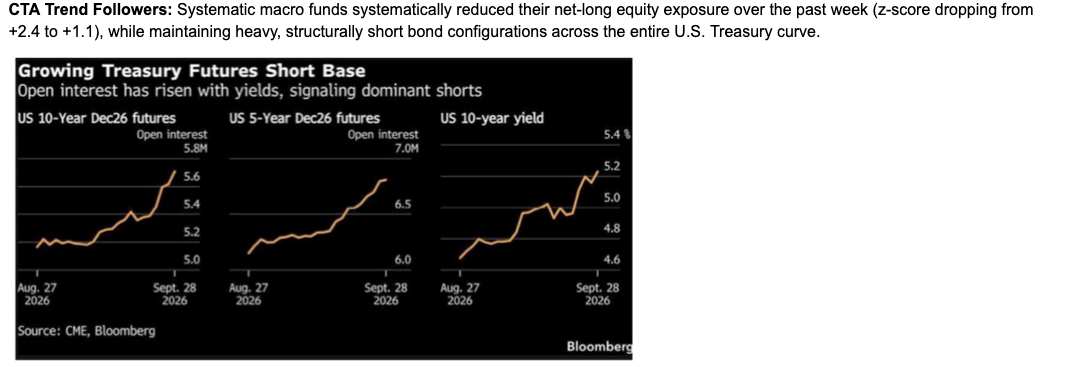
Treasury shorts are still building.
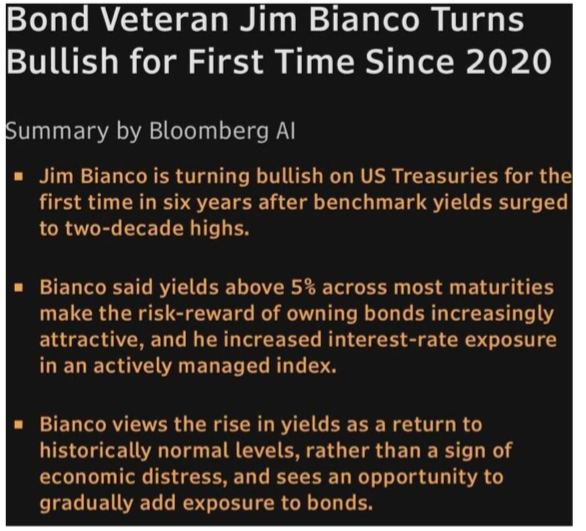
Bianco: a higher yield plateau, not a slide back to 4%.
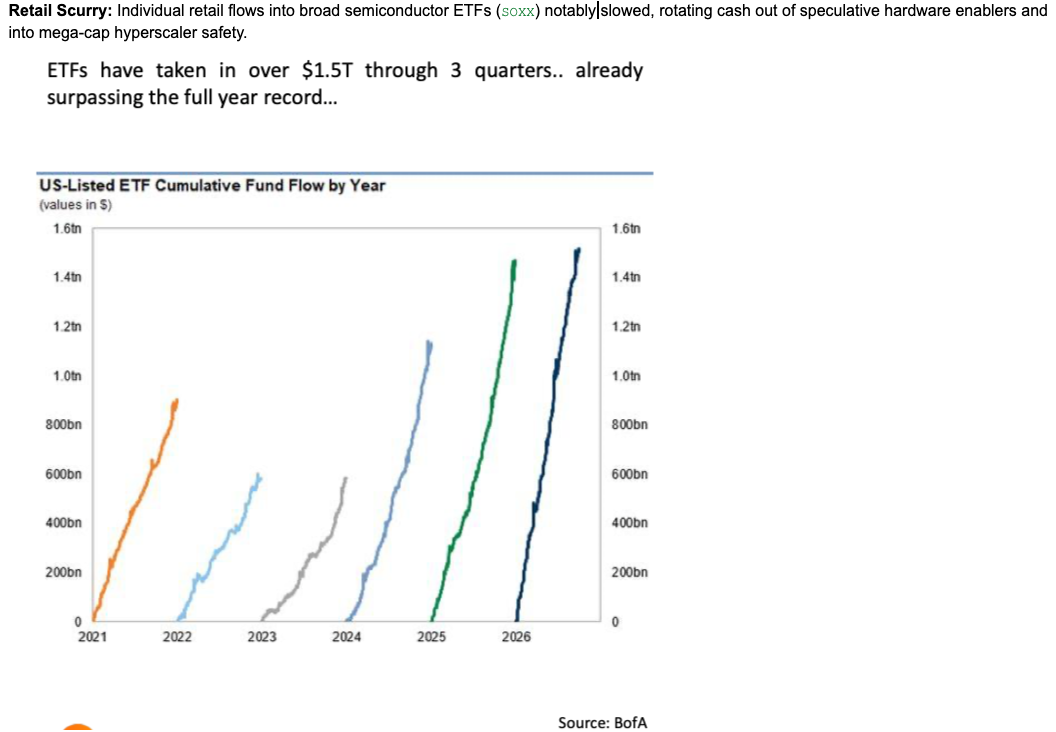
ETF inflows have not slowed down.
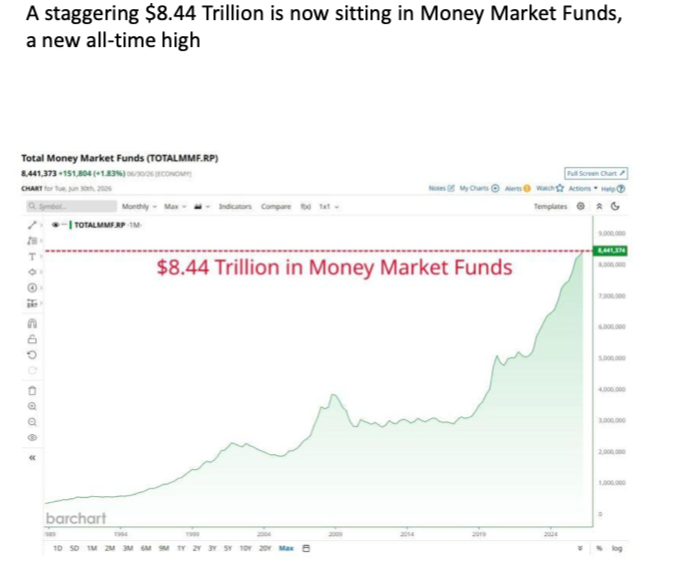
Money-market balances at a record, alongside the equity inflows.
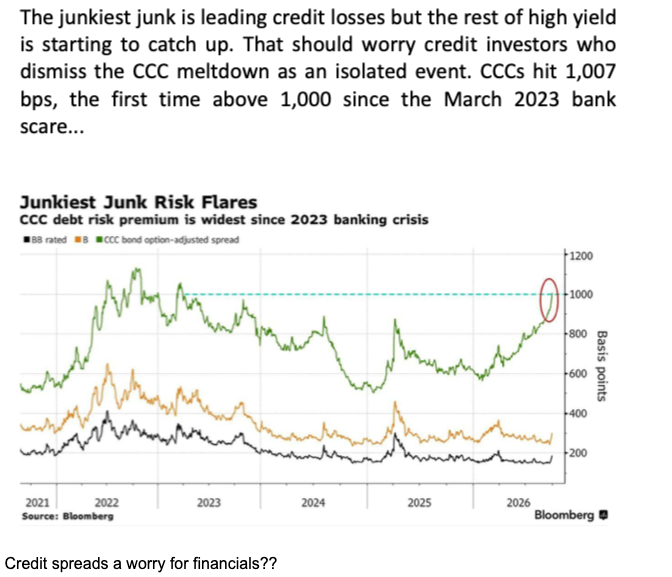
Junk bonds are starting to strain.
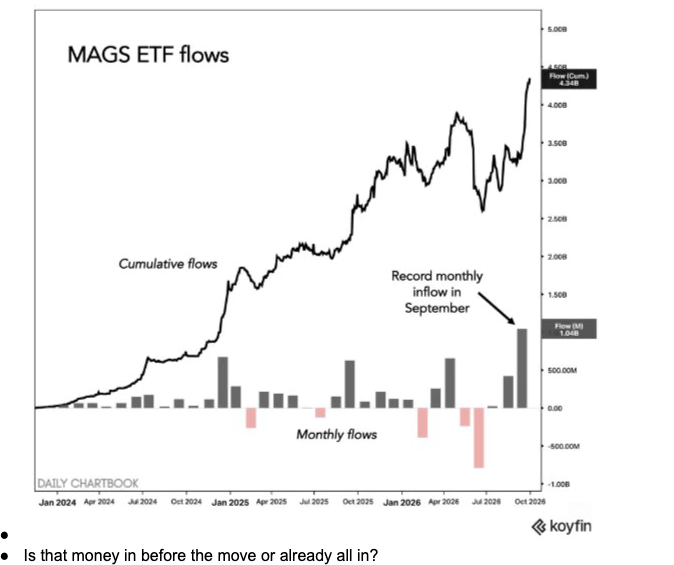
Flows concentrated in the mega-cap group.
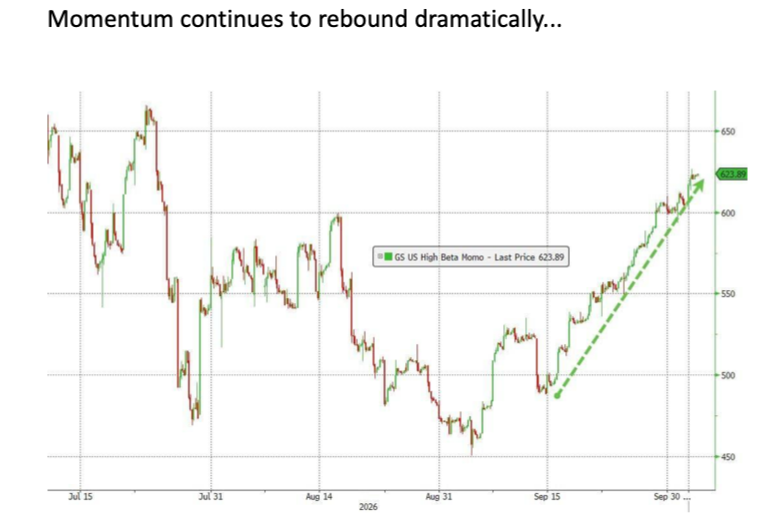
Momentum back at the top of the factor ranks.
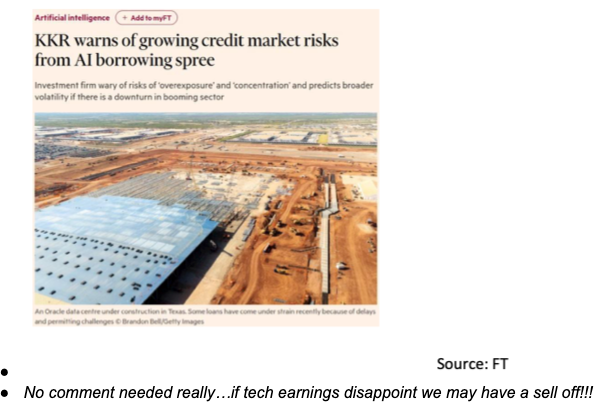
KKR on the risk that tech stress spreads.
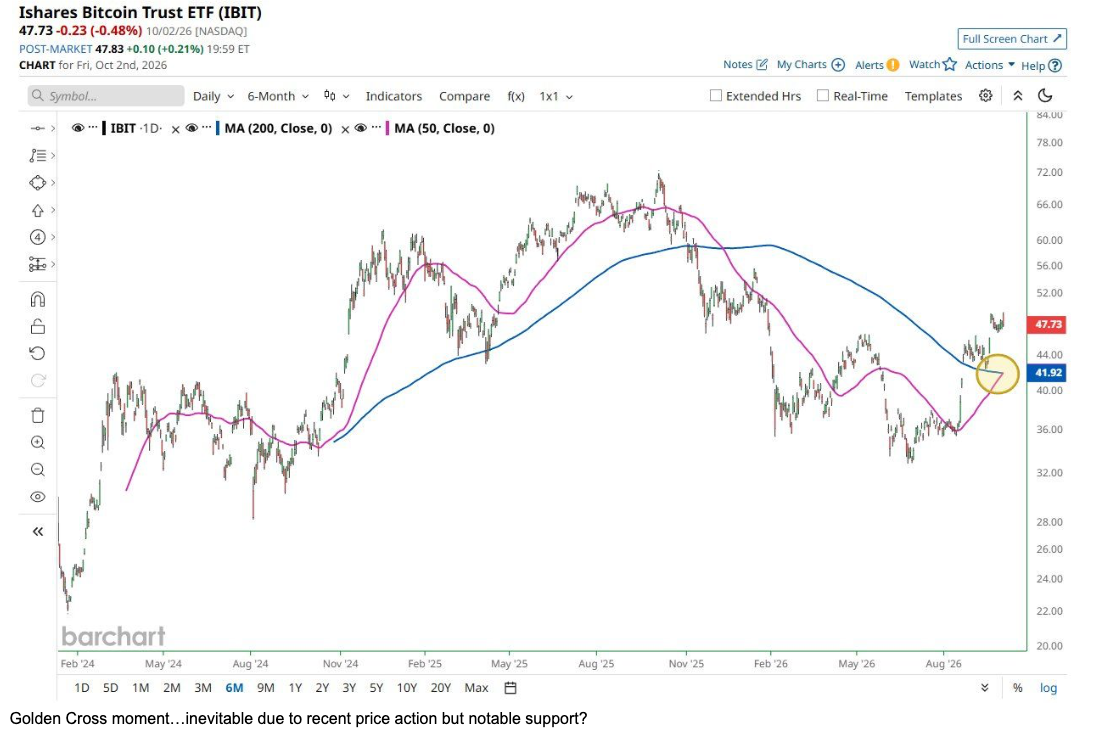
Bitcoin's longer-term cross, after holding $83,700.
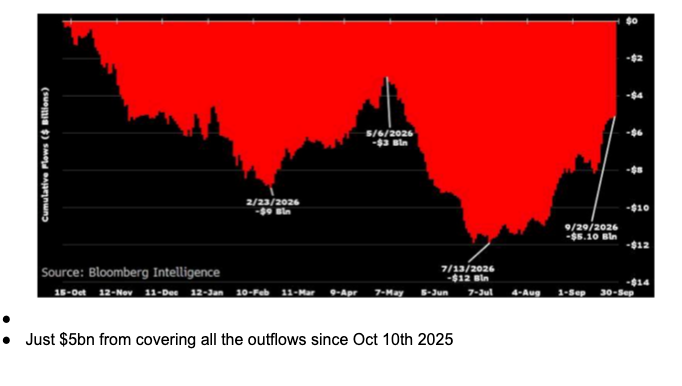
Bitcoin outflows since October 2025 are nearly reversed.
Lines in focus
These are the levels the pack is using this week. They describe where the tape is, not an order to trade them.
- S&P 500: 7,720 is the line. The index has been trading above it, near 7,756. Under 7,720 the next marks in the pack are 7,695 and then 7,623.
- Nasdaq-100: Friday's close was 30,807. The upside mark is 30,980. Underneath, 30,710 to 30,740 is the retest area from the jobs-day low.
- US 10-year: 5.342% rejected. The zone in focus is 5.16% to 5.22%.
- Gold: weekly low $4,110.55, back over $4,210, with $4,250 as the daily close the pack wants to see.
- WTI: $96.50. Diesel crack near $112, with $105 as the level the pack does not want to lose.
- Bitcoin: held near $83,700. The upside line is $87,265.
Last week's recap
- Bonds: the 10-year set a multi-decade high at 5.342%, then failed. Hike odds for 28 October fell to about 25%.
- Labour and inflation: payrolls +29,000 versus +90,000 expected, revisions -60,000, unemployment 4.2%. Core PCE +0.2% on the month, 3.0% on the year.
- Equities: indexes finished firm and then pushed after the open. Equal-weight and breadth did not confirm it.
- Gold: a near-4% drop to $4,110.55, then a bounce through $4,210. Not a confirmed reclaim of $4,250.
- Energy: G7 stock release versus a China export freeze. Diesel, not crude, is the tight market. Crack near $112.
- Europe: French yields near 5%, the Germany spread very wide, gilts through 6% on the 30-year, the dollar at an 18-month high.
- Credit and flows: Amazon and SoftBank showed the AI funding bill. ETF and money-market inflows were both heavy. Junk is the part that looks tired.
The week ahead
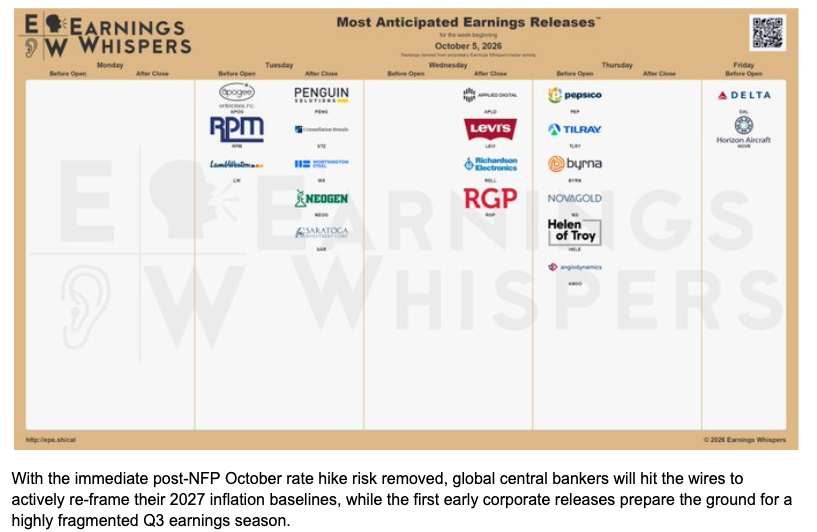
The hike scare for this meeting is off the table. What replaces it is a week of central bank talk, a thin run of US data, and the first real company reports. China is on holiday all week, so Asia liquidity is lighter than the calendar looks.
Monday 5 October. Final eurozone and UK PMIs, and the US ISM services index. The eurozone composite was an unexpected 53.1. Beth Hammack speaks. Philip Lane and Isabel Schnabel are on the European circuit. France auctions short-dated bills. This is a services-day, not a new inflation day.
Tuesday 6 October. PepsiCo before the US open is the consumer check: volumes, not just price. Eurozone retail sales show whether 3.8% inflation is already in the shopping basket. German factory orders, French industrial production, and the US trade balance are the growth prints. Michelle Bowman speaks. A 3-year US note auction tests whether Friday's yield drop has any follow-through.
Wednesday 7 October. The September FOMC minutes at 19:00 GMT+1 are the policy event. They pre-date the payrolls miss, so the useful question is how hawkish the room still was before the data. US consumer credit and the EIA oil inventories sit next to it. John Williams speaks overnight into the US day. India has a rate decision.
Thursday 8 October. Delta before the open is the first clean corporate look at a $112 diesel crack. Tesco is the UK consumer against a 6% long gilt. US jobless claims, wholesale inventories, and the UK RICS house-price balance test whether that gilt move has hit mortgages. Andrew Bailey and Huw Pill speak. The US 30-year auction is the long-end test after 6% gilts.
Friday 9 October. JPMorgan before the open is the credit bellwether: net interest margin against a 5% yield, and what they set aside for commercial property. Canada employment, University of Michigan sentiment and inflation expectations, and the WASDE crop report fill the rest of the day. Tryg in the Nordics is the smaller financial read.
Takeaway
The macro turn is real. A 5.34% 10-year and a 70% hike probability did not survive the payrolls print. Gold's low at $4,110.55 looks like a washout, not a new trend, until $4,250 is reclaimed or lost again. Equities are the part that has not caught up, and also the part that is most dependent on a handful of stocks. Equal-weight, junk credit, and the diesel crack are the checks on the headline index.
The three timing charts at the end of the pack are the same lesson. The level was knowable. The hard part was staying with it when the story changed, and changing when the facts did. Payrolls changed the rate story. They did not, by themselves, fix breadth, European bonds, or the cost of diesel.
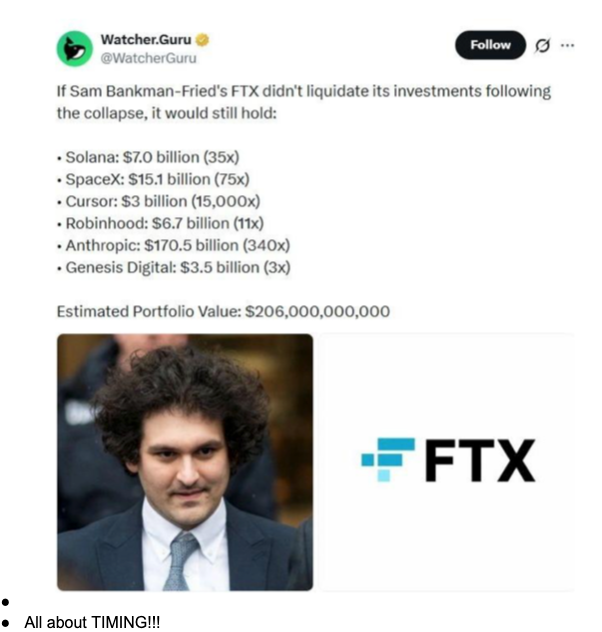
The long that would have worked if it had been left alone.
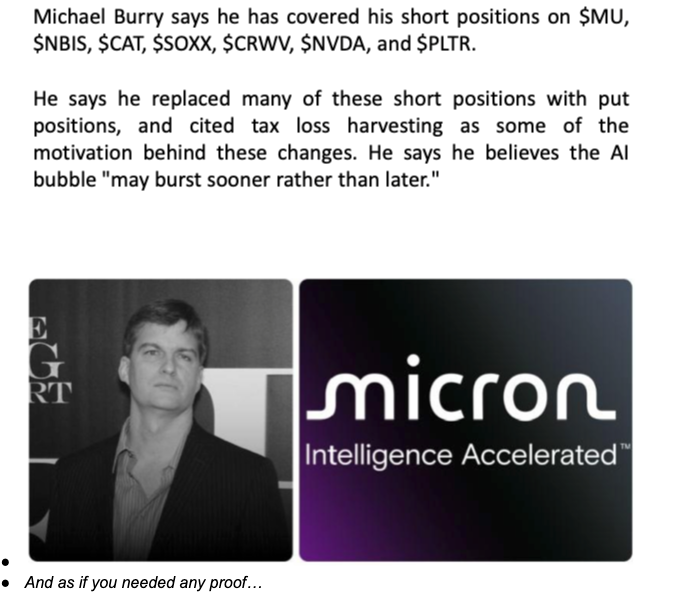
The short that would have worked if it had been left alone.
And the other rule: change the view when the facts change.
Charts and figures are from the 5 October 2026 weekly pack. This is a recap of that tape. It is not a personal recommendation, and nothing in it is guaranteed.