Weekly Market Outlook - November 9th, 2026
The Relief Rally Met the AI Bill Again, as Gold Repairs Its $4,000 Floor
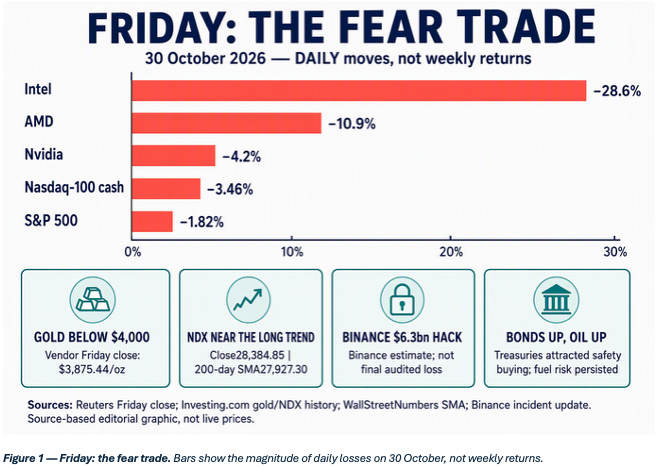
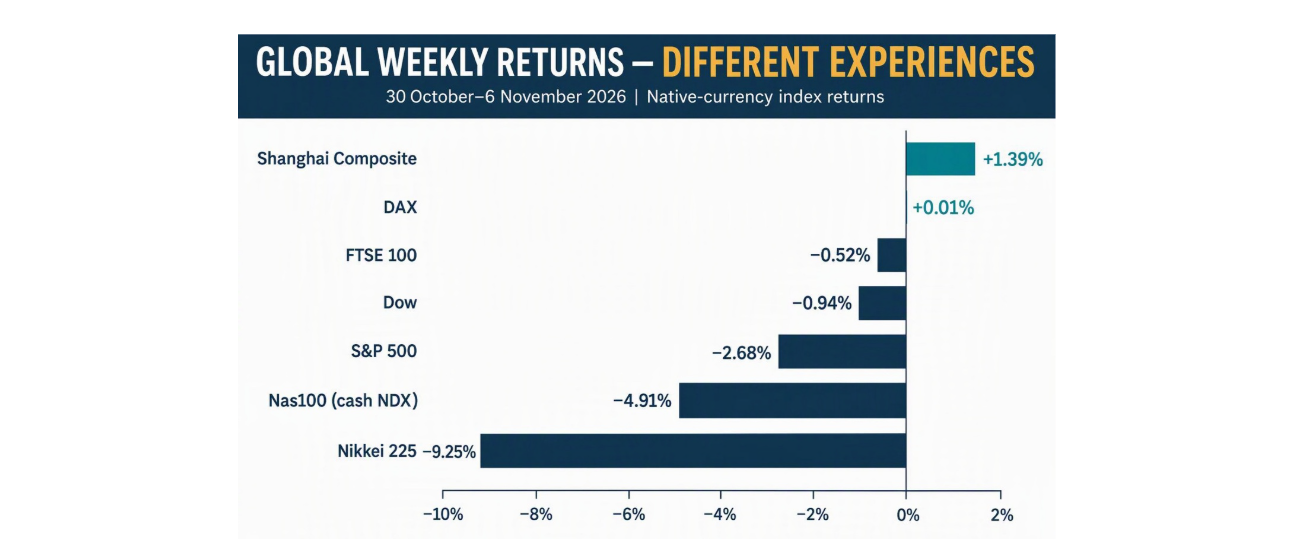
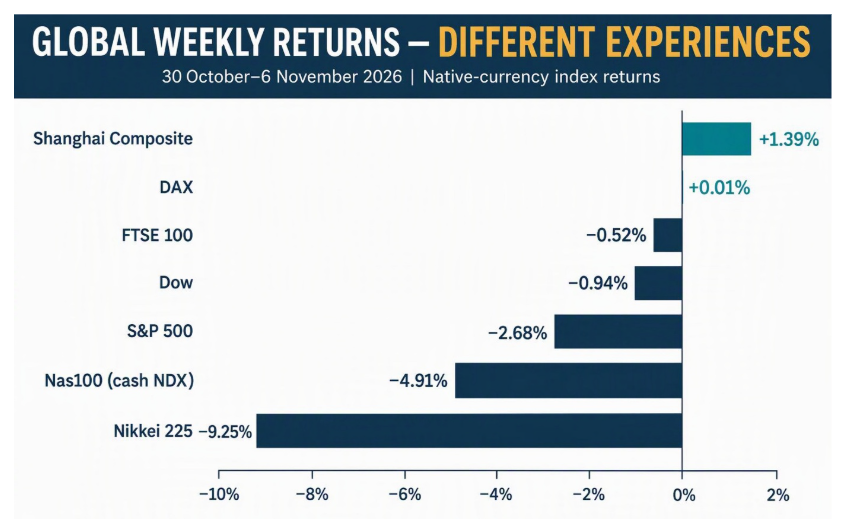
Last week delivered the relief rally and then sent the AI bill again. Wednesday's election relief was real, but Thursday's damage was bigger, as concern over data-centre permits, financing and shareholder cash returned. Friday-to-Friday, the S&P 500 lost 2.68% to 7,376.86, the Dow fell 0.94% to 51,285.73, and the cash Nasdaq-100 dropped 4.91% to 26,989.99. Those numbers hide a brutal Thursday: the Nasdaq-100 fell 6.36%, the S&P 500 lost 4.36%, and all eleven sectors declined. Friday's rebound repaired only part of the break.
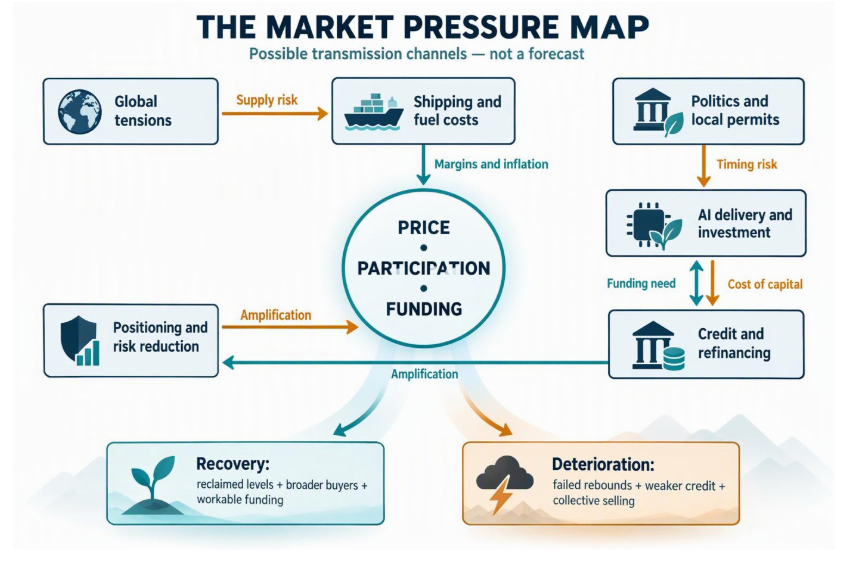
That is the change worth watching. The economy did not break with the chip shares, as October payrolls rose 165,000 and unemployment fell to 4.1%, which complicates the idea of a quick Fed rescue. Gold reclaimed $4,000, while Nasdaq lost its 200-day average and the S&P held just above its own. Credit is flashing too, with CoreWeave's 2032 bond yielding above 16%. Growth resilience and technology repricing are happening together, and the rebound now needs three things at once: price, participation and funding.
Market Overview: A Technology Break Inside a Divided World
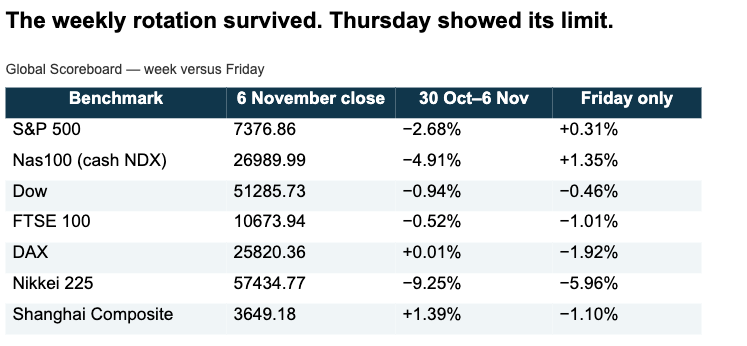
The damage was concentrated, but it travelled. The Nikkei 225 lost 9.25%, including 5.96% on Friday alone, while the Shanghai Composite gained 1.39% and the DAX finished flat at +0.01%. The FTSE 100 slipped 0.52%. Globally, technology fell 6.7% and energy 10.4%, yet consumer discretionary rose 2.7% and real estate 2.2%. Markets heavy in AI hardware felt the shock most.
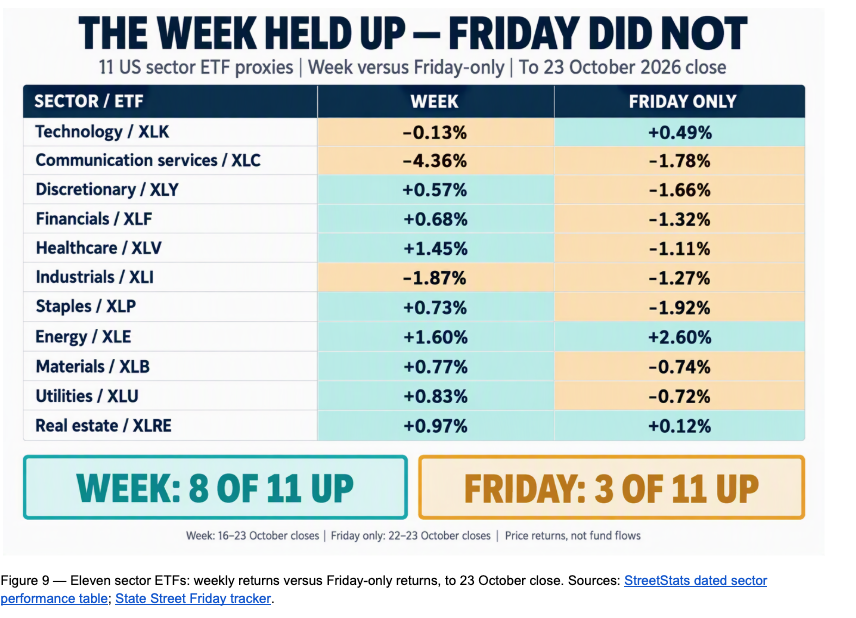
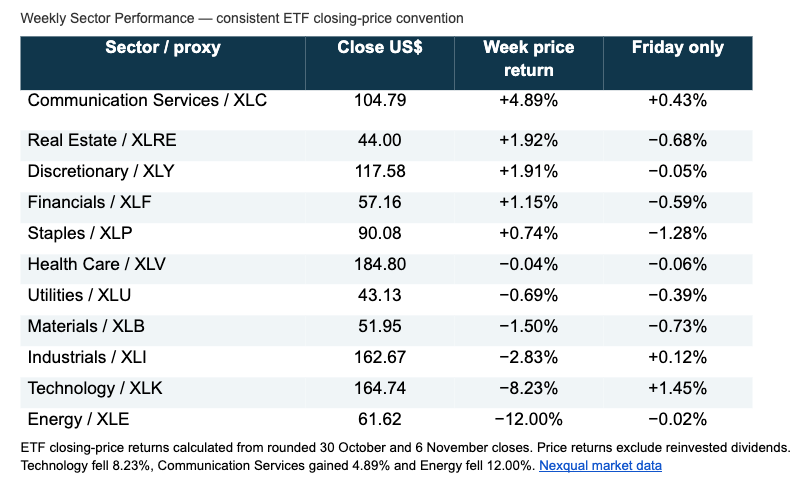
US sectors split almost down the middle. Communication services gained 4.89%, real estate 1.92% and discretionary 1.91%, while technology lost 8.23% and energy 12.00%. On Friday, technology led with a 1.45% gain, but staples fell 1.28%, and financials and real estate also slipped. That is the participation test: a rebound led by the sector that broke, while the cushions soften, is not yet a broad recovery.
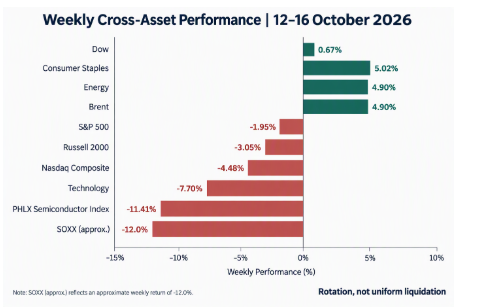
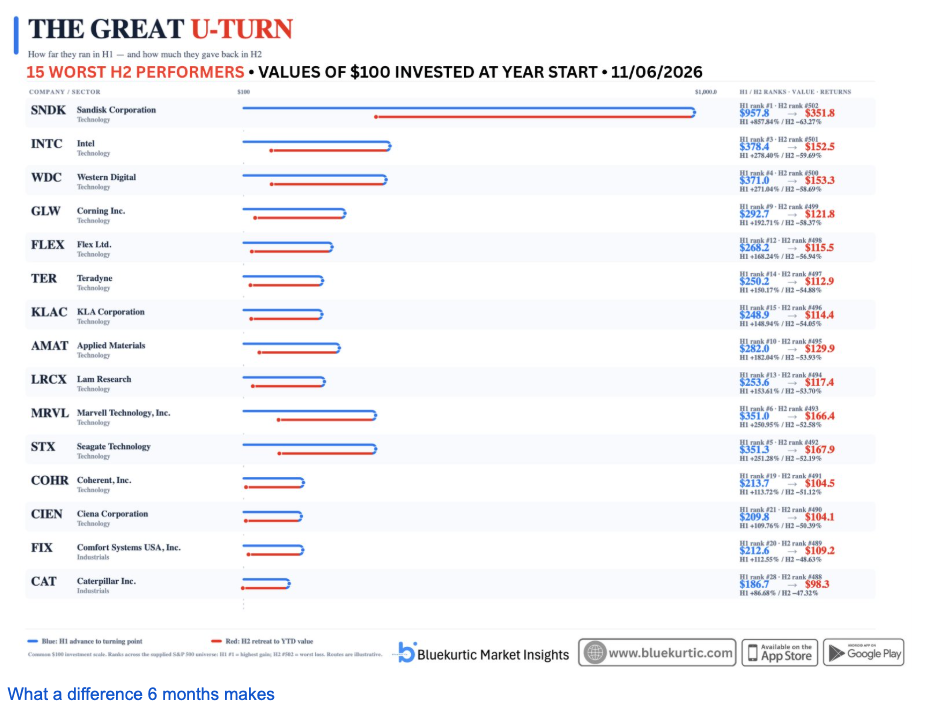
Breadth did not confirm the bounce. Friday's breadth was negative, with equal weight lagging cap weight by about 70bp. The chip complex took the deepest damage, with SOX down more than 12% on the week, though Friday still separated names: AMD rose 11.04% and Coherent 13.58%, while Microchip fell 10.02%. This year's first-half winners, led by SanDisk, Intel and Western Digital, now top the second-half losers. What a difference six months makes.
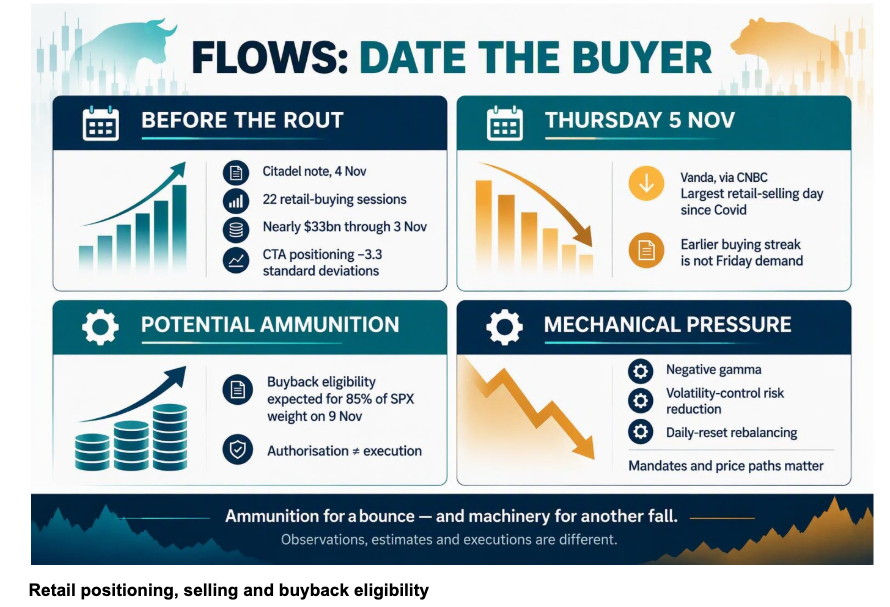
The flow base behind the bounce has changed. Citadel counted 22 consecutive retail-buying sessions and nearly $33 billion through 3 November, but Vanda estimates Thursday was the largest retail-selling day since Covid. Hedge funds entered the shock defensively, with historically low net exposure. Buyback eligibility returns for about 85% of S&P weight from 9 November, but authorisation is not execution, and Friday's volume ran roughly a quarter below Thursday's. There is ammunition for a bounce, and machinery for another fall.
Macro & Policy Watch: Jobs Held Up, Central Banks Held Firm, and Permits Became the New AI Risk
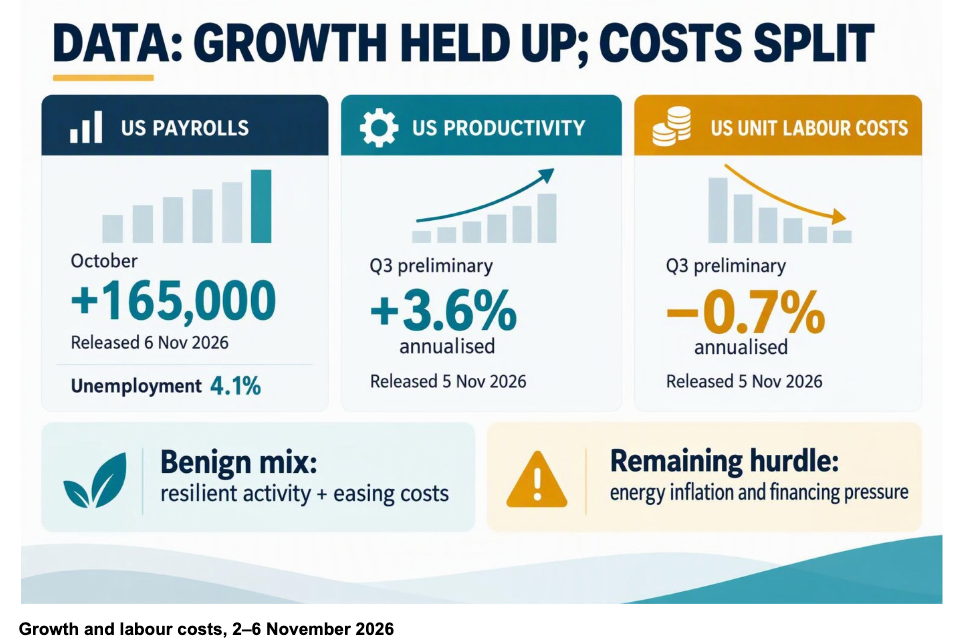
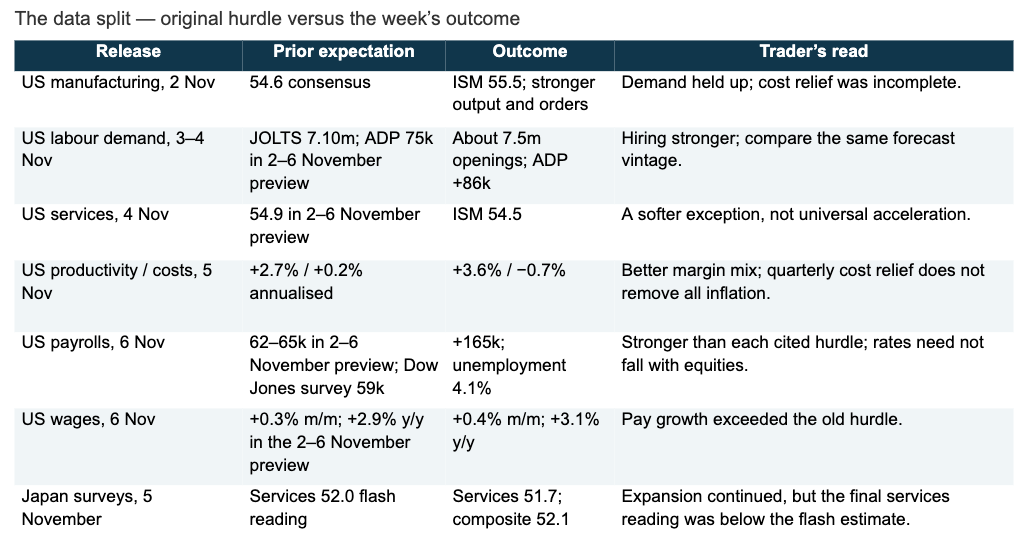
Growth did not crack, and that is not entirely good news for equities. Payrolls beat every cited hurdle, ISM manufacturing came in at 55.5 against a 54.6 consensus, and Q3 productivity jumped 3.6% while unit labour costs fell 0.7%. Good activity with lower costs is the benign combination. But strong jobs with sticky prices keep policy pressure alive, and stronger hiring limits immediate monetary relief.
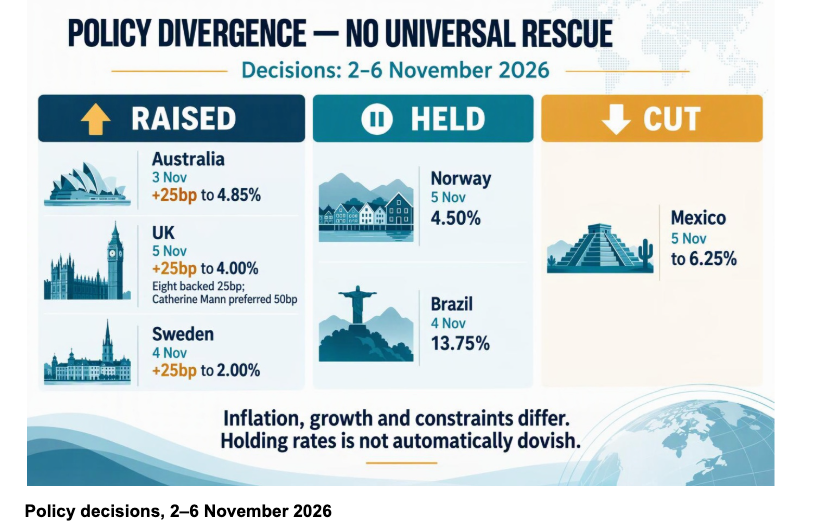
Tightening has not disappeared. The BoE raised Bank Rate to 4%, with all nine members backing a rise and Catherine Mann wanting 50bp, while the RBA lifted to 4.85% and the Riksbank to 2%. Norges Bank held at 4.5% but stands ready to raise; Brazil held and Mexico cut. Daly and Hammack both lean towards tighter Fed policy. Consensus is an upward rate bias until inflation eases, which is actually bullish, as central banks are up with the curve, if not ahead of it.
Cheaper oil was the counterweight. Diplomatic hopes stripped WTI of more than 12%, and Ukraine talks are planned in Abu Dhabi for 10 to 11 November. Then came a weekend governance shock. Nvidia's board launched an independent investigation into reports that Jensen Huang was targeted by a foreign intelligence effort, an allegation still under review, with the board seeing no reason to believe secrets were compromised. Export access and index concentration are the channels to watch.
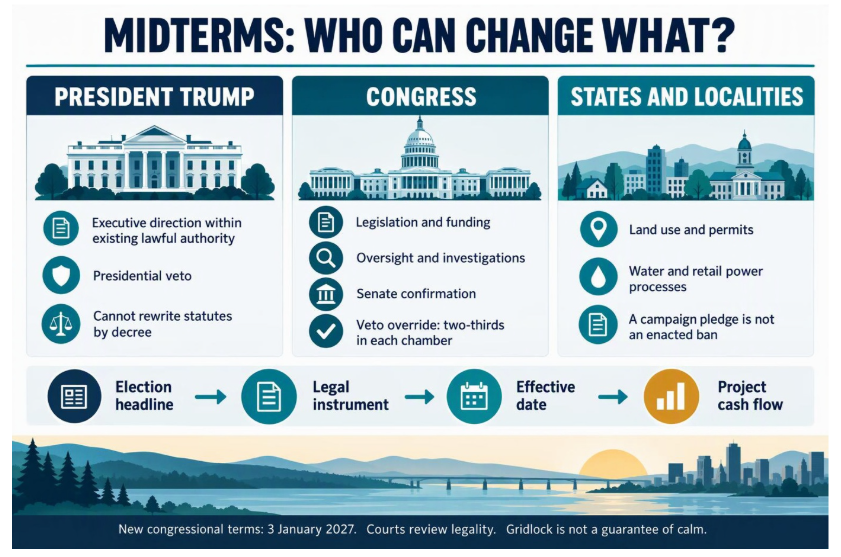
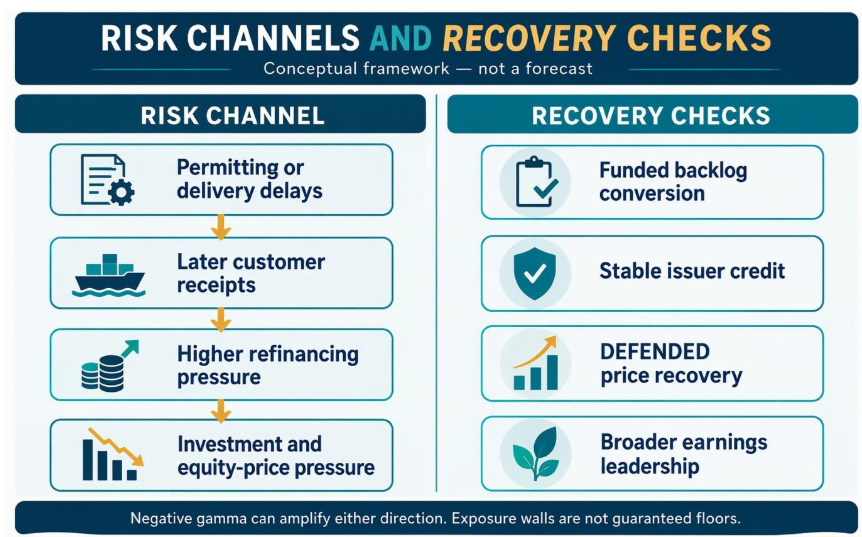
The midterm shock is about implementation, not cancellation. Democrats' gains sharpened concern over data-centre restrictions, and Texas governor-elect Gina Hinojosa called for protections before expansion proceeds. But new office-holders arrive in January, and a pledge, a permit and a law are different events. Delayed energisation still postpones orders and cash receipts while interest bills keep running. Gridlock is usually good, but 2027 may see some real Democrat-infused volatility. Maybe Republican states invite the data-centre build-outs instead.
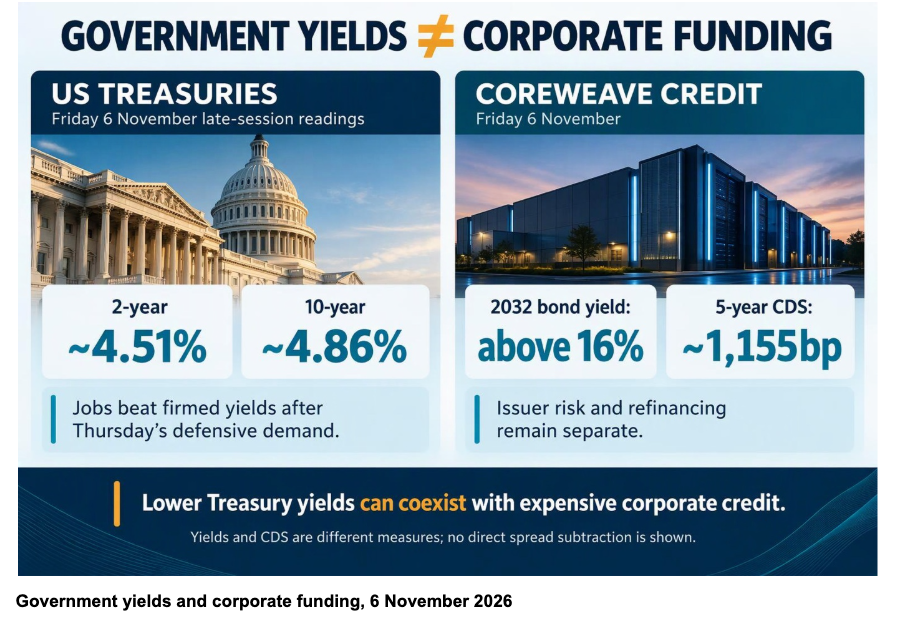
Treasuries offered shelter; AI debt offered a warning. Ten-year yields ended near 4.86% and two-year yields near 4.51%, firming on Friday's jobs beat. CoreWeave's five-year CDS sat around 1,155bp after spiking above 1,289bp on Thursday. Jim Reid warns that credit and equities are moving more in sync. Lower government yields do not reopen affordable corporate funding on their own.
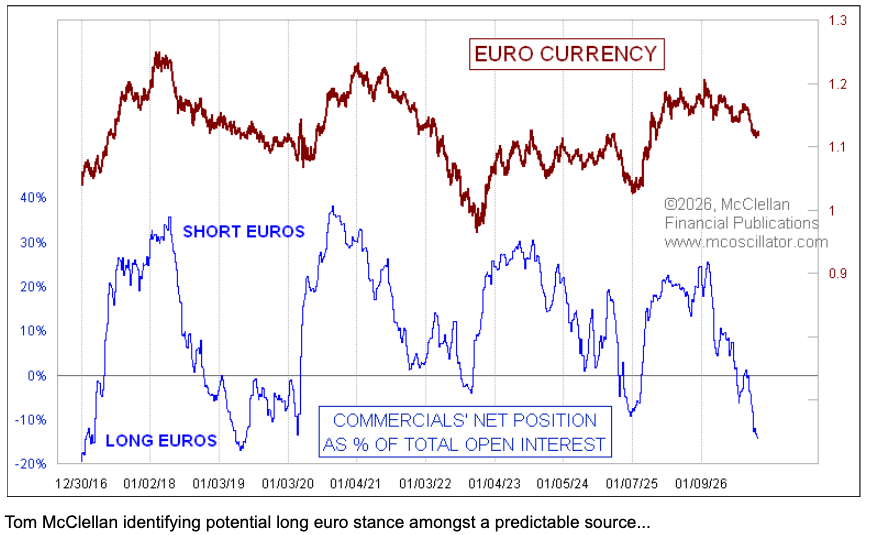
In FX, election relief weakened the dollar, and jobs brought it back, with DXY up 0.72% to 102.28 on Friday. Tom McClellan sees commercials shifting towards a long-euro stance, a predictable source, and suggests euro/yen may be the way to play it. Sterling now faces growth after the hike, with Thursday's UK GDP the test.
Technical & Sentiment Breakdown: Supportive, but Increasingly Fragile
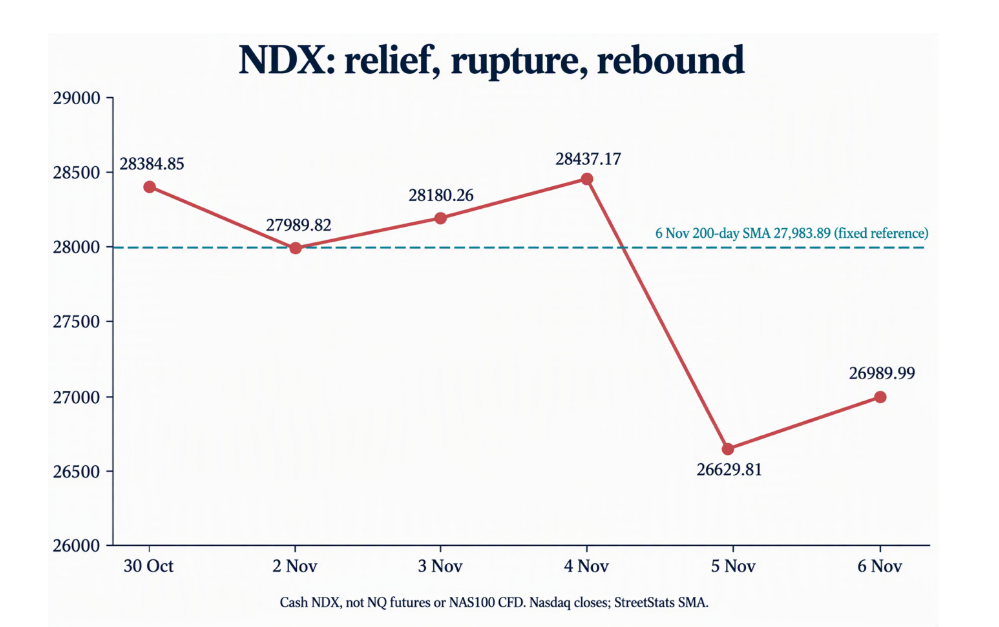
Nasdaq has broken its long-term trend; the S&P has not. Cash NDX closed at 26,989.99, 3.55% below its 27,983.89 200-day average and 13.94% below the 6 October record of 31,361.37. Thursday's 26,606.43 low survived Friday, and RSI recovered to 31.39 from 27. That is a possible reaction low inside a damaged trend, not yet a base.
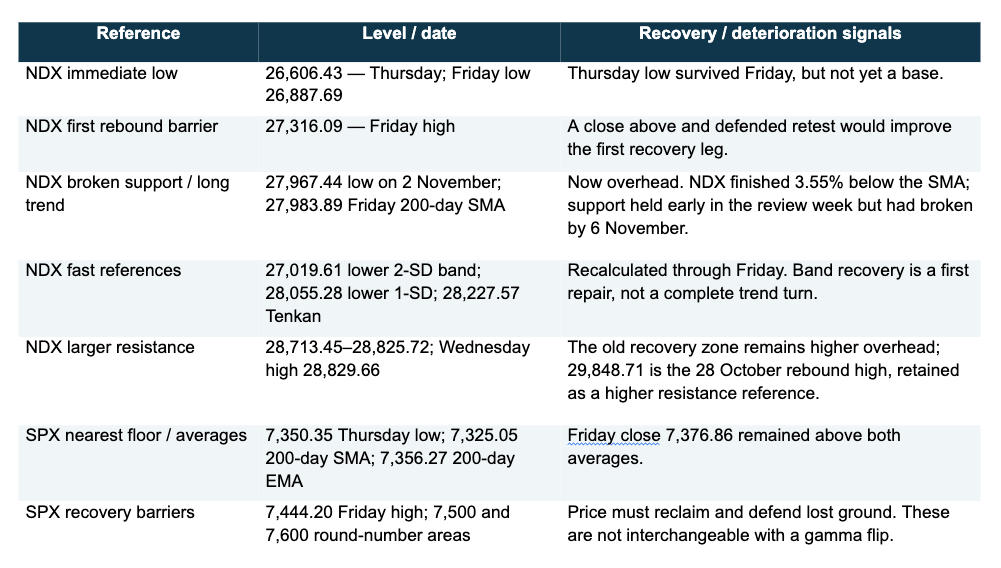
The first ground to recover is Friday's 27,316.09 high, then the broken floor and long trend at 27,967 to 27,984. The old recovery zone of 28,713 to 28,826 sits higher overhead. The S&P closed 0.71% above its 7,325.05 200-day SMA, with Thursday's 7,350.35 low as the nearest floor and 7,444.20, 7,500 and 7,600 as recovery barriers. Price must reclaim and defend lost ground.
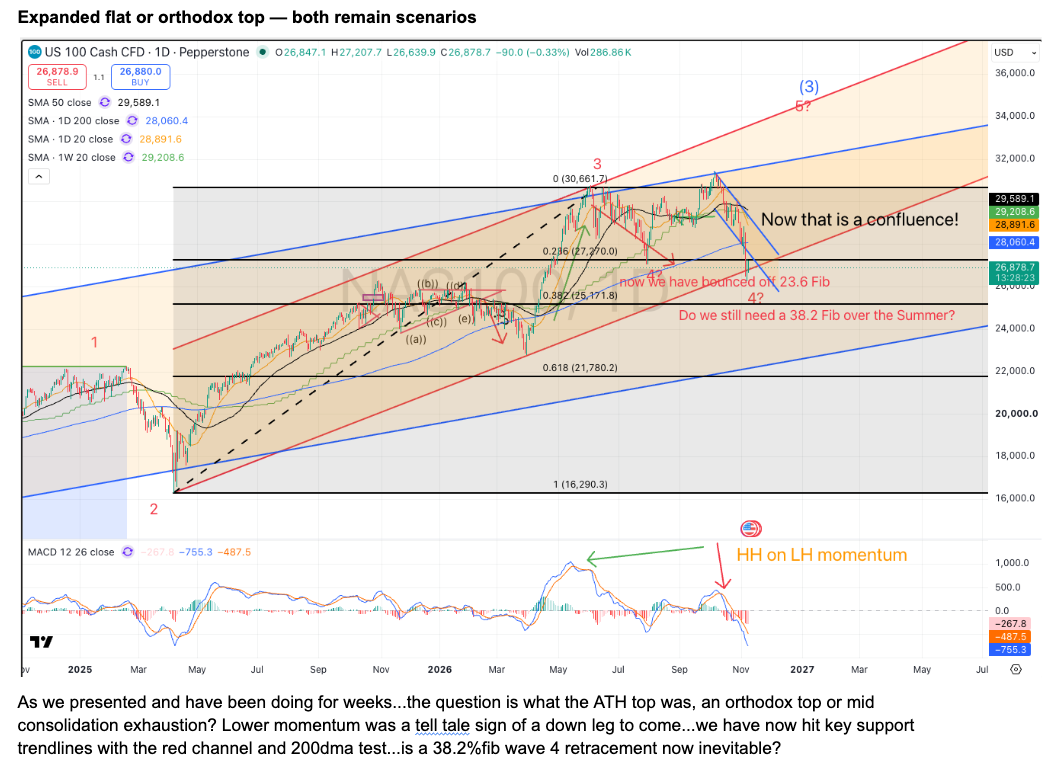
As we have been asking for weeks, was the all-time high an orthodox top or mid-consolidation exhaustion? Lower momentum was a telltale sign of a down leg, and price has now tested key channel support and the 200-day. The expanded-flat count treats the October high as a B-wave peak, with wave C now below the July low. The alternative is an orthodox top with bearish MACD divergence. Is a 38.2% Fibonacci wave-4 retracement now inevitable?
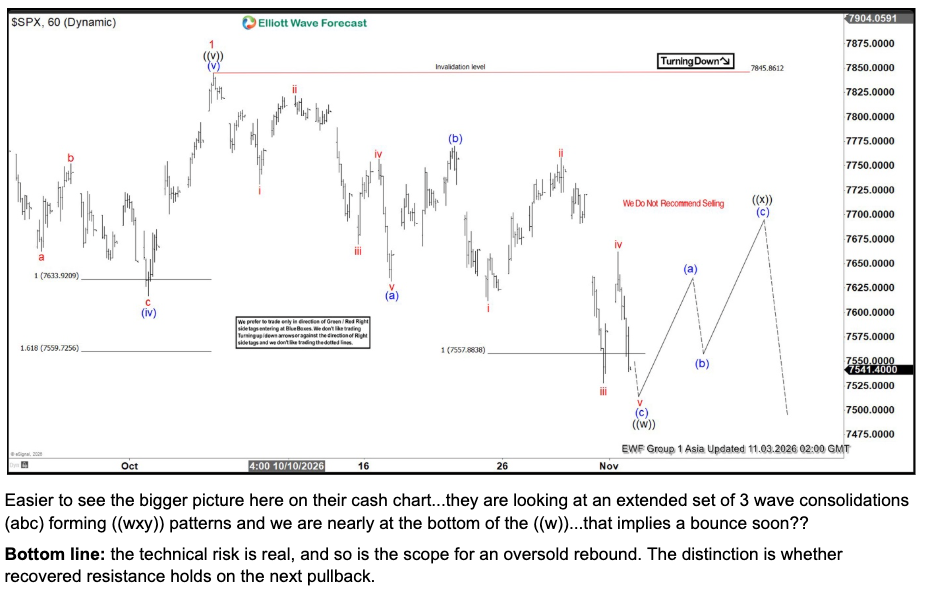
The wave analysts are split on timing. Elliott Wave Forecast's bearish ES scenario limits bounces until the March lows are retested. Their cash S&P chart shows extended three-wave consolidations forming a ((w))((x))((y)) pattern, with price nearly at the bottom of the ((w)). That implies a bounce soon.
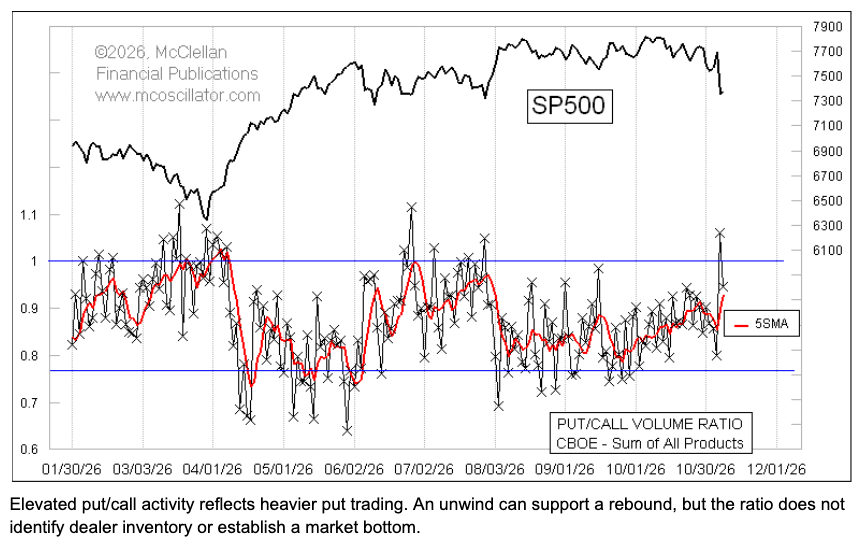
The consensus risk sits in correlation. Michael Kramer reports the 60-day correlation between cap-weighted and equal-weighted S&P indexes at a record low of 0.56, while implied correlation has climbed from 7.19 in July to around 19. Elevated put/call activity can support a rebound as it unwinds, but it does not mark a bottom. The danger is losing the non-AI diversification cushion.
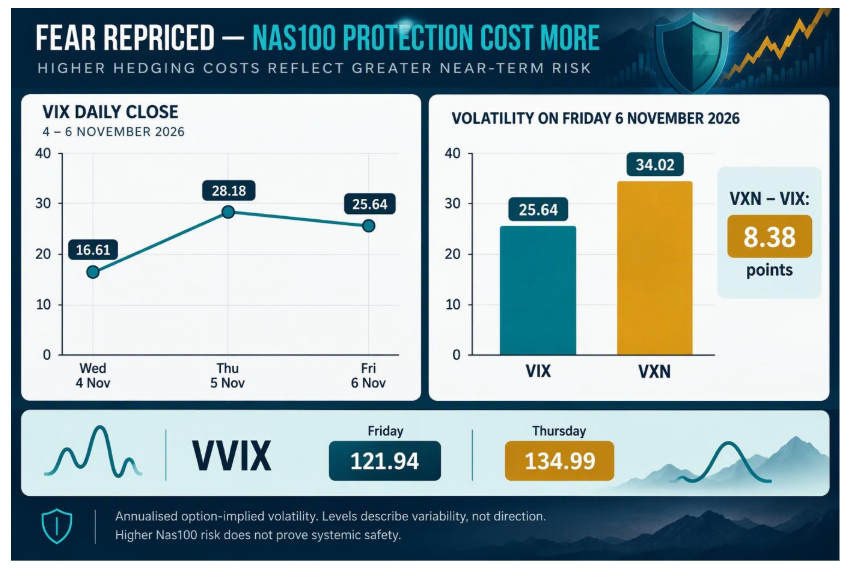
Volatility repriced dramatically. VIX jumped from 16.61 on Wednesday to 28.18 on Thursday before easing to 25.64, while VXN ended at 34.02. Dealer gamma is negative, with GammaFlip's net S&P figure at −$85.7 billion and flips near 7,602 for the S&P and 28,197 for NDX, well above price. In that regime, hedging can amplify a rebound as easily as another fall.
Last Week's Recap: Strong Jobs, Firm Policy and a Gold Repair That Outran Nasdaq
A week where hiring refused to slow, central banks refused to rescue, and earnings kept growing while the multiple stopped forgiving everything. Gold repaired its floor, oil lost its premium, and crypto failed to act as a haven.
Key Highlights
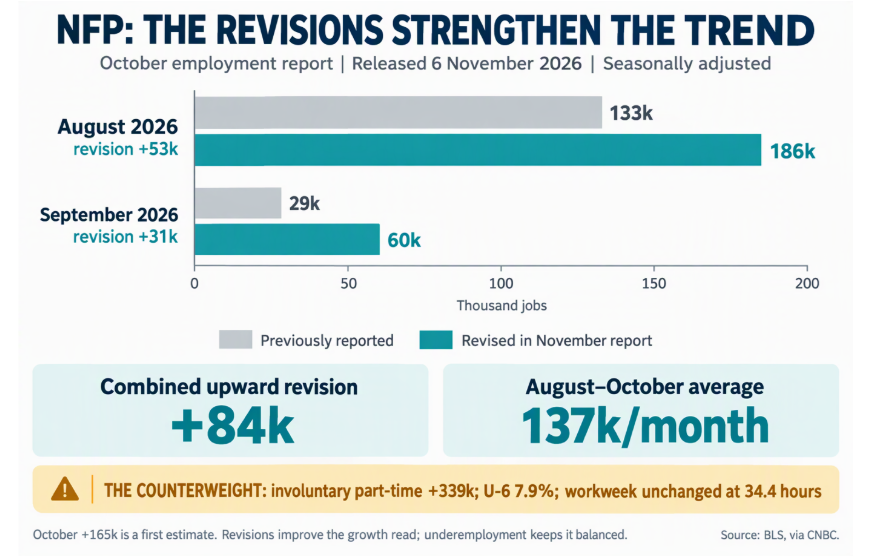
Macro: Payrolls denied the market a recession rescue. October jobs rose 165,000 against a 59,000 Dow Jones survey, with unemployment at 4.1% and hourly earnings up 0.4%. Upward revisions of 84,000 lifted the three-month average to 137,000, while professional services led October's gain with 70,000 jobs. The slack measures keep it balanced: involuntary part-time work rose 339,000, U-6 climbed to 7.9% and the workweek held at 34.4 hours.
China: China's demand profile remains its own. The official manufacturing PMI of 49.3 sits below the expansion line, an inherited backdrop rather than a new signal. Yet the Shanghai Composite was the week's standout, up 1.39% while the Nikkei lost 9.25%. Strong US hiring does not establish a recovery in China. Monday's CPI and PPI and Tuesday's trade data will separate domestic demand from export strength.
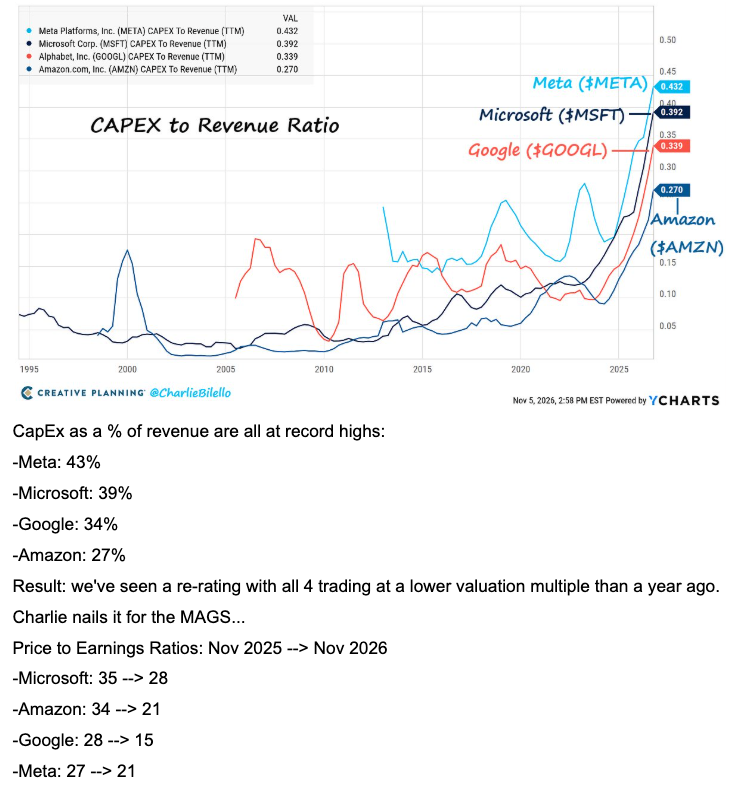
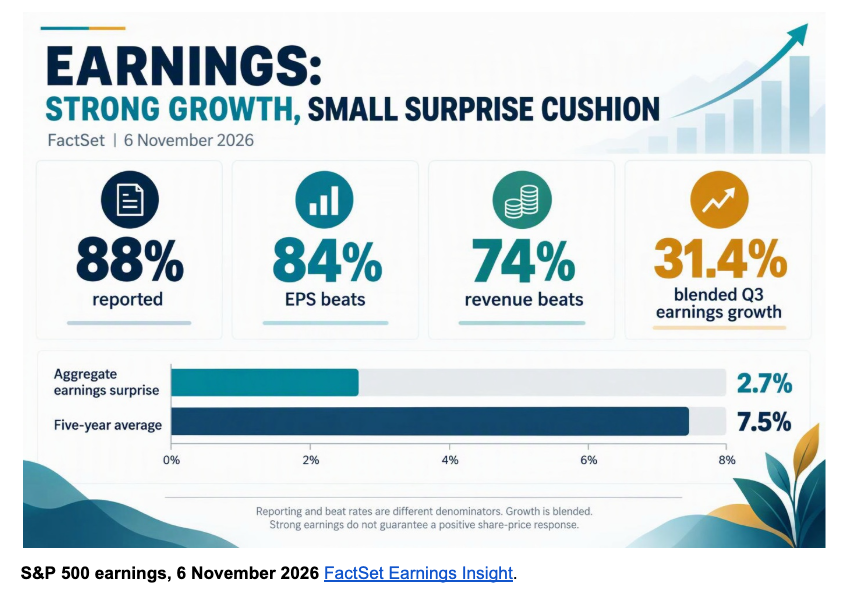
Earnings: Earnings grew; the multiple stopped forgiving everything. With 88% reported, 84% beat EPS and blended Q3 growth reached 31.4%, but the aggregate surprise was only 2.7% against a 7.5% five-year average. Capex sits at record highs, and Charlie nails it for the MAGS: Google's P/E has fallen from 28 to 15 in a year. Are we held until the market reassigns a higher rating to earnings, or a lower discount to capex?
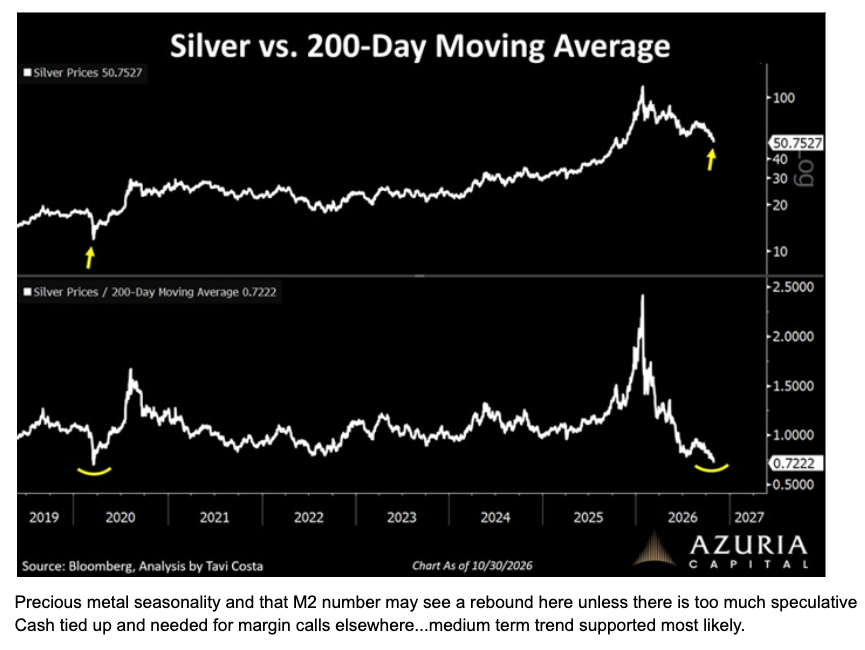
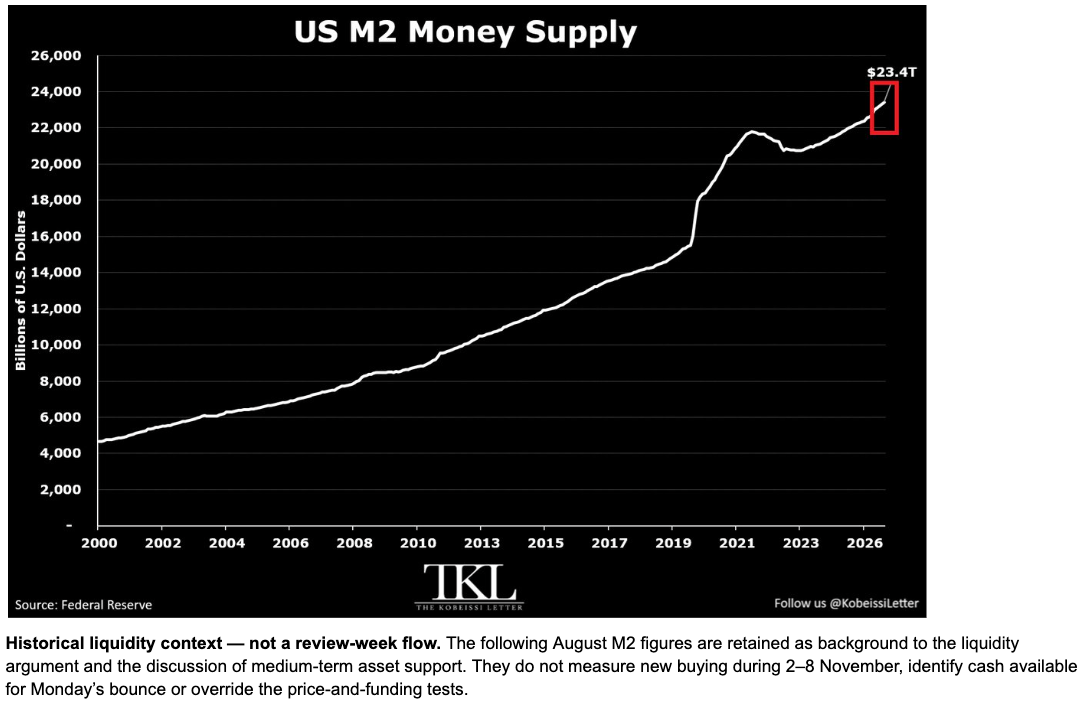
Commodities: Gold repaired broken ground. Spot recovered $4,000 to $4,022 during the week, and December futures held near $4,075 to $4,080 despite a session decline. Holding $4,000 strengthens the repair; losing it reopens the $3,870.17 low and the $3,867.86 equal-leg projection. Silver stood at $50.75 on 30 October, just 0.72 times its 200-day average. Seasonality and a record $23.41 trillion M2 may see a rebound here, unless speculative cash is needed for margin calls elsewhere.
Crypto: Crypto did not become a haven. Bitcoin's Friday late-session indication was around $75,927, below Wednesday's roughly $80,165. Binance's withdrawal restart eases the immediate disruption, but reserve composition and customer confidence remain separate risks. A sustainable recovery needs real spot demand, not just covering. Reopening is not a rewind.
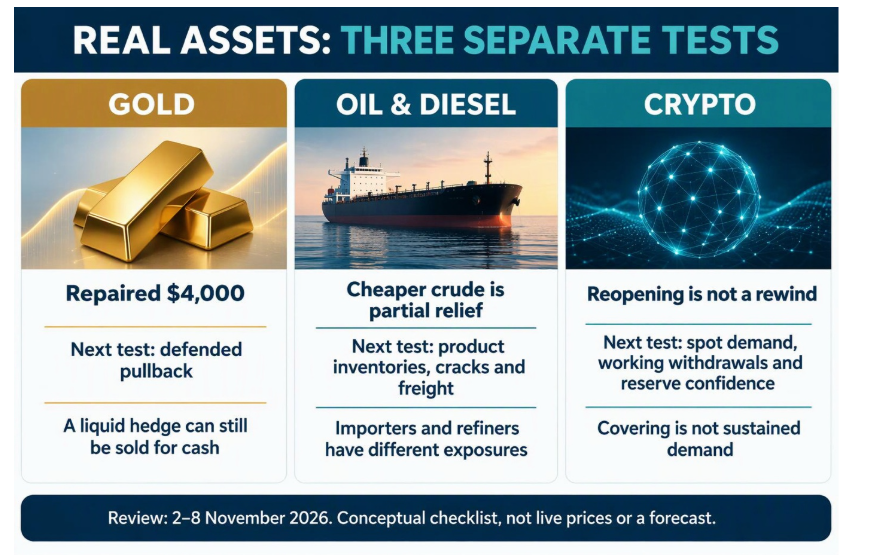
Oil: Oil lost its premium. WTI fell more than 12% to around $90.34, and January Brent settled at $94.62 on Wednesday against $113.43 on 30 October. Diesel remains the practical constraint, with New York Harbor ULSD cracks reaching $102.93 per barrel on 3 November and distillate stocks at 99.3 million barrels. Importers only benefit when relief reaches freight, insurance, and delivered fuel.
The Week Ahead: Key Data and Market-Moving Signals
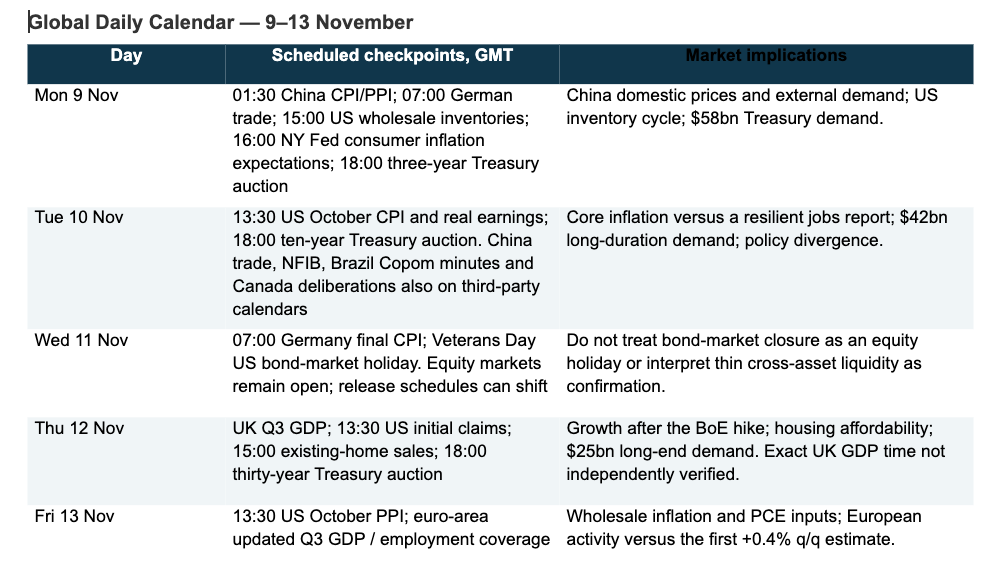
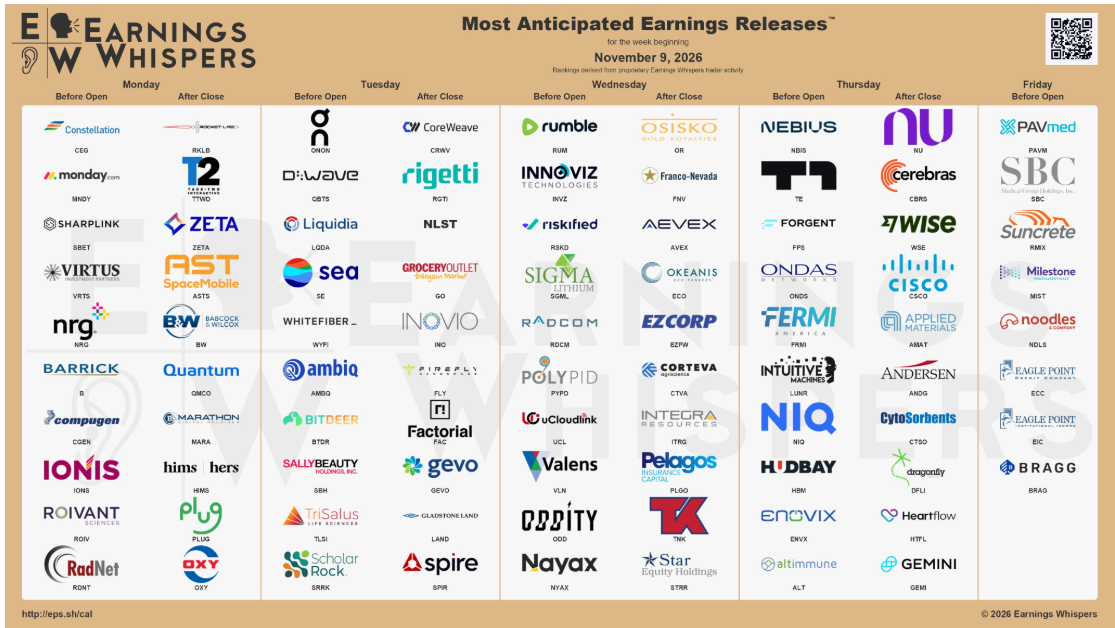
A week when the first bounce has to survive the retest. October CPI is the key rates hurdle, with forecasts of +0.3% headline and +0.2% core against Cleveland Fed nowcasts of +0.24% and +0.21%. Softer core inflation would help the rebound, while broader price pressure would strengthen the tightening case. CoreWeave, Cisco and Applied Materials then test whether the AI build-out translates into cash, where orders, energisation schedules and capex guidance matter more than the quarter's EPS. Treasury supply runs to $58bn, $42bn and $25bn, and Wednesday's Veterans Day closes the US bond market but not equities. Calendar times are GMT.
Monday, November 9
- China: CPI & PPI
- Germany: Trade Balance
- Eurozone: Eurogroup & Ecofin Meetings
- Global: COP31 & Web Summit Open
- US: Constellation Energy, KKR, monday.com & Barrick Earnings
- US: Wholesale Inventories
- US: Fed Goolsbee Speech
- US: NY Fed Consumer Inflation Expectations
- US: Fed Barkin Speech
- UK: BoE Bailey Speech, Zurich
- US: 3-Year Treasury Auction
- US: Take-Two, Skydance, Rocket Lab & Occidental Earnings
Tuesday, November 10
- Europe: Ukraine Negotiations in Abu Dhabi (10 to 11 November)
- China: Trade Balance
- UK: BoE Breeden & Cleland Panels
- US: NFIB Small Business Optimism
- US: Sea & On Holding Earnings
- UK: BoE Lombardelli Speech, Bank Watchers Conference
- US: CPI & Real Earnings (Oct)
- US: Fed Waller Keynote, Bank Watchers Conference
- US: Fed Logan & Paulson Speeches
- Eurozone: ECB Lane Keynote, Bank Watchers Conference
- US: 10-Year Treasury Auction
- US: Fed Schmid Speech
- UK: BoE Pill Speech
- Brazil: Copom Minutes
- Canada: Policy Deliberations
- US: CoreWeave Earnings
Wednesday, November 11
- Germany: Final CPI
- Sweden: Riksbank Rate Rise Takes Effect
- US: Veterans Day (Bond Market Closed, Equities Open)
- UK: BoE Hall Speech
- Global: Honda & CGI Earnings
- US: Corteva & Franco-Nevada Earnings
Thursday, November 12
- UK: Q3 GDP
- Japan: BoJ Asada Speech
- Sweden: Riksbank Thedéen, Bunge & Seim Appearances
- Europe: European Political Community Meeting
- US: Nebius & Brookfield Earnings
- US: Initial Jobless Claims
- US: Fed Hammack Speech
- US: Existing Home Sales
- US: Fed Goolsbee Speech
- US: 30-Year Treasury Auction
- US: Fed Daly & Williams Speeches
- US: Cisco, Applied Materials & Cerebras Earnings
Friday, November 13
- Europe: Informal EU Leaders' Meeting
- Eurozone: Updated Q3 GDP & Employment
- US: PPI (Oct)
- US: Fed Daly Speech
- Brazil: Cosan Earnings
Alpha Takeaway: The Bounce Has Fuel, but It Still Has to Earn Trust
This looks like tactical relief inside a damaged trend, not yet an established bottom. There is enough covering and buyback capacity to fuel a bounce, but enough negative gamma and fragile credit to make another fall sharper.
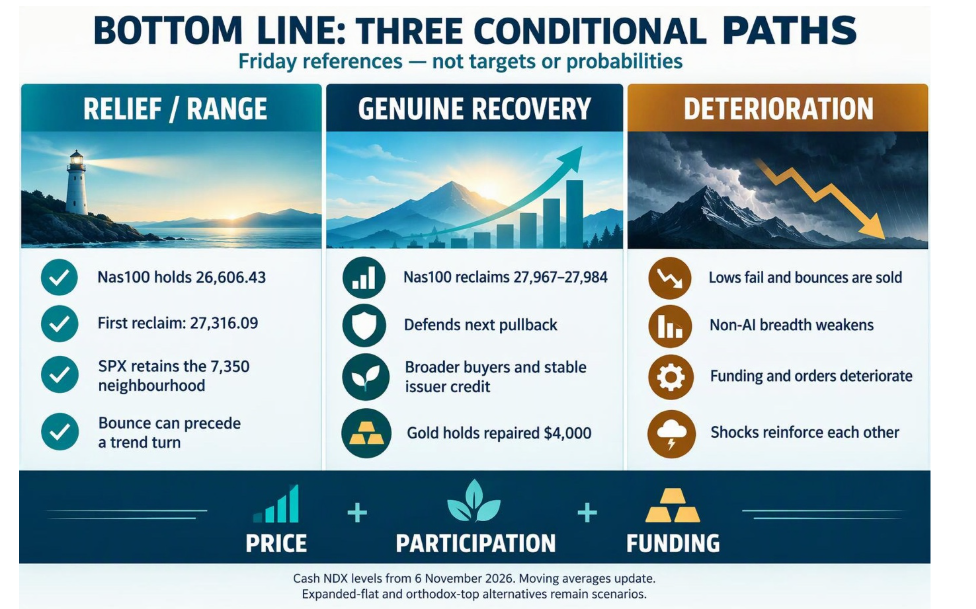
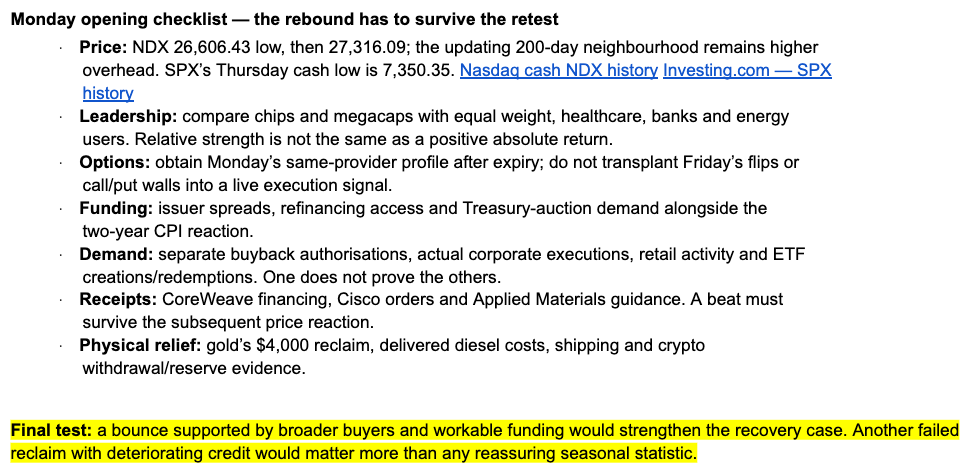
Equities: Thursday's 26,606.43 low and Friday's 27,316.09 high frame the first test for Nasdaq. Reclaiming the 27,967 to 27,984 broken floor and then defending a pullback would show real repair. The S&P needs to keep the 7,350 area and its 200-day averages. Nvidia's headline is Monday's first test, then CoreWeave, Cisco and Applied Materials.
Gold & Silver: Gold needs to defend its repaired $4,000 area on the next pullback. Holding it would confirm the repair, while losing it reopens $3,870.17 and $3,867.86. Silver at 0.72 times its 200-day leaves room for a rebound if margin calls do not force more selling.
Crypto: Treat Bitcoin's slide from around $80,165 to $75,927 as a trust problem, not just a price one. Working withdrawals, reserve confidence, and genuine spot demand are the tests. Covering alone is not sustained demand.
Macro: The benign outcome is softer core CPI alongside resilient activity. The less comfortable one is strong jobs with sticky prices, which keeps tightening in play. Watch the two-year reaction to CPI, auction demand and issuer spreads separately, and remember that cheaper crude only matters once it reaches delivered diesel.
A sharp rally can still be corrective until NDX reclaims and defends its broken long-trend neighbourhood. The bottom line: a held rebound, broader participation and steadier credit would argue for repair, while failed reclaims, fresh lows and weaker credit would argue the other way. Trust a defended recovery more than an oversold label, and cash flow more than a story about who must buy next. Stay cautious on the damaged trend, but open to selective recovery when price, breadth and funding agree, and let the retest prove itself.
Charts and figures are from the 9 November 2026 weekly pack. This is a recap of that tape. It is not a personal recommendation, and nothing in it is guaranteed.