



TL;DR: A fair value gap is a three-candle imbalance. Price jumps, leaves a zone, and you may wait for a return. On our Alpha Capital evaluations that zone is not a strategy by itself. You still need direction, a trigger, a stop that matches structure, and a size that fits remaining daily-loss and max-loss room on simulated funds. If the honest stop is too wide, you pass. We do not score your boxes. We score whether you stay inside published rules.
Short definition (keep this page separate): What is a Fair Value Gap (FVG)?
This is general education, not a signal, not personal financial advice. Our evaluations and Qualified Accounts run in a simulated trading environment. Simulated results do not reflect real trading outcomes. Performance fees are performance-based. Nothing is guaranteed.
We do not require ICT, SMC, or FVGs. You can pass with support and resistance, a news filter, and a boring 1% risk rule. This guide is for people who already draw the boxes and keep turning a 12-pip idea into a 30-pip loss.
Also useful: What is a trading evaluation? · What are simulated funds?
What we mean by a fair value gap
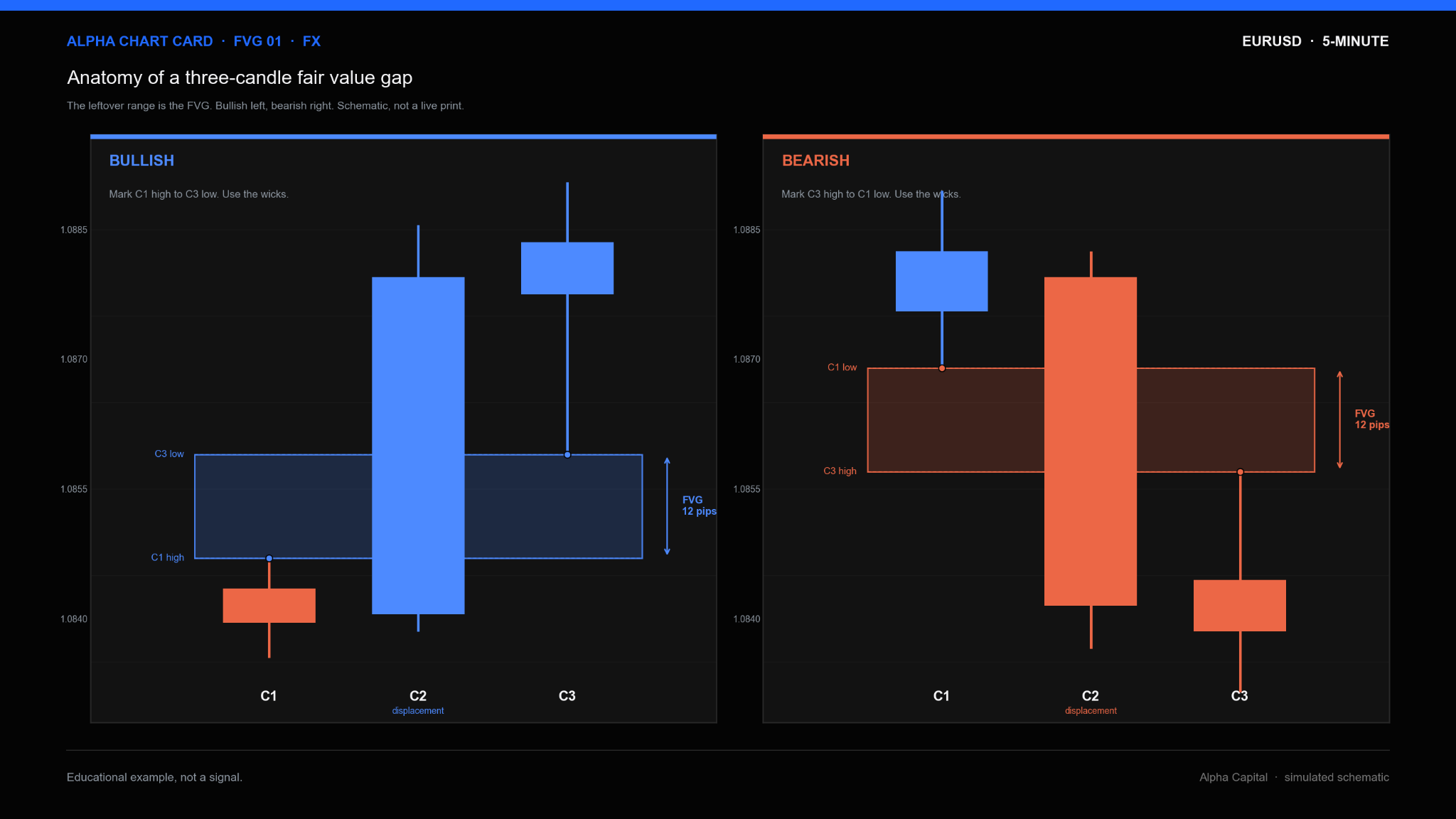
Three candles:
- Candle one sets a side of the zone
- Candle two is the shove
- Candle three fails to overlap part of candle one
- The leftover range is the FVG
Bullish: candle one high below candle three low. Draw from candle one high to candle three low.
Bearish: candle one low above candle three high. Draw from candle three high to candle one low.
Use wicks. The gap is the non-overlap, not a blank print between two bars sitting next to each other. The middle candle can have traded those prices.
On FX, spread is part of the object. A 3-pip FVG on GBPUSD at London open is not the same trade as a 3-pip FVG on a quiet pair at 2am. Write a minimum pip size before you start saving screenshots.
Labels you will hear
- Displacement: the shove candle
- Mitigation / fill: price traded back into some or all of the zone
- Unmitigated: it has not come back
- 50% / CE: midpoint of the box
- Inverse FVG: failed box, then traded from the other side, only if failure was defined first
We are not married to the jargon. We are married to you not changing the definition after you are red.
What the box cannot do for you
It cannot tell you who traded. It cannot promise a fill. It cannot shrink our daily loss limit.
It can give you an objective area to watch so you are not guessing in the middle of a candle.
If you want extra context, some of our traders pair FVGs with break of structure or a liquidity sweep. That is optional. Stacking five labels on one candle so any outcome can be called a win is not confluence. That is a story.
How to mark it so two people get the same box
Bullish
- Find a three-candle run with a real push up in the middle
- Check candle one high vs candle three low
- If they do not overlap, draw the zone
- Note the midpoint if your plan uses it
Bearish: same steps, inverted.
Borderline: decide in writing:
- minimum pips
- does the middle candle have to close through a level, or is a wick enough?
- London only, NY overlap only, or any session?
- can the next candle immediately eat the zone and still count?
If a 2-pip gap is an FVG on the winners and "not clean enough" on the losers, stop. You are not testing.
The plan we want on paper before price comes back
Context
One sentence that can die.
Example: "Longs only if H1 is making higher highs, and the FVG printed after London took the Asia high and reversed."
Not: "Looks bullish."
Ask:
- what session is this?
- with H1 or against it?
- is NFP / CPI / FOMC inside the next hour?
We would rather you sit out news displacement than treat it like a textbook FVG. Spreads widen. Stops that looked fine on the replay do not fill the same.
Qualify the zone
Before you wait:
- middle candle is obviously larger than recent bars
- it formed after a level you already had on the chart
- it agrees with your higher-timeframe bias
- it is in the session you trade
- it is not already fully filled
- there is a target that does not require the pair to trend for three days
One entry model
Model | Trigger | The catch |
|---|---|---|
First touch | Limit at the near edge | You are in with no proof it is holding |
Midpoint | Limit near 50% | You may never fill |
Confirmation | M5 or M15 rejection / reclaim in the zone | Later, often a wider stop |
Pick one for a sample of trades. Do not switch mid-trade because you are scared of missing GBP.
Invalidation
Examples we see work as rules (not as promises):
- M15 close through the far side of the FVG
- break of the swing that created the idea
- no bounce after N bars
Your stop can sit a few pips beyond that for spread. It cannot sit "wherever I still feel okay."
Size from the stop, on our rules
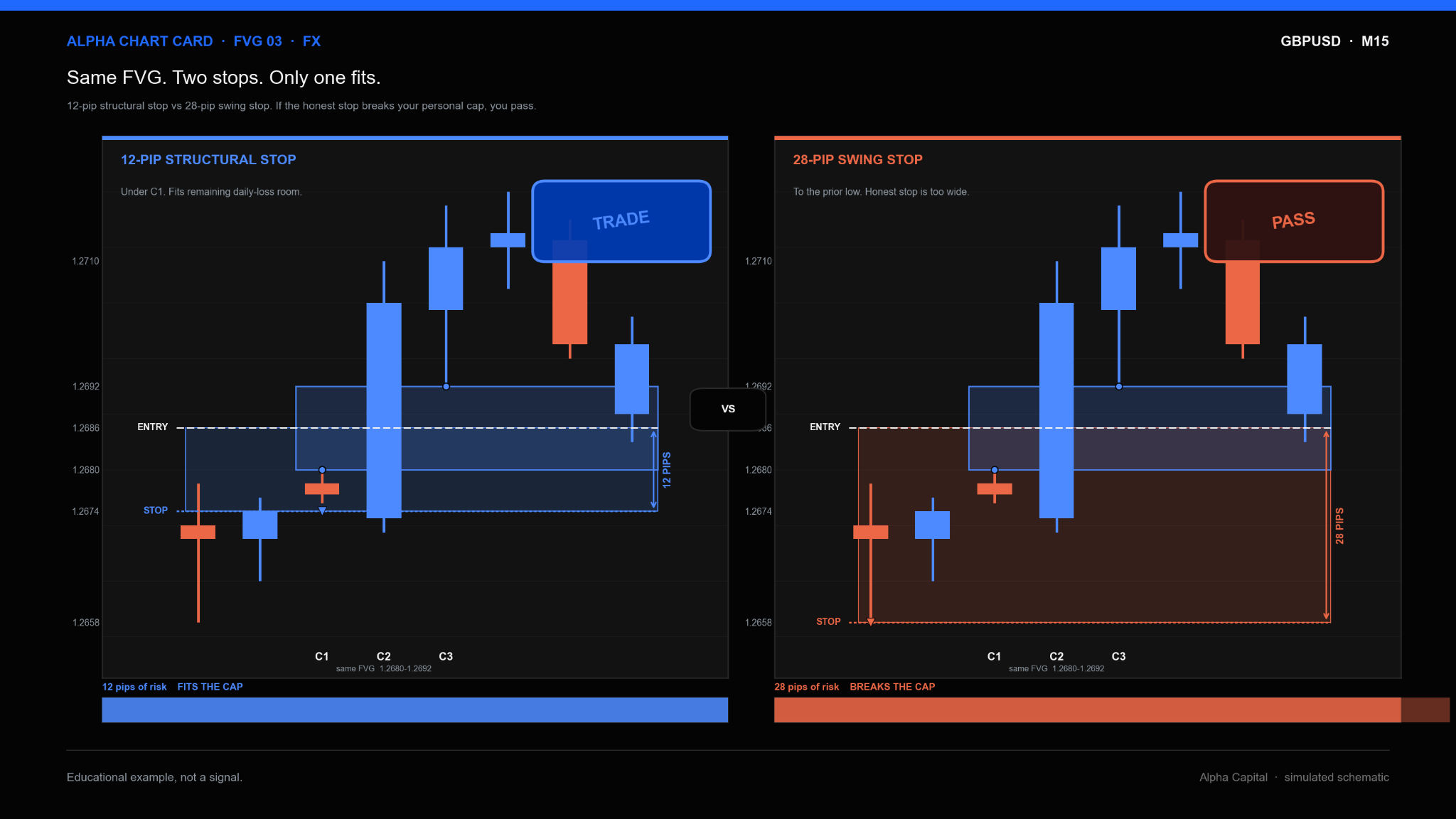
Pip distance × pip value × lots has to fit a personal cap that is tighter than the daily loss on your programme.
If one mini lot already eats that cap, you pass. You do not drag the stop to 8 pips so a standard lot "fits." That is a different trade.
We publish programme rules on the site and help centre. They change. This article is not your rule sheet. Check the live figures for your evaluation before you size.
Read: What is a trading evaluation?
Target before entry
Prior swing, session high/low, opposing FVG. Then look at the math. A 24-pip stop to a 10-pip target is allowed by the universe. It is usually a bad use of an evaluation day.
GBPUSD example, then the pass
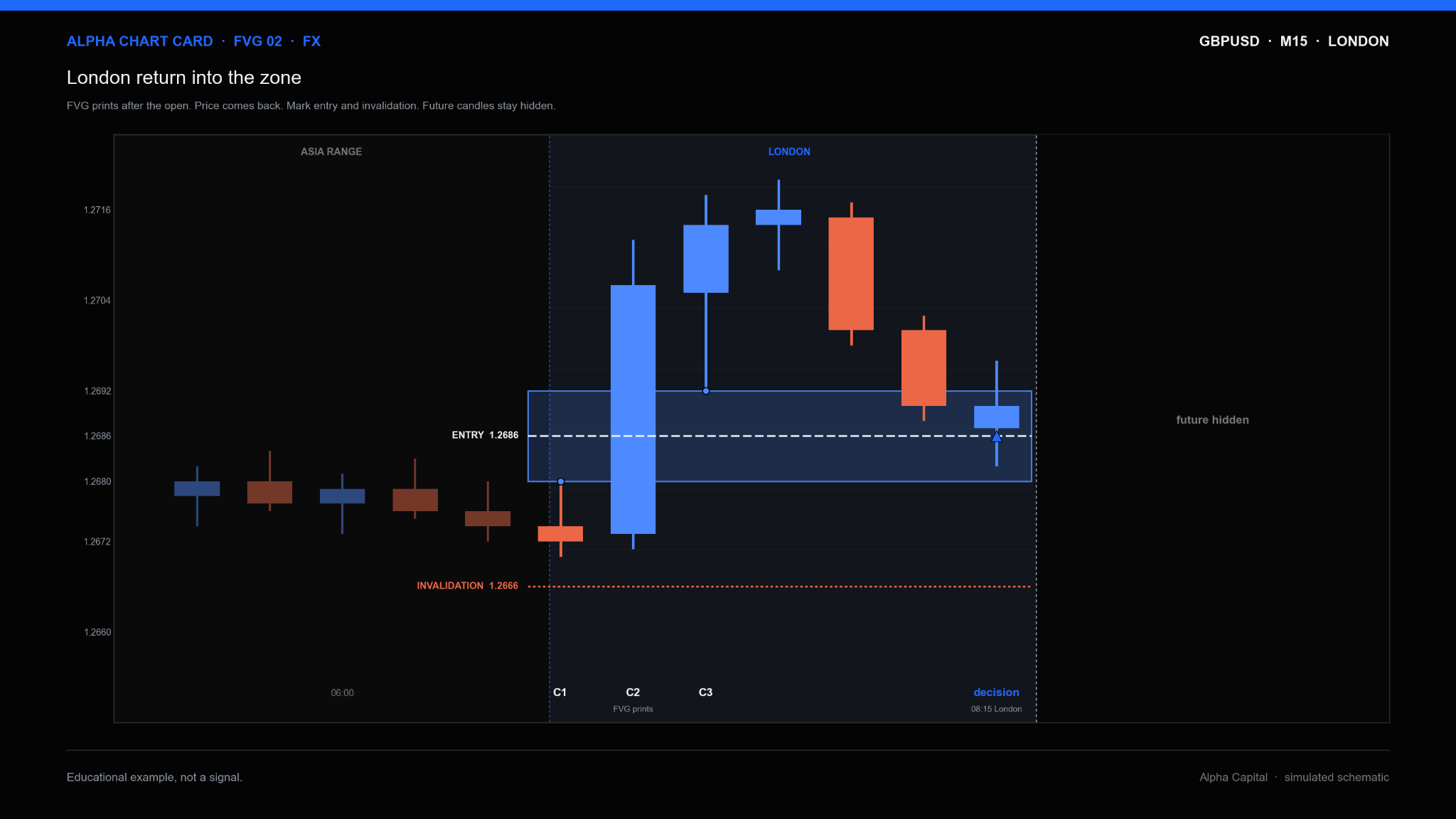
Illustrative prices. Not a live level.
London open. GBPUSD displaces higher on M15. Bullish FVG 1.2680 to 1.2692 (12 pips). Midpoint 1.2686.
Plan:
- H1 bias up
- enter on M15 close back above midpoint
- stop below the swing low at 1.2662 (about 24 pips from that entry, not 12)
- target prior day high
The box looked like 12 pips of risk. The thesis dies 24 pips away. At the lot size they wanted, 24 pips is over their personal cap.
Pass.
The bounce can still print. Our evaluation does not give extra credit for catching magnets. It fails you for going through daily loss or max loss on simulated funds.
Does this fit an Alpha Capital evaluation?
Before you click:
- What does the account show if this stop fills, with spread and commission?
- Is this your first idea of the day or your third attempt at the same London FVG?
- Are you already in EURUSD the same direction (correlated, one idea)?
- Is a red-folder event inside your hold time?
- How many times can this zone be traded? Write "once" if you cannot decide.
Set a personal daily stop inside whatever we publish. Still being able to think at noon is the point.
We do not have a secret "official FVG." We have rules. Your method has to live inside them.
Timeframes for FX
A pairing a lot of our traders actually use:
- H1 or H4: direction and which gaps matter
- M15: mark the FVG
- M5: trigger, only if the plan says so
M1 will give you a new FVG every other candle during London. That is not an edge. That is a slot machine with extra drawings.
Do not drop to M1 after you are in so you can find a new reason to hold. Manage on the timeframe you named.
Session notes (this is FX, not NQ)
- Asia: lots of small gaps inside a range. Fine if your tested plan is Asia. Most evaluation blow-ups we hear about are people trading Asia noise with a London playbook.
- London: where a lot of the usable displacement lives for EUR, GBP, XAU.
- NY overlap: faster, wider spreads into US data. Your news rule matters more here than your FVG indicator.
Write the window in one timezone. Do not convert in your head under pressure.
Similar concepts
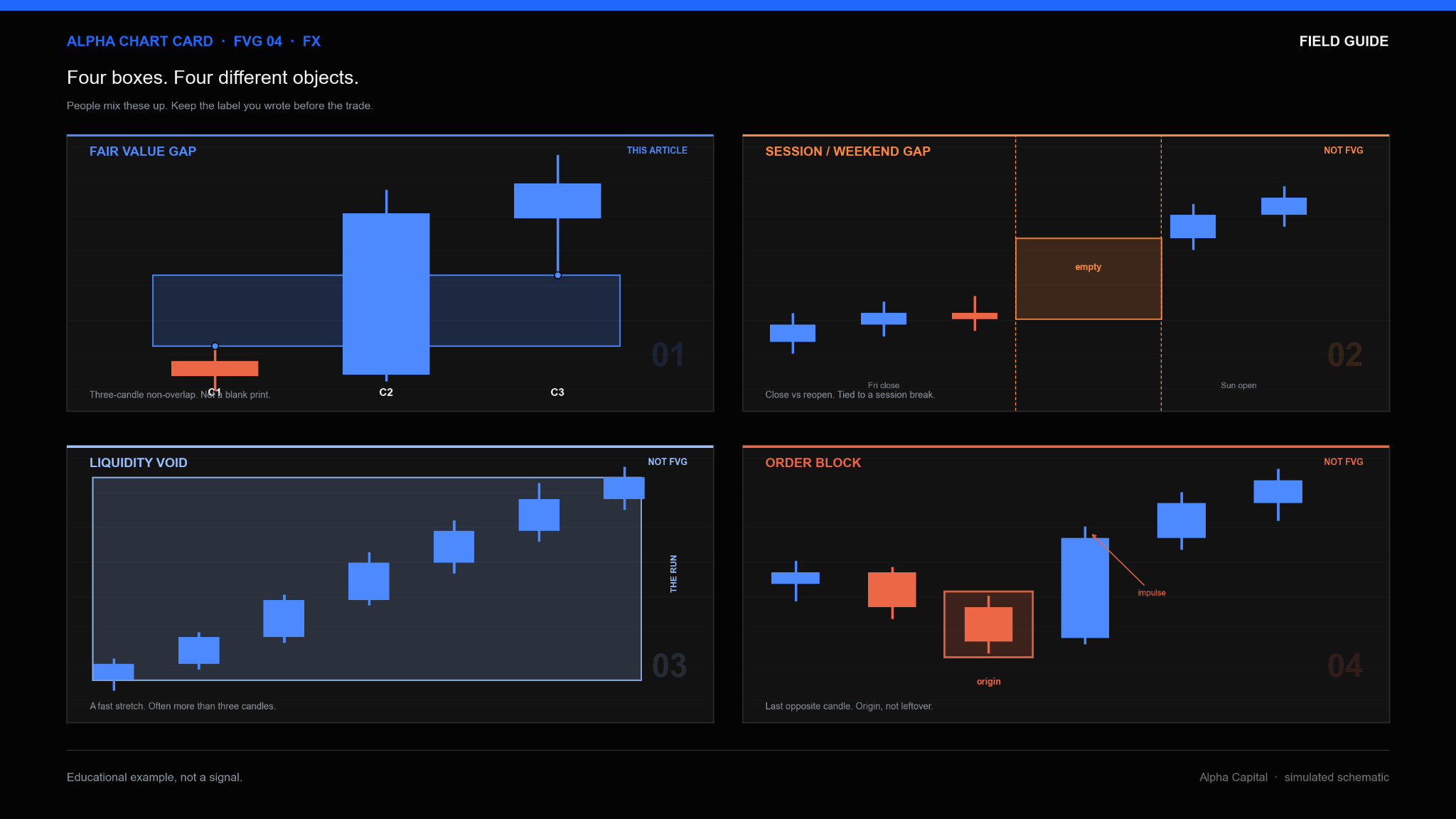
Label | Meaning | Do not confuse with |
|---|---|---|
Three-candle non-overlap | A weekend gap | |
Session gap | One session's close vs the next open | An intraday FVG |
Liquidity void | Fast stretch, often more than three candles | One FVG box |
Order block | Last opposite candle or base before the shove | The imbalance the shove left |
Backtest without a highlight reel
Lock before you screenshot:
- one pair (not five)
- session and timezone
- H1 context / M15 execution (or whatever you will really use)
- min pip size
- entry model
- stop and target
- news: trade / wait / flat
- one attempt per zone unless you define a re-entry
Record skips. If you only keep the FVGs that filled and ran, you are decorating a folder.
Then ask: does this rule set work on this pair, in this session, after spread, while staying inside our evaluation math? "Do FVGs work?" is a YouTube title, not a test.
Mistakes that show up in our inbox as "the strategy stopped working"
Every FVG on M1
You will be in ten trades before London lunch. That is not how most people keep daily loss intact.
"It has to fill"
It does not.
Buying the shove candle
You are late, far from the stop, and the target is already behind you.
Ignoring spread on a tiny zone
A 4-pip FVG with a 1.5-pip spread is not a 4-pip FVG.
Trading NFP displacement like a normal FVG
If your plan does not include news, sit out. We would rather you miss it.
Changing the story after entry
New timeframe, new label, new "actually this is an inverse." That is a new strategy, launched at the worst time.
Re-trying a dead zone
Define mitigated. If it is mitigated, it is done unless your rules say otherwise.
FAQ
Does a fair value gap always fill?
No.
Best timeframe?
The one you tested with a stop you can afford on your programme. There is no universal best.
Do we require FVGs at Alpha Capital?
No. We require that you follow published rules on simulated funds. Strategy is yours.
Can I use this on a Qualified Account the same way?
Same idea, same honesty on size. Qualified Accounts still have loss limits and performance-fee rules. Check the live terms for the programme you are on.
Should I delete the glossary and only rank this page?
No. The glossary targets "what is." This page targets "how to trade." Keep What is a Fair Value Gap (FVG)? live and linked. That is the SEO version of not eating your own homework.
What to do next
Read the FVG glossary if the three-candle bit is still fuzzy.
Then pick one pair, one session, one entry model. Journal every qualifying FVG for a block of trades, including the ones you pass on. Do that in simulation before you put it on a paid evaluation with us.
→ Start an Alpha Capital evaluation · What is a trading evaluation?
Related reading
- What is a Fair Value Gap (FVG)?
- What is a Trading Evaluation?
- What are Simulated Funds?
- What is a Break of Structure (BOS)?
- What is a Liquidity Sweep?
- What is a Performance Fee?
- What is a Qualified Trader?
General information only, not personal financial advice. Simulated trading results do not reflect real trading outcomes. Confirm live programme rules before you trade.


