How Does a Prop Firm Work?
Most retail prop firms in 2026 follow the same three-stage model: evaluation, funded account, and performance fees. Alpha Capital Group uses evaluation and performance fee language; the industry often says challenge, funded account, and payout.
Stage 1 - The Evaluation Challenge

Before you can access a funded account, you need to prove you can trade profitably while following a defined set of risk rules. This is called an evaluation, challenge, or assessment.
Here is how it works:
- You pay a one-time fee (typically between $50 and $500 depending on account size)
- The firm gives you a simulated account, usually between $5,000 and $200,000
- Your job is to hit a profit target (commonly 6% to 10% of the account) without breaking any rules
- If you pass, you move to a funded account
Evaluations come in different formats. Some firms use a one-step challenge, hit the target and you are funded. Others use a two-step process where you complete a challenge phase and then a verification phase with a lower profit target.
Stage 2 - The Funded Account

Once you pass the evaluation, you receive a funded account. You trade the simulated account under a set of ongoing rules, drawdown limits, position size limits, and sometimes consistency requirements.
Most modern prop firms use simulated accounts that mirror real market conditions. Your trading takes place on a simulated account. If you qualify and meet the firm's conditions, the firm pays you a performance fee calculated from your eligible simulated profit; nothing is guaranteed.
Stage 3 - Performance Fees

When your funded account shows eligible simulated profit and you meet the firm's conditions, you submit a performance fee request. The performance split, usually 70% to 90% across the industry, sets the size of the fee, which firms pay by bank transfer, PayPal, cryptocurrency, or payment platforms like Deel or Rise.
Most firms process performance fee requests within one to five business days.
Do you trade real money at a prop firm?
At most retail prop firms, including Alpha Capital, no. You trade simulated funds: a demo balance that uses live market prices, while your orders are not sent to a real market. The money that is real is your evaluation fee, and the performance fee the firm pays you if you qualify. Alpha Capital's Terms (clause 8.1) say that "any trading that you perform as part of the Services is not real but simulated".
This is why "you trade the firm's capital" is misleading for most retail evaluation programmes. The table shows how the three models differ.
Retail prop firm (evaluation model) | Broker account | Traditional "live capital" prop desk | |
|---|---|---|---|
Whose money is in the account | Nobody's: a simulated balance | Yours | The firm's real capital |
What you can lose | The evaluation fee (plus any add-ons or resets) | Your deposit, and on some products more | Usually your share of losses, or your seat, under your contract |
How you get paid | Performance fee on eligible simulated profit | Your own trading profit | Salary and/or profit share |
How you get in | Buy an evaluation | Open an account | Selection, interview or a track record |
Alpha Group example | Alpha Capital evaluations and Qualified Accounts | ACG Markets, a separate company | — |
More detail: What are simulated funds? and Prop firm vs broker.
What Rules Do Prop Firms Have?
Every prop firm has a ruleset that applies during both the evaluation and the funded phase. Breaking any rule, even accidentally, typically results in account termination.
The most common rules are:
Maximum Drawdown
The total amount your account balance can fall before it is terminated. Usually set at 8% to 12% of the starting balance. For example, on a $100,000 simulated account with a 10% max drawdown, you cannot lose more than $10,000 in total.
Daily Loss Limit
The maximum you can lose in a single trading day. Usually 4% to 5% of the account. Hit this limit and trading stops for the day or the account is closed.
Profit Target
The minimum profit you need to reach during the evaluation to pass. Typically 6% to 10% of the account balance.
Minimum Trading Days
Most firms require you to trade on a minimum number of different days before completing an evaluation or requesting a performance fee. Usually between four and ten days.
Consistency Rule
Some firms require that no single trading day accounts for more than a set percentage (often 30% to 50%) of your total profits. This prevents traders from passing by getting lucky on one big trade.
Who Are Prop Firms For?

Prop firms are built for traders who can trade within tight risk rules but do not want to put a large amount of their own money at risk. Illustration only, not a typical result: if a $100,000 simulated account shows $10,000 of eligible simulated profit and the performance split is 80%, the performance fee would be $8,000.
The typical prop firm trader is:
- Someone with trading experience who wants to trade a larger simulated account
- A retail trader who wants to earn performance fees if they trade within the rules
- A new trader willing to learn the rules and prove themselves through a structured evaluation
You do not need to be an expert. Most evaluations reward consistent, disciplined risk management over aggressive profit-chasing.
How Much Does a Prop Firm Challenge Cost?

Challenge fees vary depending on the firm and the account size you choose. As of 2026:
- Small simulated accounts ($5,000 to $25,000): roughly $50 to $150
- Mid-size simulated accounts ($50,000 to $100,000): roughly $250 to $500
- Large simulated accounts ($150,000 to $200,000): roughly $500 to $1,000
The fee is what you risk. If you fail the evaluation, you lose the fee, not the full account size. Most firms also allow you to reset or retry for a reduced fee. For Alpha Capital pricing tables and industry ranges, read our prop firm evaluation cost guide (2026).
How Do You Choose the Right Prop Firm?
Not all prop firms are equal. Here is what to look for:
Performance split: Look for firms offering 80% or higher. Anything below 70% is not competitive in 2026.
Drawdown rules: Understand whether drawdown is calculated from your starting balance or your peak balance. Trailing drawdown from peak is much stricter.
Performance fee history: Read several independent review sources and trading communities to check the firm pays performance fees consistently and on time.
Platform options: Make sure the firm supports the trading platform you use (MT5, cTrader, DXTrade, TradeLocker, etc.).
Challenge structure: One-step challenges are faster but sometimes come with stricter funded rules. Two-step challenges are more thorough but give you more room to trade naturally.
Customer support: If something goes wrong with your account, you need to be able to reach someone quickly.
Alpha Capital Group - A Prop Firm Built for Traders
Alpha Capital Group offers multiple evaluation formats to suit different trading styles:
- Alpha One: A straightforward one-step evaluation starting from $50
- Alpha Pro: A two-step evaluation with an 8% profit target in Phase 1 and 5% in Phase 2
- Alpha Swing: Designed for swing traders who hold positions longer
- Alpha Direct: Instant-qualified path with no evaluation phase. Alpha Three was a gradual three-phase evaluation; it is not currently offered for new purchases.
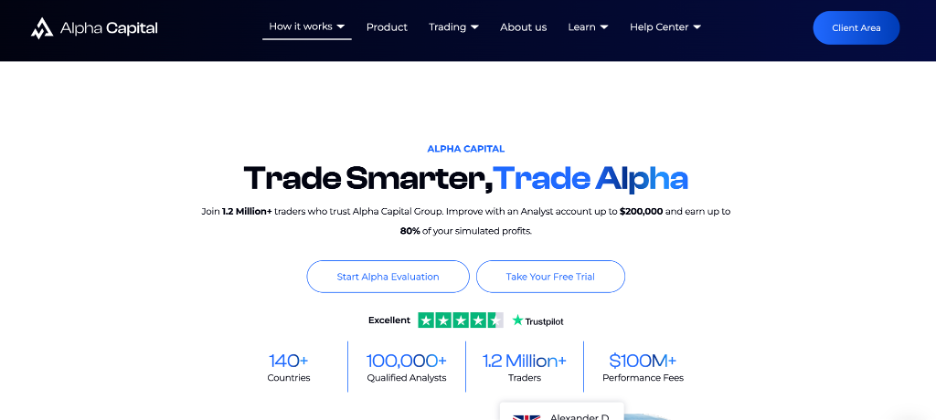
Alpha Capital reports 1.2 million+ traders across 140+ countries and 100,000+ Qualified Analysts (Alpha Capital's term for fully qualified traders). It offers simulated accounts from $5,000 to $200,000, with an 80% performance split, zero commission, unlimited trading days, and performance fees available bi-weekly or on demand.
Ready to get started?
Explore Alpha Capital evaluations here!
Compare Alpha Capital. Published side-by-side guides based on each firm's own rules — re-verify before buying: vs FTMO (plan variety) · vs FundedNext (scaling) · vs The5ers (account size & leverage) · vs Blue Guardian (swing path) · vs E8 Markets (FX leverage) · vs FundingPips (performance fee split).
Related guides
Prop firm guide series. Explore related terms: are prop firms legit?, how prop firms work, prop firm vs broker, trading evaluation, simulated funds, performance fee, qualified trader, drawdown types, prop firm red flags, choose by trading style, evaluation cost, realistic performance fees, copy trading UK, Alpha Capital login, ACG vs ACG Markets, performance fee delays, evaluation attempts, prop firm comparisons hub, vs E8 Markets, vs FundingPips, vs Blue Guardian, prop firms in South Africa, prop firms in India, pass without rebuilding strategy, why traders fail evaluations, evaluation fee & refund policy, free monthly trading competition. · what is a CFD prop firm
Frequently Asked Questions
What is the difference between a prop firm and a broker?
A broker executes trades on behalf of clients using the clients' own money. A prop firm sells an evaluation on a simulated account with a virtual balance. The evaluation fee is the money you put at risk. If you qualify, the firm pays a performance fee based on your eligible simulated profit; nothing is guaranteed. For a full side-by-side comparison, read our prop firm vs broker guide (2026).
Are prop firms legit?
Many are. Established prop firms with clear published rules, a verifiable record of paying performance fees and a long operating history are legitimate businesses. Read the terms and several independent sources before you pay an evaluation fee. For a full trust checklist, red flags, and UK regulation context, read our Are Prop Firms Legit? guide (2026).
Do you need trading experience to join a prop firm?
No qualification is required, but passing takes a tested strategy and strict risk control. Evaluations reward staying inside daily-loss and drawdown limits more than big wins. Practise on a free demo, read the full rules, and start with a size and plan whose drawdown suits how you trade.
What happens if you lose money on a funded account?
Because the account is simulated, you do not owe the firm for simulated losses. The money at risk is the evaluation fee you paid. At Alpha Capital, breaching the maximum daily loss or maximum total loss closes the account, while some other rules are treated as soft breaches. To continue after a closed account, you buy a new evaluation.
How long does it take to get funded?
With a one-step evaluation and active trading, some traders pass in as little as five to ten trading days. Two-step evaluations typically take two to four weeks depending on the minimum trading day requirements.
Can you trade any instrument at a prop firm?
It depends on the firm. Most forex prop firms offer forex pairs, indices, commodities and sometimes crypto. Futures prop firms offer futures contracts on commodities, indices and bonds. Always check the firm's available instruments before you buy an evaluation.
Alpha Capital Group is a proprietary trading firm based in London, UK. All trading accounts are demo accounts with simulated funds. More details can be found in our FAQ .