Part of our prop firm guide series. Start with What is a Prop Firm? (2026 complete guide), then explore: are prop firms legit?, how prop firms work, prop firm vs broker, trading evaluation, simulated funds, performance fee, qualified trader, drawdown types, prop firm red flags, choose by trading style, evaluation cost, realistic performance fees, copy trading UK, Alpha Capital login, ACG vs ACG Markets, performance fee delays, evaluation attempts, prop firm comparisons hub, vs E8 Markets, vs FundingPips, vs Blue Guardian, prop firms in South Africa, prop firms in India, pass without rebuilding strategy, why traders fail evaluations, evaluation fee & refund policy.
Quick answer: Prop firm trading runs on three mechanics — profit targets, drawdown limits, and performance fees (often called payouts). Evaluations use simulated funds; qualified traders may earn up to 80% performance splits. For Alpha Capital limits see rules explained.
Scope: This is a generic guide to how prop firms structure rules, drawdown, and performance splits across the industry. For Alpha Capital's published programme limits (Alpha One, Pro, Swing, Three), see Alpha Capital rules explained (2026).
Prop firm trading is one of the fastest-growing retail finance categories of the 2020s. As of 2026 more than 1.2 million traders are active across FTMO, FundedNext, FundingPips, The 5%ers, TopStep, Alpha Capital, and dozens of smaller firms. The total market is estimated above $1.5 billion in annual evaluation fees, with FTMO alone reporting over $200 million paid to qualified traders since launch.
The product is structured around three core mechanics: profit targets, drawdown limits, and performance fees (in industry slang, payouts). Alpha Capital, a UK proprietary trading firm founded in 2021 by CEO George Kohler and co-founder Andrew Blaylock, runs current evaluation paths under this structure: Alpha One, Alpha Pro, Alpha Swing, and Alpha Direct. Alpha Three is not currently offered for new purchases. Simulated account sizes range from $5,000 to $200,000, scaling to $400,000 total allocation, with performance fees of up to 80% paid bi-weekly or on demand. This guide explains each mechanic, compares Alpha Capital to FTMO, FundedNext, and The 5%ers in a side-by-side table, and covers what every retail trader should check before paying for an evaluation.
What is prop firm trading?
Prop firm trading is the practice of trading a simulated account provided by a proprietary trading firm after passing a paid evaluation. The trader keeps a performance fee (in industry slang, a payout) of up to 80% to 90% of profits. Risk is capped at the evaluation fee, not at the full account size.
Prop firm trading sits between retail trading (your own broker, your own money) and institutional trading (employee at a bank or hedge fund). The trader pays a one-time evaluation fee of $50 to $1,000 depending on account size, and gains access to a simulated account of $5,000 to $200,000. The trader provides the strategy; the firm provides the platform, the rules, and the simulated capital.
In 2026 the model is dominated by retail prop firms running multi-phase evaluations. Alpha Capital, FTMO, FundedNext, FundingPips, The 5%ers, and TopStep account for the majority of global retail volume. Each firm publishes a full ruleset before purchase, covering profit targets, drawdown limits, minimum trading days, consistency rules, and prohibited strategies (tick scalping, latency arbitrage, cross-firm copy trading).
The trading environment is simulated. The performance fees paid out are real cash. This is the structural fact most beginners miss: when a Qualified Trader receives a $4,000 performance fee from Alpha Capital, that payment is real cash, transferred by the firm from operational revenue. The simulated nature of the account caps the firm's exposure and allows the model to scale to hundreds of thousands of active traders.
How do prop firm rules work?
Prop firm rules cover three mechanics: profit targets (typically 6% to 10%), drawdown limits (4% to 12%), and performance fees (70% to 90%). Alpha Capital adds a 2-minute minimum trade duration and a 1% cooling-off rule. Breaching any hard rule ends the account immediately.
Every reputable prop firm in 2026 publishes its full ruleset on the product page, including drawdown percentages, profit targets per phase, minimum trading days, and lists of prohibited strategies. Three hard rules end an account when breached: (1) daily drawdown breach, (2) maximum total drawdown breach, and (3) trading in restricted hours or news windows when those restrictions apply. Soft rules trigger account flags or performance fee delays: 2-minute trade duration violations, copy trading flags, consistency violations.
The 2-minute rule at Alpha Capital excludes tick scalpers exploiting broker latency. The 1% cooling-off rule activates after defined drawdown thresholds and pauses trading temporarily to reset risk discipline. Both rules are documented openly before purchase.
Rule complexity varies by firm. FTMO's ruleset is concise and standardized. FundedNext layers more flexibility across plans. The 5%ers uses tighter scaling-based discipline. Alpha Capital's four evaluation paths each carry their own rule profile; Alpha Swing is the only path that permits overnight and weekend holds. See /alpha-swing-account-explained for the swing rule profile and /alpha-capital-rules-explained for the full active ruleset.
What are prop firm profit targets?
Profit targets are the minimum profit a trader must reach during an evaluation to qualify. Typical 2026 targets are 6% to 10% in Phase 1 and 4% to 5% in Phase 2. Alpha Pro at Alpha Capital offers 6%, 8%, and 10% Phase 1 variants. Alpha One has a single phase. Alpha Three had three on accounts sold that path; it is not currently offered for new purchases.
Profit targets are deliberately set at levels the firm believes a disciplined trader can hit inside drawdown constraints. The math matters: a trader risking 1% per trade with a 50% win rate and a 1:2 reward-to-risk ratio statistically reaches an 8% target in 30 to 60 trades, well inside the unlimited trading days Alpha Capital allows on standard evaluations.
At Alpha Capital, profit targets break down by path. Alpha One is single-phase with one target and the fastest path to qualification. Alpha Pro is 2-step with three Phase 1 variants (6%, 8%, 10%) and a typical Phase 2 target of 4% to 5%. Alpha Swing is a 2-step swing path with adjusted targets and overnight holding. Alpha Three was 3-phase with smaller incremental targets; it is not currently offered for new purchases.
Comparable firms hit similar bands. FTMO uses 10% Phase 1 and 5% Phase 2. FundedNext varies by plan, typically 8% and 5%. The 5%ers builds in scaling milestones. TopStep on futures uses contract-based net profit targets. Aggressive traders pick the 10% Alpha Pro variant for speed; methodical traders pick the 6% variant for safety. Profit targets, more accurately tied to performance discipline at Alpha Capital, are a filter, not a barrier.
What is prop firm drawdown?
Drawdown is the maximum equity loss a trader can take before the account is breached. Daily drawdown caps single-day losses (typically 4% to 5%); maximum drawdown caps total losses (typically 8% to 12%). Alpha Capital applies both concurrently, with thresholds documented per evaluation plan.
Drawdown is the most important rule in prop firm trading because it ends the account immediately when breached. Daily drawdown is the maximum allowable equity loss within a single trading day, typically 4% to 5% across Alpha Capital, FTMO, and FundedNext, and resets at the broker's daily reset time. Maximum total drawdown is the largest equity loss from the account high-water mark, typically 8% to 12%.
Drawdown is calculated differently per firm. Static drawdown uses the starting balance as the floor and never moves. Trailing drawdown uses the highest equity reached as the floor, materially stricter once the account is in profit. End-of-day trailing drawdown moves the floor at daily reset rather than tick by tick. Alpha Capital uses different drawdown models per evaluation; the exact model is documented per plan at /alpha-capital-rules-explained .
The practical impact: on a $100,000 simulated account with a 10% static maximum drawdown, the floor is $90,000 from day one. On a 10% trailing drawdown the floor moves up: if equity reaches $105,000, the new floor moves to $94,500. A subsequent $11,000 drawdown breaches the account even though the closing balance is still in profit. FTMO uses 10% static on the standard 2-step. FundedNext typically uses 10% maximum and 5% daily. Always read the drawdown rule before purchasing any evaluation.
How do prop firm performance fees work?
Performance fees, also called payouts or profit splits in some firms, are the trader's share of profits generated on a qualified simulated account. Alpha Capital pays up to 80%, bi-weekly on standard plans or on demand on eligible plans. FTMO and FundedNext offer similar bands up to 90%.
Profit splits, more accurately called performance splits at Alpha Capital, are the recurring revenue side of prop firm trading. Once qualified, the trader trades a simulated account and is paid a percentage of simulated profit in real cash by the firm. Splits range from 70% at entry levels to 90% on scaled accounts across the 2026 industry. Alpha Capital pays up to 80% on current evaluation plans (Alpha One, Alpha Pro, Alpha Swing), and 90% as standard on Alpha Direct. FTMO pays 80% by default and scales to 90%; FundedNext sits between 80% and 90%; The 5%ers structures around scaling milestones; FundingPips runs fast cycles; TopStep on futures pays 100% on the first $10,000 of profits and 90% beyond.
Payment processing in 2026 typically uses bank transfer, crypto (USDC, USDT, BTC), or eligible third-party processors. Alpha Capital processes on-demand performance fees within a defined window after request, subject to the on-demand consistency rule.
A practical example: a Qualified Trader on a $100,000 Alpha Capital simulated account booking a 4% monthly return generates $4,000 of simulated profit. At an 80% performance fee, the trader is paid $3,200 in real cash; $800 (20%) is retained by the firm. Earnings scale with account size and discipline; outcomes are performance-based and not guaranteed.
Prop firm comparison: Alpha Capital vs FTMO vs FundedNext vs The 5%ers
Alpha Capital, FTMO, FundedNext, and The 5%ers are among the most established 2026 retail prop firms. Performance fees range from 80% to 90%, profit targets between 6% and 10%, and maximum drawdown between 8% and 12%. Differences in evaluation paths, payment frequency, and platform support matter most.
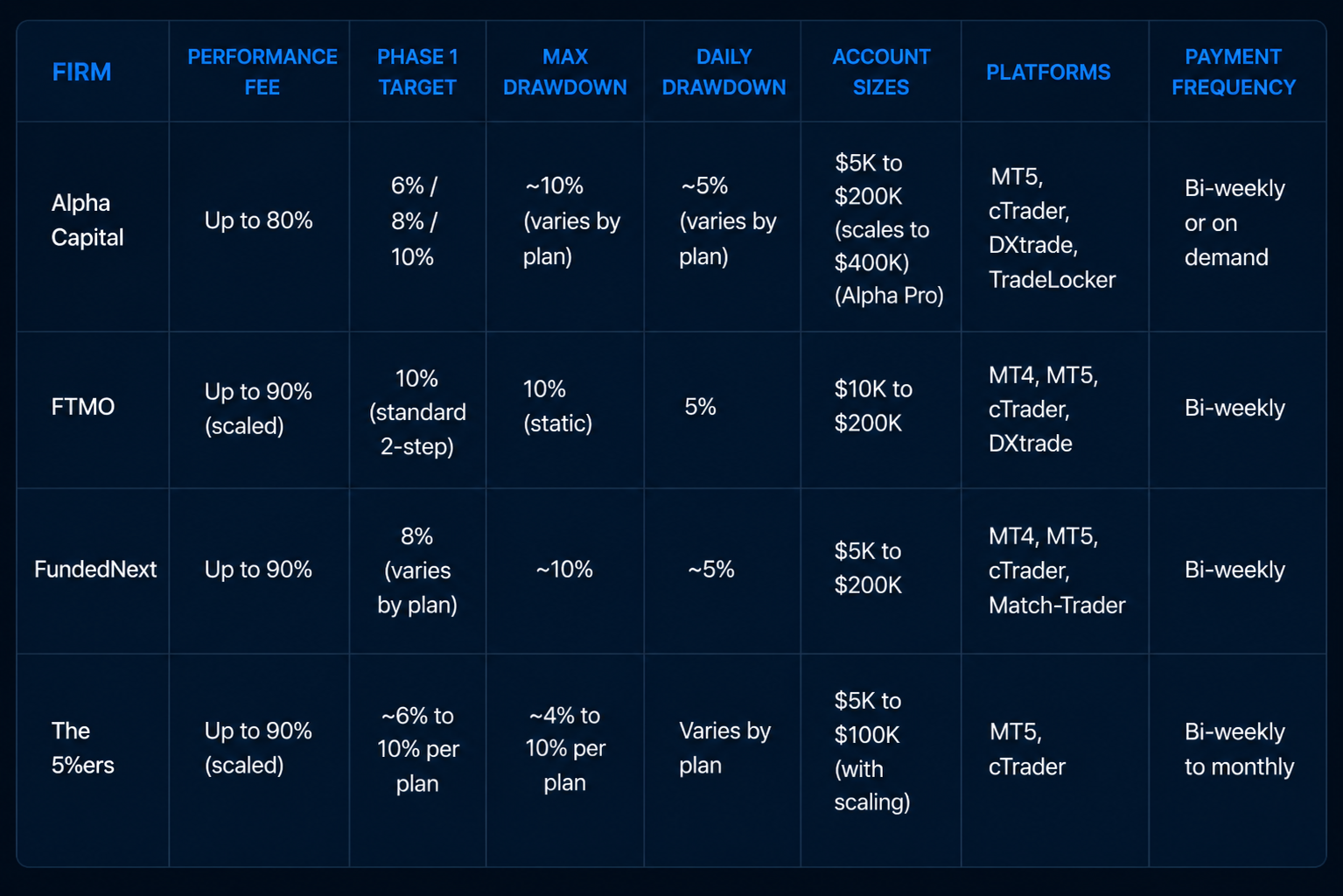
Alpha Capital stands out on three points: four evaluation paths (1-step, 2-step, swing-specific 2-step, 3-step), on-demand performance fees on eligible plans, and four supported platforms (MT5, cTrader, DXtrade, TradeLocker). FTMO remains the largest by global traffic with a narrower 2-step focus. FundedNext leads on growth in South Asian markets. The 5%ers runs an aggressive scaling model.
Always confirm live rules, profit targets, drawdown thresholds, performance splits, and pricing on each firm's website. Rules change. Alpha Capital's current rules and pricing are at /alpha-capital-rules-explained and /product .
Frequently Asked Questions
What is prop firm trading?
Prop firm trading is trading a simulated account provided by a proprietary trading firm after passing a paid evaluation. The trader keeps a performance fee (in industry slang, a payout) of up to 80% to 90% of profits. Alpha Capital pays up to 80%; FTMO and FundedNext pay up to 90%. Risk is capped at the evaluation fee ($50 to $1,000), not at the account balance.
What are the rules of a prop firm?
Prop firm rules cover profit targets (6% to 10%), maximum drawdown (8% to 12%), daily drawdown (4% to 5%), minimum trading days, consistency rules, and prohibited strategies (tick scalping, latency arbitrage, copy trading across firms). Alpha Capital adds a 2-minute minimum trade duration and a 1% cooling-off rule. Full rules are at /alpha-capital-rules-explained .
How does drawdown work at a prop firm?
Drawdown is the maximum equity loss before the account is breached. Static drawdown uses the starting balance as the floor and never moves. Trailing drawdown uses the highest equity as the floor, stricter once profitable. End-of-day trailing drawdown moves the floor at daily reset rather than tick by tick. Alpha Capital uses different drawdown models per evaluation; specific thresholds are documented per plan.
What is a profit split at a prop firm?
A profit split, more accurately called a performance split at Alpha Capital, is the trader's share of profits on a qualified simulated account. Alpha Capital pays up to 80% on all four paths; FTMO and FundedNext pay up to 90%; The 5%ers structures around scaling milestones. The remaining percentage is retained by the firm. There is no guaranteed income; performance fees depend on trading performance.
Are prop firms legit?
Established prop firms with verifiable performance fee histories and strong Trustpilot ratings are legitimate. Alpha Capital is a UK proprietary trading firm founded in 2021, co-led by CEO George Kohler and co-founder Andrew Blaylock, with a 4.6 to 4.7 Trustpilot rating across thousands of reviews. FTMO, FundedNext, The 5%ers, and TopStep have similar multi-year track records.
Can you really make money prop firm trading?
Qualified Traders at Alpha Capital can earn up to 80% of profits generated on a simulated account, paid bi-weekly or on demand. Earnings depend on win rate, risk per trade, account size, and discipline. There is no guaranteed income. Trustpilot reviews show consistent performance fees for disciplined traders; many traders also fail evaluations. Outcomes are performance-based.
What is the difference between a prop firm and a broker?
A broker executes trades on behalf of clients using client funds; the client deposits a balance and bears full risk. A prop firm provides a simulated account to a trader after they pass an evaluation; the trader does not deposit a balance. The prop firm pays a performance fee based on simulated profits. Alpha Capital is a prop firm, not a broker, supporting MT5, cTrader, DXtrade, and TradeLocker.
How much can you make at a prop firm?
Earnings depend on account size and trading performance. A Qualified Trader on a $100,000 Alpha Capital simulated account booking 4% monthly generates $4,000 of simulated profit; $3,200 (80%) is paid as a real cash performance fee. Scaling lifts total allocation to $400,000 across multiple qualified accounts. There is no guaranteed income; outcomes are performance-based.
Ready to Start Your Alpha Capital Evaluation?
If you want to put a strategy on a simulated account provided by a UK proprietary trading firm with a 4.6 to 4.7 Trustpilot rating, Alpha Capital offers four evaluation paths and up to 80% performance fees. Browse live account sizes and pricing at /product , read the active rules at /alpha-capital-rules-explained , or talk to current Qualified Traders inside the /community Discord. For swing-specific holding rules, see /alpha-swing-account-explained .
Alpha Capital Group is a proprietary trading firm based in the United Kingdom. All accounts operate in a simulated trading environment with simulated funds. Performance fees are based on eligible simulated trading results and outcomes are not guaranteed. Always confirm live rules, pricing, and eligibility on alphacapitalgroup.uk before purchasing an evaluation.