Availability: Alpha Three is not currently offered for new purchases at checkout. Tables and Help Centre copy below still document existing-account rules. Current buyable paths are Alpha One, Alpha Pro, Alpha Swing, and Alpha Direct. Confirm live plans on the product page.
Scope: This page explains the qualified trading account product for UK traders (sizes, fees, platforms). For the qualified trader role and Qualified Analyst terminology, see what is a qualified trader?
Part of our prop firm guide series. Start with What is a Prop Firm? (2026 complete guide), then explore: are prop firms legit?, how prop firms work, prop firm vs broker, trading evaluation, simulated funds, performance fee, qualified trader, drawdown types, prop firm red flags, choose by trading style, evaluation cost, realistic performance fees, copy trading UK, Alpha Capital login, ACG vs ACG Markets, performance fee delays, evaluation attempts, prop firm comparisons hub, vs E8 Markets, vs FundingPips, vs Blue Guardian, prop firms in South Africa, prop firms in India, pass without rebuilding strategy, why traders fail evaluations, evaluation fee & refund policy.
Quick answer: A qualified trading account (often called a funded account) is a simulated account issued after passing a prop firm evaluation. UK traders at Alpha Capital can access $5K–$200K simulated sizes with up to 80% performance fees — not the same as the qualified trader role.
The phrase "funded trading account" pulls roughly 24,460 UK searches a month according to keyword tracker data, and more than 151,000 globally when grouped with related terms like "funded trading firms" and "funded trader programs". Most of the people typing those queries are retail traders who want access to serious capital without putting up six figures of their own savings. The answer is the qualified trading account model, the modern format of what the prop trading industry once called the funded account.
This guide explains what a qualified trading account is, how the model works inside a UK proprietary trading firm, how much simulated capital is available, how performance fees of up to 80 percent are paid, and how Alpha Capital compares with FTMO, FundedNext, FundingPips, The 5%ers, and TopStep. The model is now used by an estimated 4 million retail traders worldwide. Every figure cited is sourced from public Alpha Capital documentation or verified prop-industry data current as of May 2026.
What does it mean to have a qualified trading account?
A qualified trading account, also known as a funded account in older industry copy, is a simulated trading account issued to a trader who has passed a proprietary trading firm evaluation. The trader keeps up to 80 percent of any simulated profits as performance fees, while the firm absorbs all simulated losses.
In practical terms, having a qualified account means a trader has proven, against rules set by the firm, that they can hit a defined profit target without breaking a drawdown limit. At Alpha Capital, the four qualifying paths are Alpha One (a 1-step evaluation), Alpha Pro (a 2-step evaluation with 6, 8, or 10 percent profit-target variants), Alpha Swing (a 2-step swing-trader programme), and Alpha Direct. Alpha Three was a 3-step evaluation; it is not currently offered for new purchases.
The account itself trades in a simulated environment. Order flow runs through institutional-grade platforms (MetaTrader 5, cTrader, DXtrade, and TradeLocker at Alpha Capital), pricing mirrors live market data, but the simulated capital is not deposited into a personal brokerage account. Performance fees, however, are paid as monetary rewards based on eligible simulated trading results.
This model emerged because most retail traders cannot self-fund a six-figure trading account. A 2024 BrokerNotes survey found that more than 70 percent of UK retail forex traders use accounts below £5,000. The qualified-account model bridges that gap and is now used by FTMO (since 2014), FundedNext, FundingPips, The 5%ers, and TopStep on the futures side, with Alpha Capital running the UK-headquartered version of the same model since 2021.
How does a qualified (funded) trading account work?
A qualified trading account works in three stages: pay a one-time evaluation fee, pass the evaluation rules, then trade the qualified simulated balance and receive up to 80 percent of profits as performance fees. At Alpha Capital, the qualified stage has no profit target and no maximum time limit.
Stage one is the evaluation. A trader picks an account size between $5,000 and $200,000 and pays a one-time fee, typically ranging from roughly $40 on the smallest account to roughly $1,000 on the $200K tier. The evaluation runs on a simulated balance that mirrors live forex, indices, commodities, metals, and crypto pricing across MT5, cTrader, DXtrade, or TradeLocker.
Stage two is qualification. The trader hits a defined profit target (6 to 10 percent depending on programme) while staying inside two drawdown rules: a maximum total drawdown (6 to 10 percent at Alpha Capital) and a daily loss limit (3 to 5 percent). Alpha Capital evaluations carry no time limit, a meaningful difference from older models that pressured traders into deadline-driven over-leveraging.
Stage three is the qualified account. Once a trader passes all phases, they receive a qualified simulated account with the same balance, the profit target drops to zero, and drawdown rules remain. The trader keeps up to 80 percent of profits, paid bi-weekly on standard plans or on demand on eligible plans subject to a 40 percent best-day rule. Trading rules carry over: the 2-minute minimum trade duration and the 1 percent cooling-off rule still apply. Instant funding (skipping the evaluation entirely) is not offered at Alpha Capital, by deliberate design, to protect the integrity of the qualified pool.
How much simulated capital can you get with a qualified account?
Most UK prop firms issue qualified accounts from $5,000 to $200,000 of simulated capital, with scaling plans that push total allocation higher. Alpha Capital offers six account sizes ($5K, $10K, $25K, $50K, $100K, $200K) plus a scaling plan to $400,000 in total simulated allocation across multiple qualified accounts.
The most common size purchased across the UK prop industry in 2025, according to PropFirmMatch tracking, was the $50,000 tier at roughly 31 percent of evaluations sold. The $100,000 tier was second at about 27 percent. The $200,000 tier accounted for roughly 14 percent and is preferred by experienced traders with proven strategies and capital to risk on the evaluation fee.
At Alpha Capital, every account size is available across all four evaluation programmes. The scaling plan stacks allocations up to a $400,000 simulated cap across multiple qualified accounts. Comparable models exist at FTMO, FundedNext (up to $400K), FundingPips (up to $500K as of 2026), and The 5%ers. The qualified account size is not capital a trader withdraws; it is the simulated balance traded against. The number that matters most is the performance fee paid on profits earned. On a $200,000 account generating 5 percent monthly, that is roughly $8,000 per month gross at the 80 percent split.
What is the performance fee on a qualified trading account?
A performance fee (sometimes called a profit split or payout in older industry copy) is the percentage of qualified-account profits paid to the trader. Most UK prop firms now offer 70 to 90 percent. Alpha Capital pays up to 80 percent, bi-weekly on standard plans or on demand on eligible plans subject to consistency rules.
The 80 percent figure is the standard in the UK prop industry as of mid-2026. FTMO pays up to 90 percent on the qualified stage after a scaling cycle. FundingPips and FundedNext both list 80 to 90 percent figures depending on programme. The 5%ers pays 50 to 75 percent depending on the scaling tier. TopStep, on US futures, pays 90 percent above a defined threshold. Alpha Capital's 80 percent applies across all four evaluation programmes once a trader qualifies.
The fee is paid as a monetary reward against simulated trading performance. A trader who generates $10,000 in simulated profits on an Alpha Capital qualified $100K account receives up to $8,000 in performance fees, typically delivered by bank transfer, cryptocurrency, or eligible third-party processors. Withdrawal turnaround is bi-weekly on standard plans and within a defined window after a request on on-demand plans. Two consistency rules apply on on-demand requests: a 2 percent minimum gross profit threshold, and a 40 percent best-day rule (no single day can contribute more than 40 percent of total cumulative profit). The 40 percent rule does not apply to bi-weekly schedules. There is no income guarantee; performance fees track trading performance directly.
Are qualified trading accounts simulated or live capital?
Qualified trading accounts at UK proprietary trading firms operate on simulated funds, not the trader's own personal capital. The simulated environment mirrors live forex and futures pricing, but the trading balance is not deposited capital. Performance fees, however, are paid as monetary rewards based on eligible simulated trading results.
Issuing live retail capital under FCA rules is a much heavier regulatory build, so Alpha Capital, FTMO, FundingPips, and most UK and EU-headquartered prop firms operate on simulated capital. The trader is not exposed to out-of-pocket loss on the account itself, only the loss of the one-time evaluation fee if rules are breached. The simulated environment is engineered to be statistically close to live conditions, though slippage, fills, and spread can diverge during high-volatility moments. Alpha Capital has paid performance fees to qualified traders since launching in 2021, with a 4.6 to 4.7 Trustpilot rating across thousands of reviews and routine payment proofs published by independent reviewers at PropFirmMatch and FundedTrading.com . UK FCA expectations and 2024 industry guidance pushed firms to language ("qualified account", "simulated funds") that does not imply traders are managing the firm's live cash.
How do top UK qualified trading account providers compare?
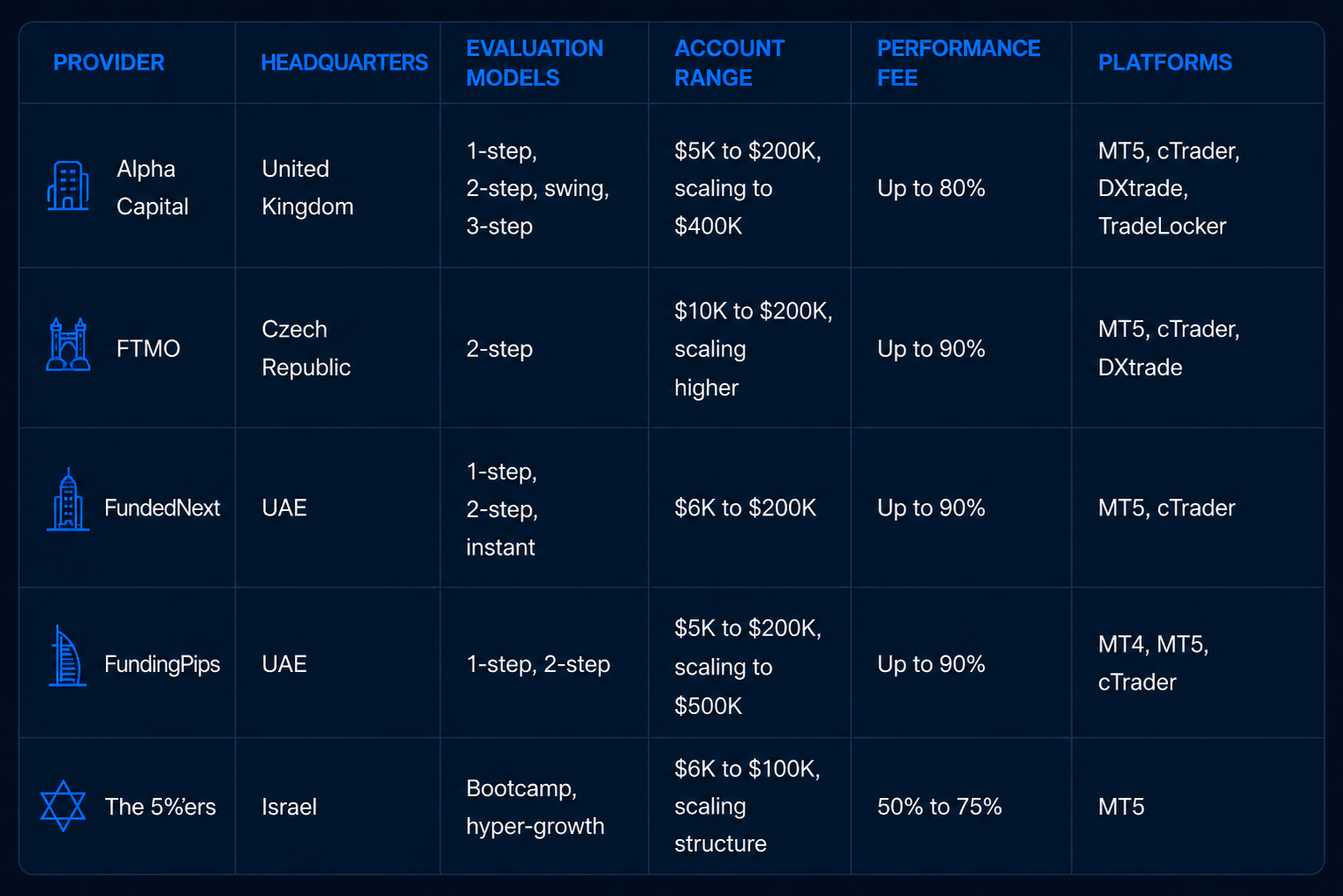
The largest UK-relevant qualified trading account providers in 2026 are Alpha Capital, FTMO, FundedNext, FundingPips, and The 5%ers in forex, with TopStep and the Alpha Futures sister brand on the futures side. Each offers a different evaluation structure, performance-fee schedule, and platform mix.
Alpha Capital, founded 2021 and headquartered in the United Kingdom, runs four evaluation programmes, up to 80 percent performance fees, four platforms (MT5, cTrader, DXtrade, TradeLocker), and accounts from $5K to $200K scaling to $400K. CEO George Kohler and co-founder Andrew Blaylock built the firm around forex, indices, commodities, metals, and crypto. FTMO, founded 2014 in Prague, is the most recognised name in European prop trading with roughly 12 million monthly site visits as of late 2025. FundedNext (founded 2022, UAE) has scaled in South Asia, while FundingPips (also 2022) competes on price with scaling to $500K. The 5%ers (2016, Israel) is built around aggressive scaling at 50 to 75 percent splits. A useful filter for UK traders: location, platform, asset class, and Trustpilot rating (Alpha Capital 4.6 to 4.7, FTMO 4.8, FundingPips 4.7, FundedNext 4.6).
How long does it take to get a qualified trading account?
Most traders take 4 to 8 weeks to qualify, depending on evaluation type and trading style. At Alpha Capital, Alpha One can be passed in as little as 1 trading day (the minimum), Alpha Pro typically takes 4 to 6 weeks across both phases, and Alpha Swing or Alpha Three usually stretch longer due to multi-phase structure.
There is no maximum time limit on standard Alpha Capital evaluations. FTMO removed time limits in 2023 and FundingPips followed in early 2024. Alpha Capital has run unlimited-time evaluations since launching in 2021, which reduces the pressure that historically caused traders to over-leverage near a deadline. Trader testimonials published on /resources report fastest pass times of 6 to 10 calendar days on Alpha Pro 6% or Alpha One, a median of 30 to 45 days, Alpha Swing traders around 60 to 90 days because longer holding periods mean fewer trades per week, and Alpha Three around 90 to 120 days due to its three-phase structure. Two rules shape pass speed: minimum trading days (1 day on Alpha One, 3 days per phase on the others) and the 2-minute minimum trade duration, which prevents tick-style scalping from compressing results artificially. Industry-wide first-time pass rates remain low, with independent estimates from PropFirmMatch and TradersUnion in 2024 putting first-time pass rates between 7 and 12 percent across major prop firms.
Frequently Asked Questions
What is a funded trading account in simple terms?
A funded trading account, more correctly called a qualified trading account at most modern UK prop firms, is a simulated trading account issued after a trader passes an evaluation. The trader keeps up to 80 percent of profits as performance fees. Simulated capital at Alpha Capital ranges from $5,000 to $200,000, scaling to $400,000 total under the firm's scaling plan.
Do funded trading accounts use simulated funds or live capital?
Qualified trading accounts (sometimes referred to as funded accounts) operate on simulated capital, not live cash deposited by the firm. The simulated environment mirrors live market pricing on MT5, cTrader, DXtrade, and TradeLocker. Performance fees, however, are paid as monetary rewards based on eligible simulated trading results, typically by bank transfer or cryptocurrency.
How do funded trading accounts make money?
A qualified trading account makes money for the trader through performance fees of up to 80 percent of simulated profits. The firm covers operations through evaluation fees paid up front. At Alpha Capital, a $100K account generating 5 percent monthly produces roughly $4,000 per month in performance fees at the 80 percent split, paid bi-weekly or on demand subject to consistency rules.
Can you get a funded trading account without an evaluation?
Some firms offer instant-funding products that skip the evaluation. Alpha Capital does not. Every Alpha Capital qualified account requires passing a current evaluation (Alpha One, Alpha Pro, or Alpha Swing) or buying Alpha Direct. Alpha Three is not currently offered for new purchases. The choice to skip instant funding protects the integrity of the qualified pool and reduces the share of accounts that breach in the first 30 days.
Are funded trading accounts legal in the UK?
Yes. UK proprietary trading firms operating the simulated-account model are legal and widely used. Alpha Capital is headquartered in the United Kingdom. UK FCA expectations apply to financial promotions and risk language, which is why most modern UK prop firms use "qualified account" and "simulated funds" rather than older "funded" language. Always confirm tax treatment with a qualified accountant.
How much can you earn from a funded trading account?
There is no income guarantee. Earnings depend on win rate, risk per trade, and account size. A consistent 5 percent monthly return on a $100K Alpha Capital qualified account at the 80 percent performance fee equals roughly $4,000 per month gross. Top traders running multiple qualified accounts under the scaling plan (up to $400K total) can earn mid-five-figures monthly.
What happens if you lose money on a funded trading account?
If a qualified trader breaches a drawdown rule (typically 6 to 10 percent at Alpha Capital), the account closes. The trader does not owe the firm the simulated loss because the funds are simulated. To regain a qualified account, the trader purchases a new evaluation. This is the same model used by FTMO, FundedNext, FundingPips, and The 5%ers.
Ready to Start Your Alpha Capital Evaluation?
If you are considering a qualified trading account in 2026 and you want a UK-headquartered firm with four evaluation paths, four trading platforms, and an 80 percent performance fee, Alpha Capital is one of the most established options in the market. Compare the four evaluation programmes on /product, read the detailed evaluation rules on /resources, join the active trader community on /community, and read the firm's story on /about before deciding.
Alpha Capital Group is a proprietary trading firm based in the United Kingdom. All accounts operate in a simulated trading environment with simulated funds. Performance fees are based on eligible simulated trading results and outcomes are not guaranteed. Always confirm live rules, pricing, and eligibility on alphacapitalgroup.uk before purchasing an evaluation.