Scope: Industry-wide trust guide — are prop firms legit? applies to any operator. For an Alpha Capital–specific product review (plans, pricing, Trustpilot), see Alpha Capital review 2026.
Part of our prop firm guide series. Start with What is a Prop Firm? (2026 complete guide), then explore: how prop firms work, prop firm vs broker, trading evaluation, simulated funds, performance fee, qualified trader, drawdown types, prop firm red flags, choose by trading style, evaluation cost, realistic performance fees, copy trading UK, Alpha Capital login, ACG vs ACG Markets, performance fee delays, evaluation attempts, prop firm comparisons hub, vs E8 Markets, vs FundingPips, vs Blue Guardian, prop firms in South Africa, prop firms in India, pass without rebuilding strategy, why traders fail evaluations, evaluation fee & refund policy.
Quick answer: Yes, prop firms are a legitimate business model in 2026. Most use simulated evaluations and performance-based fees. This guide explains how they work, why regulation differs from brokers, and how to verify a firm before you pay.
Yes, prop firms are legit.
Proprietary trading firms are real businesses. The evaluation model — pay a fee, trade inside published rules, progress to a Qualified Account if you meet objectives, earn performance fees on eligible simulated profits — is used by millions of traders globally and operated by firms that have been running for years, paying out hundreds of millions in aggregate across the industry.
The follow-up question matters more: is this specific firm legit? The industry had collapses and fraud cases. Hundreds of small operators shut down in 2024 when they could not sustain their model. The category is legitimate. Individual firms vary. Your job is to verify the one you are about to pay.
That is the straight answer to "are prop firms legit?"
This guide covers what searchers actually want when they type are prop firms legit — how the model works, what simulated accounts really mean, how regulation differs by country, red flags, a five-minute verification checklist, and what to look for in any operator. Alpha Capital Group publishes it; where programmes are referenced, official terminology applies (evaluation, Qualified Account, performance fees, simulated funds).
General information only, not personal financial advice. Performance fees are performance-based; outcomes are not guaranteed. Always confirm live rules on each firm's official help centre before purchasing.
What are prop firms in 2026?
A proprietary trading firm (prop firm) runs trader evaluation programmes. You buy access to a simulated account, trade inside Trading Objectives (profit targets, drawdown limits, daily loss limits, consistency rules where applicable), and, if you meet the rules, progress to a stage where the firm pays you performance fees on eligible simulated profits according to a published performance split.
That is the modern retail prop model. It is not the same as a bank hiring you onto a live desk. It is also not automatically a scam — it is a service contract: evaluation access + rule enforcement + performance fee processing if you qualify.
Most established firms in 2026 are transparent that trading happens in a simulated environment. Some legal disclaimers use the term demo account. Editorial best practice: simulated account or evaluation account. Read our trading evaluation glossary and step-by-step prop firm guide for the full journey.
Are prop firms legit or a scam?
The model is legit. Scams exist inside the industry.
Think of it like any sector with low barriers and high search volume: real operators and bad operators share the same keywords.
| Legitimate prop firm | Scam or unsustainable operator | |
|---|---|---|
| Rules | Published before checkout | Vague, hidden, or changed retroactively |
| Account type | Discloses simulated trading | Implies you hold real cash in the account |
| Income claims | Performance-based fees, no guarantees | "Guaranteed" withdrawals or get-rich-quick copy |
| Fees | Evaluation fee + reset policy stated | Hidden fees, pressure tactics |
| History | Years operating, large review volume | New domain, anonymous team, off-platform payments |
| Support | Tickets, help centre, documented processes | Ghosting after payment |
Legit does not mean "easy money." It means the firm does what it publishes: if you pass the evaluation and meet performance fee conditions, you get paid on the stated schedule. If you breach, you lose the attempt — that is the contract, not fraud.
How do prop firms make money?
This is the question behind most scepticism — and the honest answer helps you evaluate any firm, including Alpha Capital.
Prop firms typically earn from:
- Evaluation fees — what you pay to start (and resets/repurchases if you fail)
- Optional add-ons — split upgrades, plan variants, etc.
- A minority of traders who reach performance fee stages — the firm retains a share of simulated profits under the performance split
Failed evaluations are part of economics. That alone does not make a firm illegitimate — gym memberships work similarly. It becomes predatory when:
- Rules are designed to be nearly impossible so you keep repaying
- Rules are so easy that the firm likely never intended to pay (unsustainable)
- Performance fee requests are systematically denied without documented cause
Before you pay any firm, read whether their objectives are achievable for your strategy — not just whether the fee is cheap.
Simulated accounts: what you are actually buying
Most retail prop evaluations in 2026 use simulated funds in a simulated trading environment. Your $50,000 simulated account is not £50,000 in your bank. It is a $50,000 rule-set used to measure whether you trade within limits.
Simulated ≠ scam. It is the standard infrastructure at scale. See what simulated funds mean and prop firm vs broker for how this differs from a live brokerage account.
What would be misleading:
- Suggesting the balance is real capital you own
- Implying live market outcomes match simulation perfectly
- Promising income regardless of performance
Simulated results do not reflect real trading outcomes in every respect — execution, slippage, and psychology differ. Performance fees are performance-based — nothing is guaranteed. Your evaluation fee is at risk if you breach.
Alpha Capital Group states on official pages that programmes operate in a simulated trading environment with simulated funds unless a specific product says otherwise. Read the same disclosure on any firm you compare.
Why aren't most prop firms FCA-regulated?
UK traders often ask: If I am paying money, where is the FCA?
Most prop evaluation programmes are not regulated like retail brokers. Reasons commonly cited across industry education (including regulator commentary in 2025–2026):
- You are typically buying a performance evaluation service under contract law, not depositing into an FCA-regulated investment account
- Trading is often simulated — no client money brokerage in the classic sense
- Some groups market programmes as financial education or skill assessment — regulators have scrutinised this framing
Unregulated does not automatically mean illegal. It means you do not get FSCS-style protections. Your safety net is due diligence: published rules, company transparency, review volume, and performance fee track record.
UK context (2026): The FCA has increased scrutiny of financial promotions and crypto/forex-adjacent marketing. Firms with UK customers still must handle promotions, AML/KYC, and consumer clarity responsibly even when the evaluation product itself is not a regulated investment scheme. Read each operator's legal and disclaimer pages — do not rely on forum shorthand like "FCA-approved prop firm" unless the firm states that explicitly for the product you buy.
Alpha Group includes related entities (for example ACG Markets) with licence disclosures on official pages. The Alpha Capital evaluation you purchase is a simulated programme — confirm how checkout and invoices describe it.
When prop firms fail — what traders learned
Skepticism spiked for good reason.
My Forex Funds (2023–2024) faced CFTC fraud charges — alleged manipulation, misleading counterparty claims, and practices that harmed traders. Services stopped; withdrawals froze. That case is not "all prop firms" — it is one catastrophic operator used as a warning in almost every are prop firms legit article for a reason.
2024 industry shakeout: Dozens of smaller firms closed when they could not manage liquidity, payouts, or platform pressure. Traders with outstanding performance fee balances often had no regulatory body to recover from — because these programmes sit outside broker-style insolvency protections.
Lesson for 2026: Prefer firms with years of operation, public rules, large independent review samples, and identifiable company structure. Treat "brand new + unbelievable promises" as high risk.
How to check if a prop firm is legit (5-minute checklist)
Use this before any evaluation purchase — Alpha Capital included. Trust, but verify.
1. Read Trading Objectives on the official help centre
You should see, before payment:
- Profit target(s) per phase
- Static vs trailing drawdown
- Daily loss limit
- Minimum trading days / consistency rules
- News, weekend, and leverage rules
If objectives live only in a PDF sent after payment, stop.
Alpha Capital: help.alphacapitalgroup.uk
2. Check recent independent reviews — not just stars
Open Trustpilot (or equivalent), sort by most recent, read 2-star and 3-star reviews for patterns:
- Performance fee delays systematically?
- Rules changed mid-evaluation without notice?
- Support unresponsive on documented issues?
One angry breach post is noise. Repeating themes over months are signal.
3. Test support before you buy
Ask three specific questions (any legit firm answers clearly):
- What is the daily drawdown reset time (timezone)?
- What happens to my account if I breach daily limit vs max loss?
- How are performance fees processed — schedule, minimums, methods?
Vague answers are a red flag — noted in multiple industry guides including competitor education pages.
4. Sanity-check the evaluation difficulty
| Signal | Concern |
|---|---|
| Impossible targets + cheap fee | Fee-collection model |
| Absurdly easy + huge split marketing | Unsustainable |
| Rules unclear or contradictory | Room to deny you later |
Legit firms protect themselves with realistic risk limits — not lottery odds.
5. Confirm company identity
Registered entity name, address, legal pages, privacy policy, terms. Off-platform payments (random crypto wallet, Telegram checkout) = walk away.
For a dedicated pre-checkout filter with a five-minute checklist, read Red Flags When Choosing a Prop Firm (2026).
Red flags: when to walk away
Walk away if you see:
- Guaranteed income or "quit your job in 30 days"
- Marketing that you trade "the firm's money" as if it is cash in your pocket
- No published drawdown rules — only a headline split percentage
- Fake regulatory badges without a link to official register entries
- Rules that change on active accounts without written notice
- Only promotional reviews — no substantive help centre
- Pressure to pay today before reading objectives
None of these require a regulator to tell you — they are commercial common sense.
Can you actually make money with prop firms?
Yes — traders do earn performance fees at legitimate firms. No — it is not guaranteed, quick, or passive.
You make money when all of this is true:
- Your strategy fits the published rules (drawdown type, hold times, news windows)
- You pass the evaluation (and any verification phases)
- You maintain discipline on the Qualified Account
- You meet performance fee conditions (minimums, consistency, schedule)
Industry pass rates on the first attempt are often low (commonly cited around 10–15% for multi-step evaluations — treated as directional, not precise). Budget fees × expected attempts, not one perfect run. Read what performance fees are and how the full process works.
Which prop firms are legit? (What UK traders ask on Quora and Reddit)
There is no official government list of "approved prop firms." Legitimacy is verified, not awarded.
Use criteria, not hype:
| Criterion | What to verify |
|---|---|
| Operating history | Founded when? Still paying performance fees publicly? |
| Rule transparency | Full objectives online? |
| Review depth | Thousands of reviews with recent activity? |
| Simulated disclosure | Clear that accounts are simulated? |
| UK relevance | Eligibility, support hours, payment clarity for GBP/USD |
Compare two or three operators side by side on their official help centres before you pay anyone — rules and eligibility differ by firm.
For Alpha Capital specifically, read our dedicated Alpha Capital review (2026) — Trustpilot snapshot, programme breakdown, and an honest trader verdict. We publish this checklist against ourselves because you should not take our word alone.
How Alpha Capital fits in
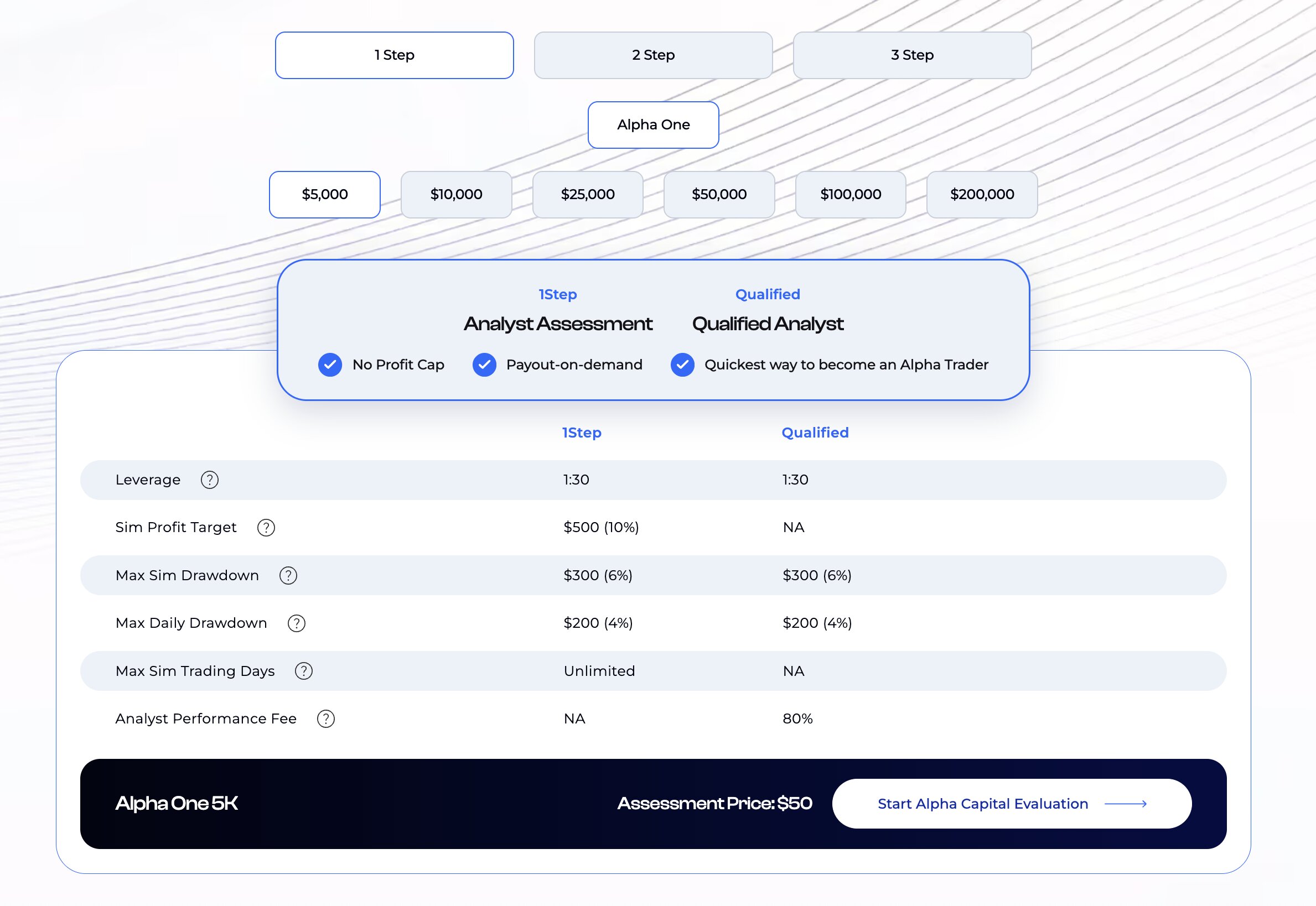
Alpha Capital Group is a UK-headquartered proprietary trading firm (founded November 2021) with current evaluation paths including Alpha One, Alpha Pro, Alpha Swing, and Alpha Direct (Alpha Three is not currently offered for new purchases), platforms including MT5, cTrader, DXtrade, and TradeLocker, and performance fees up to 80% on eligible simulated profits.
Legit here means transparent and operating at scale — not easy. See evaluation plans, Trading Objectives, and our complete prop firm guide before checkout.
Frequently Asked Questions
Are prop firms legit?
Yes. The evaluation and performance fee model is a legitimate, widely used business structure. Firm selection determines whether your experience is fair — not whether the concept exists.
Are prop firms a scam?
Some are. The model is not. Scams and failed operators usually show red flags above — hidden rules, fake guarantees, opaque ownership. Established firms with published objectives and long review histories are a different category from anonymous checkout pages.
Are prop firms legal in the UK?
Operating structures vary. Many firms serve UK traders under contract terms and financial promotion obligations without being FCA-regulated retail brokers. Read the legal pages of the entity you pay. Do not confuse "legal to operate" with "FCA-protected deposit."
Why do prop firms use simulated accounts?
Scale, consistency, and risk control. Simulated environments let firms apply identical rules to thousands of traders. Simulated does not mean fake fees — performance fees paid to Qualified Traders are real monetary rewards on published terms, not simulated payments.
How do I know if a prop firm will pay me?
You cannot know the future. You can verify: published performance fee schedule, recent reviewer patterns, support clarity, and whether objectives match your strategy. No firm should guarantee your personal results.
Is Alpha Capital legit?
Alpha Capital Group is an operating UK-headquartered firm (founded 2021) with public Trading Objectives and a large trader community. For evidence, Trustpilot patterns, programme details, and an independent-style review, read our Alpha Capital review (2026) and verify on help.alphacapitalgroup.uk before purchase.
Can I lose more than my evaluation fee?
Typically your direct risk is the evaluation fee plus any resets/repurchases — you are not usually depositing personal trading capital into the simulation. Confirm the specific programme you buy.
What is the difference between a prop firm and a broker?
A broker holds or routes your capital (often regulated). A prop evaluation programme sells access to a rule-bound simulated account and may pay performance fees if you qualify. Different products, different protections. Read our full prop firm vs broker guide.
Do prop firms guarantee profits?
No legitimate firm should. Performance fees are performance-based on eligible simulated results. Evaluation fees are at risk if you breach.
If you want to start with Alpha Capital, open the help centre, pick a programme (Alpha One, Pro, Swing, or Three), and read the rules before you pay: help.alphacapitalgroup.uk · alphacapitalgroup.uk/product
Save on your evaluation. See active Alpha Capital promo codes before checkout.
Alpha Capital Group is a proprietary trading firm based in the United Kingdom. Accounts in Alpha Capital programmes operate in a simulated environment with simulated funds unless a specific product states otherwise. Performance fees are performance-based; outcomes are not guaranteed. Third-party cases cited (e.g. My Forex Funds) are for industry context; Alpha Capital is not affiliated. Re-verify all figures and rules on official pages before purchasing.
Author: Alpha Capital Research Team · Updated: May 30, 2026 · Related: Prop firm guide · Alpha Capital review