Prop firm guide series. Explore related terms: are prop firms legit?, how prop firms work, prop firm vs broker, trading evaluation, simulated funds, performance fee, qualified trader, drawdown types, prop firm red flags, choose by trading style, evaluation cost, realistic performance fees, copy trading UK, Alpha Capital login, ACG vs ACG Markets, performance fee delays, evaluation attempts, prop firm comparisons hub, vs E8 Markets, vs FundingPips, vs Blue Guardian, prop firms in South Africa, prop firms in India, pass without rebuilding strategy, why traders fail evaluations, evaluation fee & refund policy.
How Does a Prop Firm Work?
Most retail prop firms in 2026 follow the same three-stage model: evaluation, funded account, and payouts.
Stage 1 - The Evaluation Challenge

Before you can access a funded account, you need to prove you can trade profitably while following a defined set of risk rules. This is called an evaluation, challenge, or assessment.
Here is how it works:
- You pay a one-time fee (typically between $50 and $500 depending on account size)
- The firm gives you a simulated account, usually between $5,000 and $200,000
- Your job is to hit a profit target (commonly 6% to 10% of the account) without breaking any rules
- If you pass, you move to a funded account
Evaluations come in different formats. Some firms use a one-step challenge, hit the target and you are funded. Others use a two-step process where you complete a challenge phase and then a verification phase with a lower profit target.
Stage 2 - The Funded Account

Once you pass the evaluation, you receive a funded account. You trade the simulated account under a set of ongoing rules, drawdown limits, position size limits, and sometimes consistency requirements.
Most modern prop firms use simulated accounts that mirror real market conditions. Your trading is conducted on simulated accounts, but the performance fees paid out to you are real money. When a prop firm sends you a profit payment, that is real cash.
Stage 3 - Payouts

When you generate profit on your funded account and meet the firm's payout criteria, you request a withdrawal. Your profit split, usually 70% to 90% in your favour, is paid out via bank transfer, PayPal, cryptocurrency, or payment platforms like Deel or Rise.
Most firms process payouts within one to five business days.
What Rules Do Prop Firms Have?
Every prop firm has a ruleset that applies during both the evaluation and the funded phase. Breaking any rule, even accidentally, typically results in account termination.
The most common rules are:
Maximum Drawdown
The total amount your account balance can fall before it is terminated. Usually set at 8% to 12% of the starting balance. For example, on a $100,000 account with a 10% max drawdown, you cannot lose more than $10,000 in total.
Daily Loss Limit
The maximum you can lose in a single trading day. Usually 4% to 5% of the account. Hit this limit and trading stops for the day or the account is closed.
Profit Target
The minimum profit you need to reach during the evaluation to pass. Typically 6% to 10% of the account balance.
Minimum Trading Days
Most firms require you to trade on a minimum number of different days before completing an evaluation or requesting a payout. Usually between four and ten days.
Consistency Rule
Some firms require that no single trading day accounts for more than a set percentage (often 30% to 50%) of your total profits. This prevents traders from passing by getting lucky on one big trade.
Who Are Prop Firms For?

Prop firms are built for traders who have the skill to trade profitably but do not have enough personal capital to make meaningful returns. Instead of trading a $5,000 personal account and making $300, you trade a $100,000 funded account and make $8,000, keeping 80% of it.
The typical prop firm trader is:
- Someone with trading experience who wants access to more capital
- A retail trader looking to turn their skill into a consistent income
- A new trader willing to learn the rules and prove themselves through a structured evaluation
You do not need to be an expert. Most evaluations reward consistent, disciplined risk management over aggressive profit-chasing.
How Much Does a Prop Firm Challenge Cost?

Challenge fees vary depending on the firm and the account size you choose. As of 2026:
- Small accounts ($5,000 to $25,000): roughly $50 to $150
- Mid-size accounts ($50,000 to $100,000): roughly $250 to $500
- Large accounts ($150,000 to $200,000): roughly $500 to $1,000
The fee is what you risk. If you fail the evaluation, you lose the fee, not the full account size. Most firms also allow you to reset or retry for a reduced fee. For Alpha Capital pricing tables and industry ranges, read our prop firm evaluation cost guide (2026).
How Do You Choose the Right Prop Firm?
Not all prop firms are equal. Here is what to look for:
Profit split: Look for firms offering 80% or higher. Anything below 70% is not competitive in 2026.
Drawdown rules: Understand whether drawdown is calculated from your starting balance or your peak balance. Trailing drawdown from peak is much stricter.
Payout history: Check Trustpilot and trading communities to verify the firm actually pays out consistently and on time.
Platform options: Make sure the firm supports the trading platform you use (MT5, cTrader, DXTrade, TradeLocker, etc.).
Challenge structure: One-step challenges are faster but sometimes come with stricter funded rules. Two-step challenges are more thorough but give you more room to trade naturally.
Customer support: If something goes wrong with your account, you need to be able to reach someone quickly.
Alpha Capital Group - A Prop Firm Built for Traders
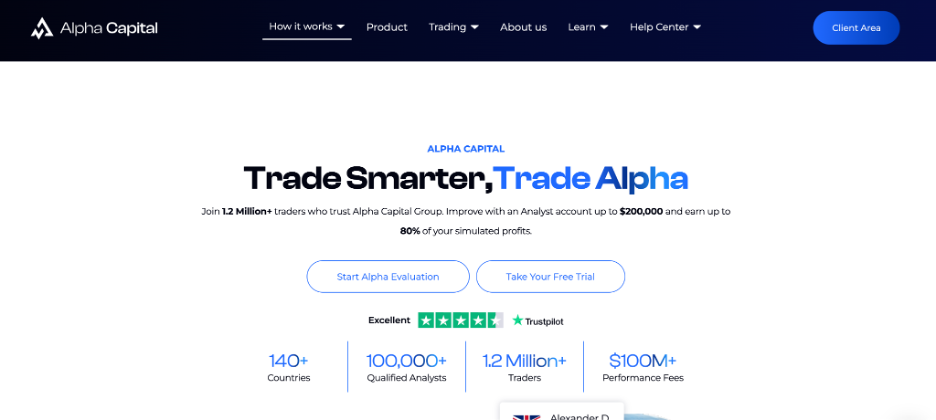
Alpha Capital Group is one of the best prop firms available to traders globally. It offers multiple evaluation formats to suit different trading styles:
- Alpha One: A straightforward one-step evaluation starting from $50
- Alpha Pro: A two-step evaluation with an 8% profit target in Phase 1 and 5% in Phase 2
- Alpha Swing: Designed for swing traders who hold positions longer
- Alpha Three-Step: A gradual three-phase evaluation
With 1.2 million+ traders across 140+ countries and 100,000+ Qualified Analysts (Alpha Capital's term for fully qualified traders), Alpha Capital is one of the most established prop firms in the industry. Accounts range from $5,000 to $200,000, with an 80% performance fee, zero commission, unlimited trading days, and performance fees available bi-weekly or on demand.
Ready to get started?
Explore Alpha Capital evaluations here!
Compare Alpha Capital. Published side-by-side guides based on each firm's own rules — re-verify before buying: vs FTMO (plan variety) · vs FundedNext (scaling) · vs The5ers (account size & leverage) · vs Blue Guardian (swing path) · vs E8 Markets (FX leverage) · vs FundingPips (performance fee split).
Frequently Asked Questions
What is the difference between a prop firm and a broker?
A broker executes trades on behalf of clients using client funds. A prop firm gives traders access to a simulated account with virtual capital after they pass an evaluation. With a prop firm, you are not risking your own money beyond the challenge fee, your payouts are real, but the trading environment is simulated. For a full side-by-side comparison, read our prop firm vs broker guide (2026).
Are prop firms legit?
Yes, established prop firms with verifiable payout histories and strong Trustpilot ratings are legitimate businesses. For a full trust checklist, red flags, and UK regulation context, read our Are Prop Firms Legit? guide (2026).
Do you need trading experience to join a prop firm?
Some experience helps, but most prop firms do not require qualifications or a professional background. What they require is that you can follow risk rules consistently and reach a profit target over a set number of trading days.
What happens if you lose money on a funded account
Your risk is limited to the evaluation fee you paid. If you breach the drawdown rules on a funded account, the account is closed. The firm absorbs the simulated loss, you do not owe anything beyond the initial fee.
How long does it take to get funded?
With a one-step evaluation and active trading, some traders pass in as little as five to ten trading days. Two-step evaluations typically take two to four weeks depending on the minimum trading day requirements.
Can you trade any instrument at a prop firm?
It depends on the firm. Most forex prop firms offer forex pairs, indices, commodities and sometimes crypto. Futures prop firms offer futures contracts on commodities, indices and bonds. Always check the firm's available instruments before purchasing a challenge.
Alpha Capital Group is a proprietary trading firm based in London, UK. All trading accounts are demo accounts with simulated funds. More details can be found in our FAQ .