Quick answer: Swing trading is a style of trading that aims to capture one price move, or "swing", over a few days to a few weeks. Swing traders usually work from the four-hour and daily charts, enter on pullbacks or breakouts within a trend, and hold positions overnight and often over the weekend, which brings gap and swap costs that day traders avoid.
What is swing trading? It sits between day trading and long-term investing. A day trader closes every position before the end of the session; a position trader may hold for months. A swing trader holds long enough for a meaningful move to play out, typically two to ten days, without watching every tick. That makes it one of the most common styles for people who trade around a job or other commitments.
This guide explains how swing trading works, how it compares with other styles, how swing traders find setups and size positions, the risks of holding overnight and over the weekend, and how it fits the rules of an Alpha Capital simulated account.
Risk note: This is an explanation of how a trading style works, not advice to trade it. Trading forex and CFDs carries a high level of risk. All Alpha Capital accounts are simulated accounts with simulated funds. Performance fees are performance-based, and outcomes are not guaranteed.
Key facts about swing trading
| Question | Short answer |
|---|---|
| What is it? | Trading one price swing at a time, held for days to weeks |
| Typical holding period | Roughly 2 to 10 trading days, sometimes a few weeks |
| Main charts | Daily for direction, four-hour for timing |
| Common setups | Trend pullbacks, support and resistance, breakouts |
| Main extra risks | Overnight and weekend gaps, swap costs, wider stops |
| Time needed | Often under an hour a day, around the market close |
| Weekend holds on Alpha Capital | Allowed on Alpha Swing, Alpha One and Alpha Three at every stage |
How is swing trading different from day trading, scalping and position trading?
The main difference between trading styles is how long a position stays open, and that one choice changes the charts, the costs and the amount of screen time involved.
| Style | Typical hold | Main charts | Held overnight? | Screen time |
|---|---|---|---|---|
| Scalping | Seconds to minutes | 1-minute to 5-minute | No | Very high |
| Day trading | Minutes to hours | 5-minute to 1-hour | No | High |
| Swing trading | Days to weeks | 4-hour and daily | Yes, often over weekends | Moderate |
| Position trading | Weeks to months | Daily and weekly | Yes | Low |
Because swing trades aim for larger moves, spread and commission are a smaller share of each trade. In return, stops are wider, position sizes smaller, and the trade is exposed to anything that happens while the market is closed.
What timeframes do swing traders use?
Most swing traders read the daily chart for direction and key levels, and use the four-hour chart to time entries and place stops.
A common routine is to review charts once a day, around the daily close, and set or adjust pending orders. Many forex charts close their daily candle at 5pm New York time, which is why the hour around the New York close is a popular time to plan swing trades. Knowing when the main forex trading sessions open and close also helps, because breakouts and pullbacks often start when London or New York becomes active.
How do swing traders find setups?
Most swing trading strategies are variations on a few ideas. The descriptions below explain how each one works, not which one to use.
Trading with the trend
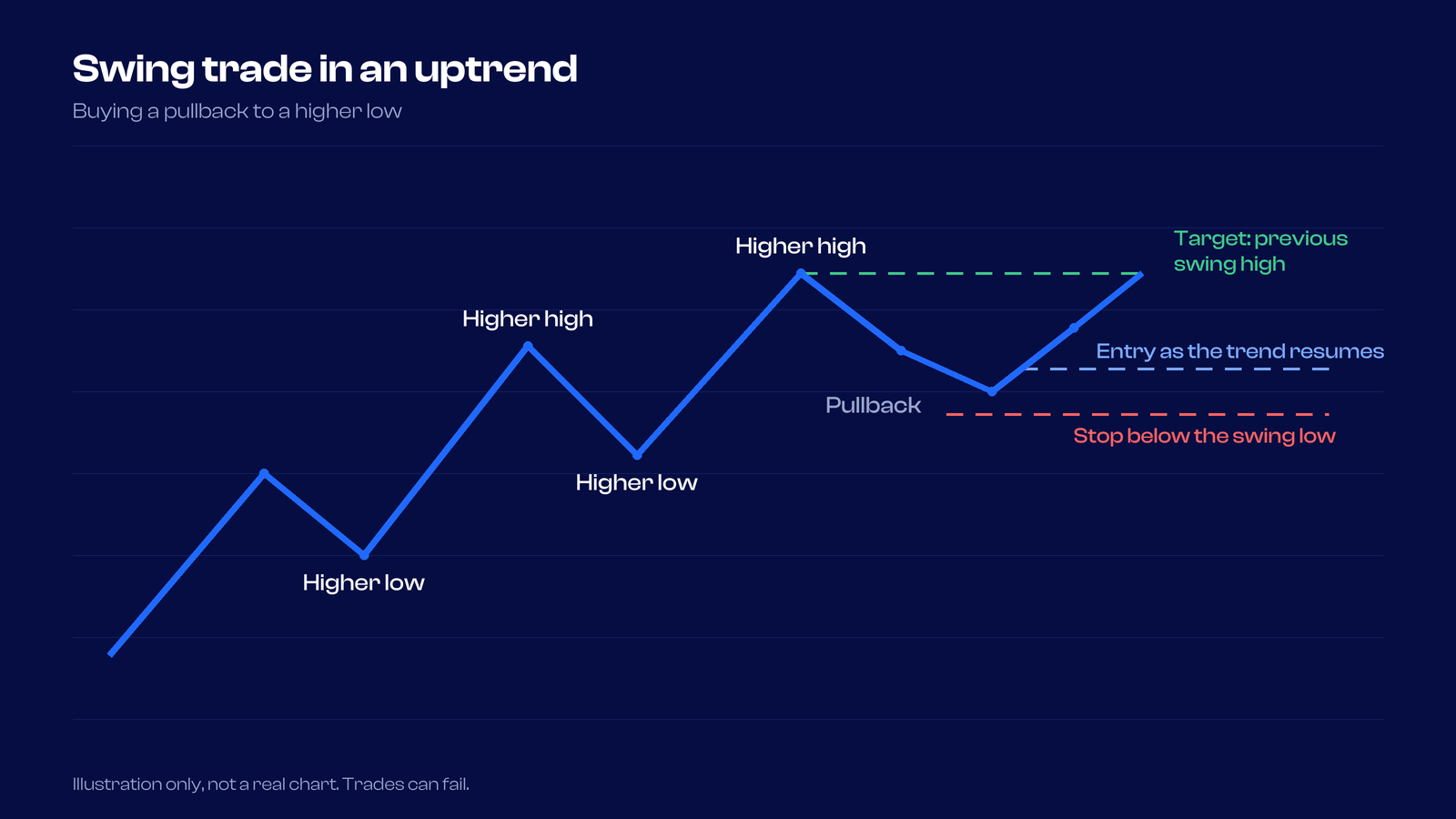
In an uptrend, price makes higher highs and higher lows; in a downtrend, lower highs and lower lows. Many swing traders only look for trades in the direction of the daily trend, on the view that the larger move is more likely to continue than to reverse.
Pullbacks
A pullback is a temporary move against the trend. In an uptrend, price dips back towards an earlier level, a moving average or a trendline before the trend resumes. Swing traders who buy pullbacks try to enter near the end of the dip, with a stop below the most recent swing low.
Support and resistance
Support is a price area where buying has repeatedly stopped a fall; resistance is where selling has stopped a rise. Swing traders watch how price behaves at these levels on the daily chart. A bounce from support in an uptrend, or a rejection from resistance in a downtrend, can form a setup.
Breakouts
A breakout happens when price closes beyond a range or a key level and keeps going. Swing traders often wait for a daily or four-hour close beyond the level, and sometimes for a retest of it, because many breakouts fail and snap back. Reversal patterns such as the head and shoulders pattern are a related idea: price breaks a level that held during the pattern.
How do swing traders set entries, stops and position size?
Every swing trade has three numbers decided before entry: where to get in, where the idea is proven wrong, and how much of the account is at risk.
- Entry: a limit order at a pullback level, a stop order above a breakout level, or a market order once a candle closes in the trade's direction.
- Stop: beyond the swing low (for a buy) or swing high (for a sell) that defines the setup. A stop loss placed only a few pips away is usually too tight for a daily-chart trade.
- Position size: worked out from the stop distance, so that a loss at the stop equals a fixed share of the account.
Worked example (illustrative)
A trader has a $100,000 simulated account and risks 0.5% per trade, which is $500. EUR/USD is in an uptrend on the daily chart and has pulled back to 1.0850. The most recent swing low is at 1.0795, so the stop goes just below it, at 1.0790.
- Stop distance: 1.0850 − 1.0790 = 60 pips
- Pip value on EUR/USD: about $10 per pip per standard lot
- Risk per lot: 60 pips × $10 = $600
- Position size: $500 ÷ $600 ≈ 0.83 lots
If the trader targets the previous swing high at 1.0970, the potential gain is 120 pips, or about $1,000 on 0.83 lots: twice the amount at risk. This is often written as a 1:2 risk-to-reward ratio. The numbers only describe the trade's structure; they say nothing about whether price will reach either level.
What are the overnight and weekend risks?
Holding positions for days brings two costs that intraday traders rarely face.
Gaps. Price can open at a different level from where it closed, most often on Monday after weekend news, or after a major release while a market is closed. If price gaps through a stop, the order fills at the first available price, not at the stop level. In the example above, a weekend gap to 1.0740 would turn a planned $500 loss into roughly $910.
Swap. A position held past the daily rollover pays or receives overnight interest, called swap, based on the interest-rate difference between the two currencies. On a trade held for a week, swap can add up, and many platforms apply three days of swap on one night of the week to cover the weekend. Swap is a running cost to include when judging whether a swing trade is worth taking.
Some swing traders reduce size or close positions before Friday's close; others accept weekend risk as part of the style.
What are the pros and cons of swing trading?
| Pros | Cons |
|---|---|
| Less screen time than day trading or scalping | Exposure to overnight and weekend gaps |
| Spread and commission are a small share of each move | Wider stops mean smaller positions |
| Fewer, more considered decisions | Swap costs on positions held for days |
| Fits around a job or study | Trades take time to play out; patience is needed |
What mistakes do new swing traders make?
- Using day-trading stops on daily charts. A 15-pip stop on a daily setup is often hit by normal movement before the idea has a chance to work.
- Ignoring the weekend. Holding full size through Friday's close without allowing for a possible gap.
- Trading against the daily trend. Repeatedly calling tops and bottoms instead of waiting for pullbacks within the trend.
- Moving the stop further away. Widening a stop as price approaches it turns a planned loss into an unplanned one.
- Overtrading. Looking for a trade every day, when good swing setups may appear only a few times a week.
Who is swing trading for?
Swing trading tends to suit people who cannot watch the market all day, are comfortable leaving positions open overnight, and prefer fewer, larger moves to many small ones. It suits those who can accept a slower pace: a single trade can take a week to resolve. People who want every position closed by the end of the day, or who find open overnight risk stressful, may find day trading a better fit.
Swing trading for beginners often starts on the daily chart alone, with one or two setups and a fixed risk per trade, before adding lower timeframes or more strategies.
How does swing trading work on an Alpha Capital simulated account?
Holding trades for days and over weekends depends on the account's rules. On Alpha Capital, the plan built for this style is Alpha Swing:
- Weekend holds: allowed in both evaluation phases and on the Qualified Analyst account.
- News: trading around major news is allowed. A trade opened within 2 minutes before or after a listed release must stay open for more than 2 minutes.
- Drawdown: a static maximum drawdown of 10% and a balance-based daily drawdown of 5%.
- Leverage: up to 1:30 on FX, 1:9 on metals and 1:10 on indices and oil, with a maximum lot exposure that depends on account size (for example, 20 lots on a $100,000 account).
- Performance fees: Alpha Swing accounts use the on-demand performance fee option only.
Weekend holds are also allowed at every stage on Alpha One and Alpha Three. On Alpha Pro they are allowed during the evaluation phases but not on the Qualified Analyst account, and they are not allowed on Alpha Direct. Positions held overnight or over the weekend pay or receive swap on every plan.
For a comparison of how other prop firms treat holding trades, see prop firms that allow swing trading, and for the full rules of Alpha Capital's plan, see the Alpha Swing account explained. For how prop firm accounts work in general, read our guide on what a prop firm is.
Frequently asked questions
What is swing trading in simple terms?
Swing trading means holding a trade for a few days to a few weeks to capture one price move. Swing traders usually use the four-hour and daily charts and keep positions open overnight, unlike day traders, who close everything before the end of the session.
How long do swing traders hold positions?
Typically between two and ten trading days, though some trades last a few weeks. The holding period depends on how long the move takes to reach the target or the stop.
Is swing trading good for beginners?
Many beginners find it easier to start with, because decisions are made on daily charts with more time to think. It still carries real risk, including weekend gaps and swap, so a fixed risk per trade and a clear stop are part of how it is usually done.
What is the best timeframe for swing trading?
Most swing traders use the daily chart for direction and the four-hour chart for entries. The weekly chart is often used for the bigger picture.
Is swing trading better than day trading?
Neither is better in general. Swing trading needs less screen time and pays less in spread per move, but it accepts overnight and weekend risk. Day trading avoids that risk but needs more time and more decisions each day.
Can you hold trades over the weekend on Alpha Capital?
Yes, on Alpha Swing, Alpha One and Alpha Three at every stage. On Alpha Pro, weekend holds are allowed during the evaluation phases but not on the Qualified Analyst account, and they are not allowed on Alpha Direct. Swap applies to positions held overnight or over the weekend.
What is a swing trading strategy?
A swing trading strategy is a set of rules for finding and managing trades that last days to weeks. Common ones are buying pullbacks in an uptrend, trading bounces from support or resistance, and trading breakouts that close beyond a key level, each with a stop beyond the swing point that defines the setup.